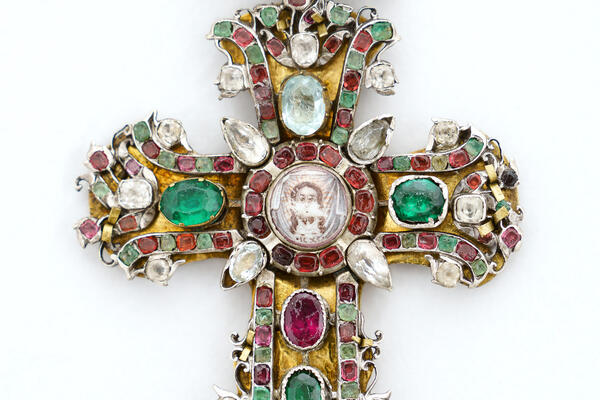
Richly decorated pectoral crosses are aesthetically close to insignia in secular court culture. This exhibit from the collection of the Andrei Rublev Museum is a four-pointed cross of the bloomed type with openwork decoration on the front side and a silver plate on the back. The bloomed cross is a type of cross which has shoots of a vine with leaves and sometimes even bunches ramping from the base.
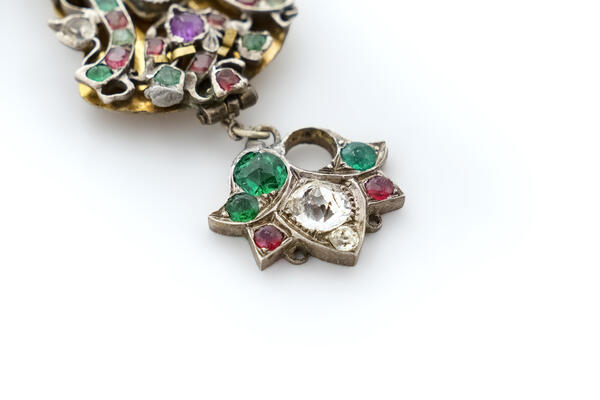
In addition to a movable headpiece (“oglavie”), it has a pendant at the lower end. The crossing point features a round enamel plaque with the image of the Holy Mandylion. The branches of the cross, the crown, and the pendant are decorated with rhinestones, colored glass, and stylized shoots of vegetation.
On its reverse side, the plate is decorated with engraved images: in the crossing point — with a multiprong star, the sides having scrolls against the background of clouds with a preserved inscription “Archistrategos Michael”. In the lower part of the plate, Archangel Michael is depicted in armor, with a shield and a flaming sword, above is a triangle with an inscription meaning “Lord”.
The shape of the Archangel’s shield and helmet, the dramatic combination of cumulus clouds that part before the light of the star, reminiscent of the Star of Bethlehem of the Nativity of Christ, are close to the Baroque style. The fact that the cross bears the image of Archangel Michael may suggest both the name of the bishop put forward for being awarded with such a cross and the dedication of a church for which the cross was intended as a chantry contribution.
All richly decorated crosses were not only symbols of the ecclesiastical rank of church hierarchs, but also had to remind of the cross built by Byzantine Emperor Justin II in glory of the Cross of the Lord and the Heavenly King Christ and presented to the Roman Pope. This ancient cross is now known as Crux Vaticana (“Vatican Cross”). Imitations of the cross of Emperor Justin II were made during the High Middle Ages, especially in Western Europe.
The Russian ecclesiastical practice inherited and
developed types of liturgical crosses adopted in Byzantium. The crosses were
copper or wooden, in a metal (silver, later gilded) casing decorated with
precious stones, pearls and other inlays. Processional and altar crosses were
particularly large.