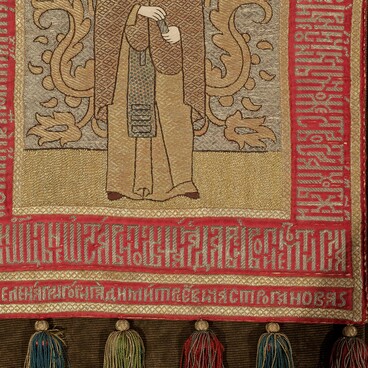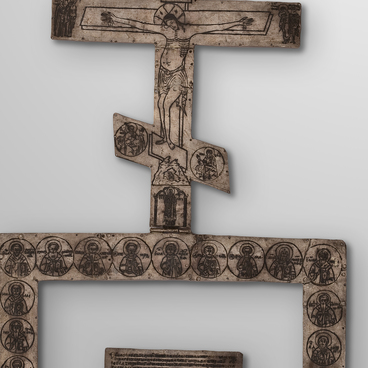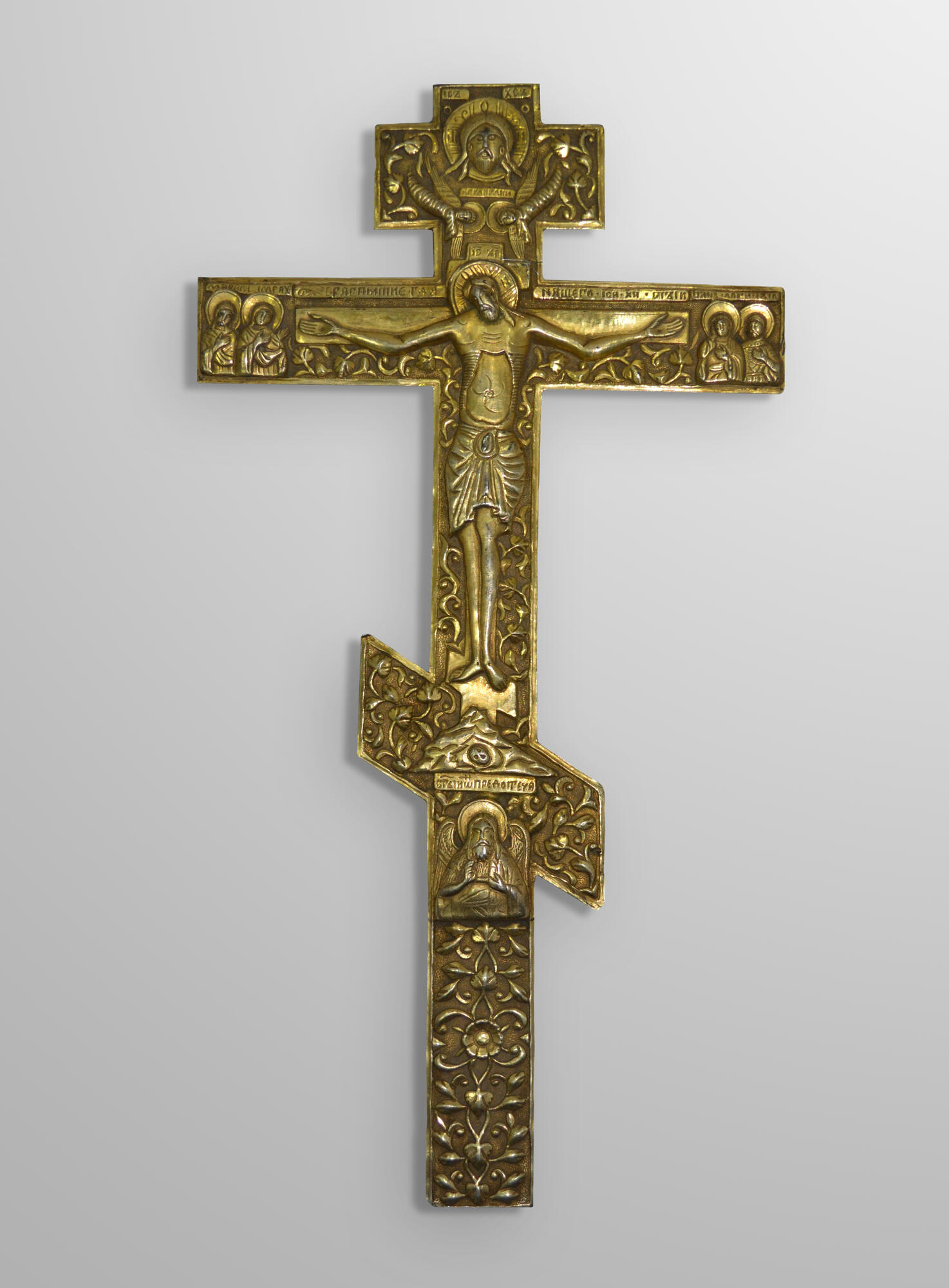


This eight-pointed altar cross is made of gilded silver. Its ends and reverse side are smooth. On the front side of the cross, there is a large relief Crucifixion against the background of a pattern of stems with small leaves and curls.
The Crucifixion is flanked by four small half-length images of saints. Above the Crucifixion, there are small text segments with the following inscriptions, “The Crucifixion of our Lord Jesus Christ”, “Mary”, and “Saint John, the Centurion Longinus”. Above the Crucifixion, the artist added two flying angels, and still above — the Image of Edessa and narrow text segments with the inscriptions “Angels of the Lord” and “Jesus Christ”.
In the area where the bottom crossbeam meets the vertical beam, there is an image of Golgotha in the form of an obtuse-angled triangle with the skull of Adam in the center. Below Golgotha, there is a half-length image of John the Baptist with wings. Above him, there is a rectangular text segment with the engraved inscription, “Saint John the Baptist”. The images on the front surface of the cross are surrounded by a floral pattern.
The chased pattern of small winding and twisting grass stems, flower rosettes, and trefoils is similar to the one found in the works of Solvychegodsk craftsmen of the second quarter of the 17th century.
On the back of the cross is a 19th -century cover with an inscription engraved on its handle. Probably, it repeats the text on the lost original cover of 1641, “On June 25, 7149 (1641), this life-giving cross was donated by Voivode Ivan Fyodorovich Shakhovskoy for the Image of Edessa in the Posad in Sol Vychegodskaya. ”In the upper part of the reverse side of the cross, there is also a 19th-century engraved inscription on the enclosure of relics.
These inscriptions indicate that the front surface of the original silver cover of the cross was made in 1641 upon the commission of Prince Ivan Fyodorovich Shakhovskoy. He was a voivode during the reign of the first tsars of the House of Romanov — Michael I and Alexis I.
The bottom end and the
sides of the silver cover are fixed with screws. Perhaps, they were made during
the item’s restoration in 1862. This is evidenced by the 19th-century
elements made in Moscow.