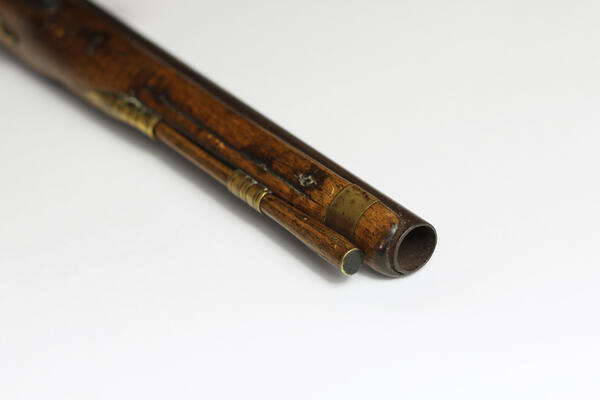
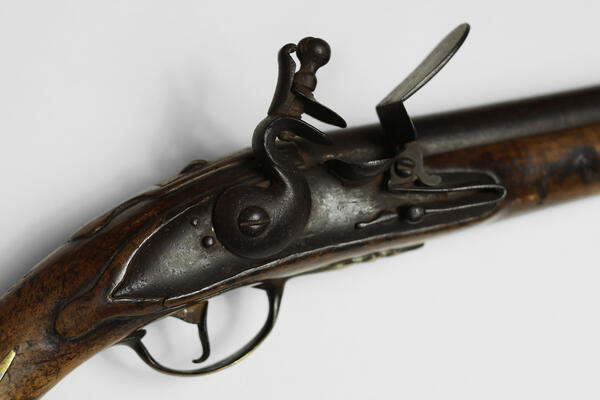
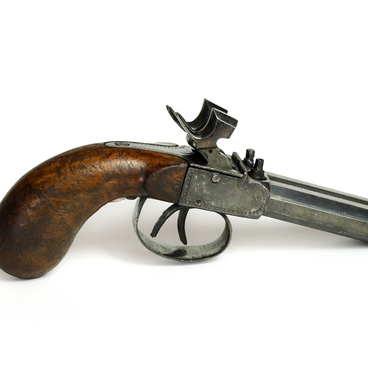
The pistol on display at the Orenburg History Museum is a remarkable example of Russian and European military weaponry. It is a powerful and heavy weapon, without any excessive décor.
This type of pistol was typically used in close-quarters combat. Traditionally, pistols, including caplock ones, were carried in pairs, due to the unreliable nature of flintlocks and the slow firing rate of single-shot, muzzle-loaded pistols. This was before the introduction of the first percussion revolvers.
The pistol features a sturdy wooden stock with a long fore-end. This was typical of cavalry weapons.
While it is questionable whether the weapon’s stock is the original element, it closely matches the specifications.
Overall, the pistol measures approximately 43.5 centimeters in length and weighs about 1.5 kilograms. The barrel measures 26.3 centimeters and has a caliber of approximately 18 millimeters.
The muzzle of the displayed pistol has varying wall thicknesses, ranging from 1.7 to 2.3 millimeters.
The barrel of the gun has a conical shape, round in cross-section, without advanced primer ignition. Only at the breech, there is a 50-millimeter-long faceted barrel section. This section almost coincides with the projection of the front portion of the lock.
The thickness of the breech is 31 millimeters, and that of the muzzle is 22.5 millimeters. The flash channel diameter is 2 millimeters.
When firing the pistol, a lead round bullet was used, with the powder charge of 6.3 grams.
The barrel has a through bore. A large 22-millimeter thread was cut into the breech with a length of 20 millimeters. A breech with a massive 53-millimeter-long connecting rod and a front threaded portion that corresponds to the barrel thread is screwed into the barrel. The breech has a beveled end. The barrel with the breech in the stock is fixed by a screw that ties the rod with the trigger and muzzle ring through the stock.
The trigger guard was attached in a manner typical of Russian weapons of that time. The rear part is screwed to the stock, and the front has a flat, perpendicular plate embedded deep into the fore-end and secured with a transverse pin.
The trigger of the pistol is mounted on an axle made from a piece of metal. It is 22 millimeters long and 8 millimeters wide.