The Forest Nenets and Eastern Khanty considered the cauldron to be a “house spirit that should always be left some food at the bottom.” A full cauldron was regarded as a source of life, wealth, and abundance, while an empty one symbolized hunger and poverty. The cauldron protected the house and its inhabitants, and people always took care of the hearth and kept the fire burning.
When leaving the house for a long time, the Agan Khanty always placed a cauldron opposite the entrance. Only if there were Russian icons inside the house, it was not necessary for “the cauldron to stand guard.” If a “toothless child” was left home alone, soot from the cauldron was smeared on its face. It was believed that before the child’s teeth started to come in, its soul could be stolen while sleeping.
The Khanty and Nenets had many rules regarding the handling of a cauldron in everyday life, and the procedure of its inheritance. If a crack appeared in the cauldron, it was a true harbinger of a marital breakdown. It was forbidden to swear and quarrel near the cauldron.
In the Northern Khanty tale “Old Man’s Daughter”, a copper cauldron given to the young woman by her father saves her from death. It acts as a kind of “horn of plenty”: it returns from the sanctuary filled to the brim with rich food; it transforms into a woman’s sled and brings the girl new fur clothes and utensils; it transforms into a man’s sled and brings her a groom — a wealthy reindeer herder. A similar legend, with the cauldron rewarding an industrious woman with a good marriage and condemning a lazy one to starvation, is also found in Nenets folklore.
For the indigenous peoples of the North, like for many others, the cauldron was not only a container for solid, loose, and liquid products but also a measure of volume. In everyday life and during rituals, cauldrons of various capacities were used — from miniature ones for cooking fish oil to extra-large ones for cooking ritual food and boiling birch bark.
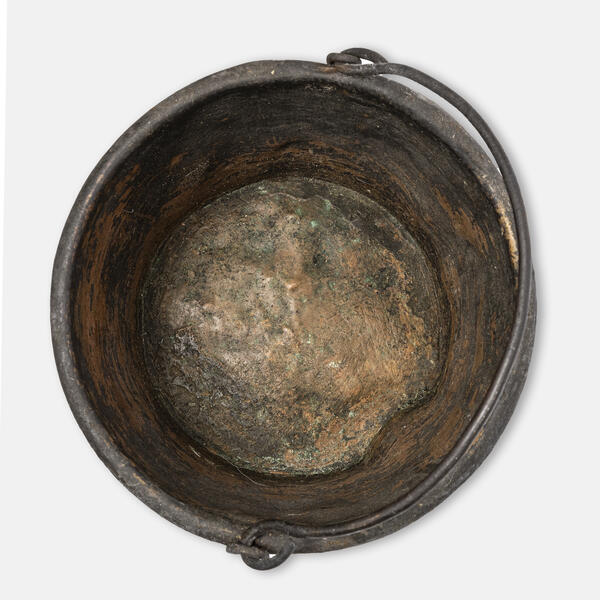
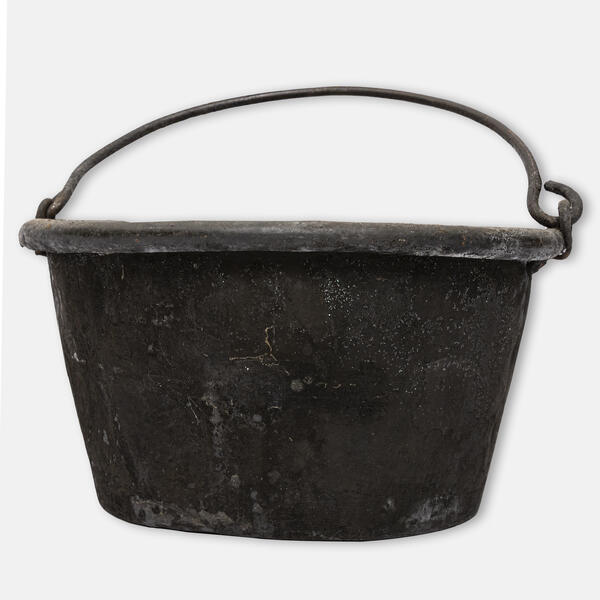
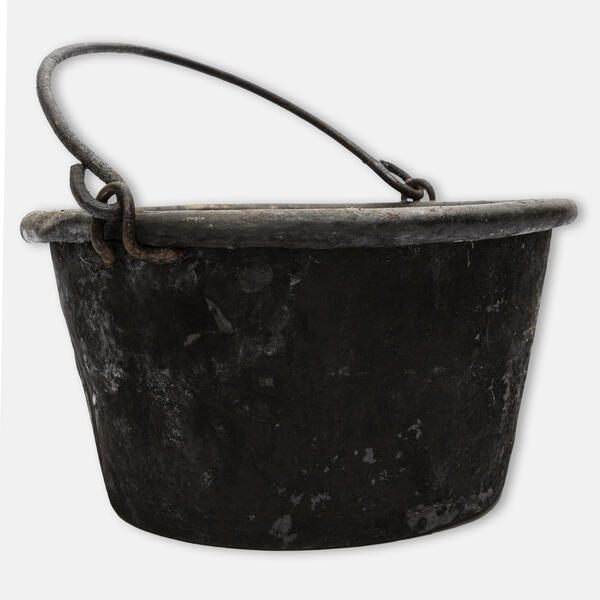
The Ethnographic Park Museum of the Varyogan Village
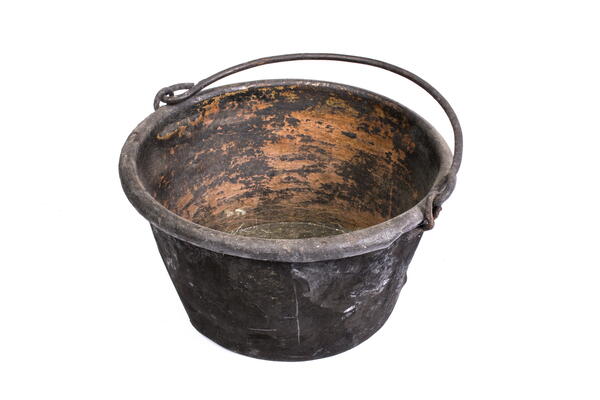
houses a flat-bottomed copper cauldron with two riveted lugs. The handle — a
shackle made of a thick metal rod — is attached to the lugs. The walls and bottom
of the cauldron are made of a single piece. The walls flare at the top and have
a curved rim.