

In the 17th century, the Schism of the Russian Church occurred after the reforms of Patriarch Nikon. All believers that maintained the liturgical and ritual practices of the old canons, led by Archpriest Avvakum, were anathematized, or excommunicated from the Orthodox Church. Persecutions began against the Old Believers who professed Ancient Orthodoxy. They settled in various regions of Russia, including on the territory of present-day Udmurtia.
The dissenters sought to preserve their faith and differ from the local population. They avoided red color in their clothing, which happened to be the main color in the Udmurt dress. Until the beginning of the 20th century, the Old Believers sewed sundresses from homespun cloth of different shades of blue, and later purchased black sateen for these purposes.
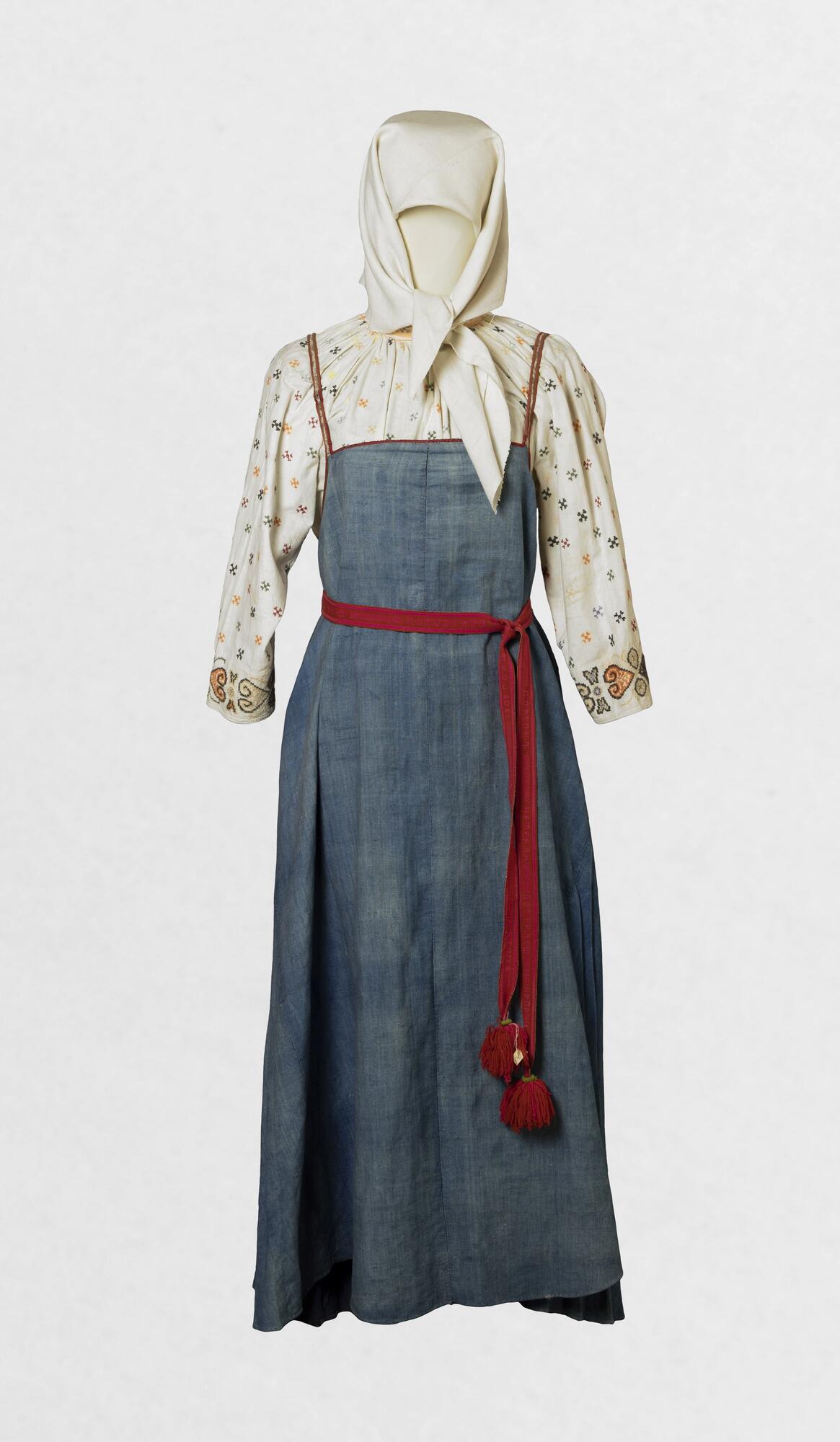
The women’s and girls’ clothing set of Old Believers was called a “peremena”. It included a shirt, a sundress (a sarafan), an apron, a belt and a scarf. The sundress from the collection of the Glazov Museum was sewn on the bias. Such sundresses were considered old-fashioned in the 20th century, and “young girls did not wear them, they were too ashamed.”
Later versions of the sundresses were called boroshniki. They had small one-sided pleats along the entire upper part, which were called “bory” or “borinki”. If the pleats were only at the back, the sundress was called a bezboroshnik. The bias-cut sundresses and boroshniki had a protruding detail on the back — a kryletchko (literally — “a porch”).
Under the sundress they wore calico shirts and more often plain wide shirts (under-dresses) of white, red, yellow and brown colors, with embroidery on the cuffs. On holidays, girls wore an apron without a bib. The hem of the apron was decorated with lace and floral ornaments. A belt was tied over the sundress, to which the Old Believers attached special importance. About a man who “has no shame”, they said: “he has completely undone his belt”, meaning “stepped over the line”. Sometimes dedicatory inscriptions and texts of prayers were embroidered on the belts.
A woman was not allowed to step outside without a headscarf. The white linen headscarf of the Old Believers was called a “povyazukha” (from the Russian word “vyazat” — “to tie”). Young women braided their hair into one braid and wove a scarlet ribbon into it. Married women wore two braids and wrapped them around the head in a half-moon shape, resembling a wreath. The scarf was tied in a special way over the braids: it was folded diagonally in the form of a kerchief, the ends covered the chin, wrapped around the neck and connected from behind.
The dissenters sought to preserve their faith and differ from the local population. They avoided red color in their clothing, which happened to be the main color in the Udmurt dress. Until the beginning of the 20th century, the Old Believers sewed sundresses from homespun cloth of different shades of blue, and later purchased black sateen for these purposes.
The women’s and girls’ clothing set of Old Believers was called a “peremena”. It included a shirt, a sundress (a sarafan), an apron, a belt and a scarf. The sundress from the collection of the Glazov Museum was sewn on the bias. Such sundresses were considered old-fashioned in the 20th century, and “young girls did not wear them, they were too ashamed.”
Later versions of the sundresses were called boroshniki. They had small one-sided pleats along the entire upper part, which were called “bory” or “borinki”. If the pleats were only at the back, the sundress was called a bezboroshnik. The bias-cut sundresses and boroshniki had a protruding detail on the back — a kryletchko (literally — “a porch”).
Under the sundress they wore calico shirts and more often plain wide shirts (under-dresses) of white, red, yellow and brown colors, with embroidery on the cuffs. On holidays, girls wore an apron without a bib. The hem of the apron was decorated with lace and floral ornaments. A belt was tied over the sundress, to which the Old Believers attached special importance. About a man who “has no shame”, they said: “he has completely undone his belt”, meaning “stepped over the line”. Sometimes dedicatory inscriptions and texts of prayers were embroidered on the belts.
A woman was not allowed to step outside without a headscarf. The white linen headscarf of the Old Believers was called a “povyazukha” (from the Russian word “vyazat” — “to tie”). Young women braided their hair into one braid and wove a scarlet ribbon into it. Married women wore two braids and wrapped them around the head in a half-moon shape, resembling a wreath. The scarf was tied in a special way over the braids: it was folded diagonally in the form of a kerchief, the ends covered the chin, wrapped around the neck and connected from behind.