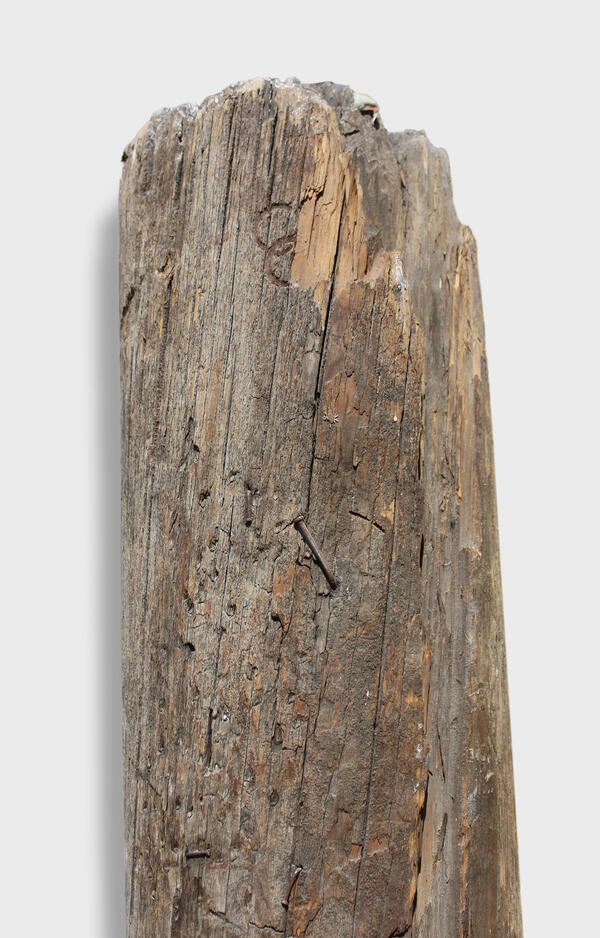
The term “serge”, meaning “horse hitching post”, was used to describe a round or chiseled thick log used to hitch horses. It was two to three meters high. Closer to the top, it was girded with a concave or convex band in one or two or three rows and finished with a figure in the form of a cup, ball or rhombus.
Ethnographers believe that such serge in Yakut households of the past centuries not only served as horse hitching posts, but also as boundary signs on land borders, decorated burials or were used for sacrificial horse hitching. Such serge replaced supporting structures, pillars of the frame, inside such Yakut dwellings like balagan and uraha.
Hitching posts were also installed at especially venerated the places, where folk festivals and shamanic rites were held, and in the yards of toyons, major herders and rich people.
The number of such poles often reached up to nine or more in one area. They were set up in an even row at an equal distance from each other.
Depending on the purpose, serge had different finishes. There are several large groups: outdoor, cult and ritual horse posts.
Outdoor hitching posts, “telgehe sergete”, were set up in all courtyards. Their identical standard appearance differed only in the number and shape of notches, which girdled the trunk on one third of its part.
Wedding serge, or daughter-in-law’s serge, were set up in courtyards before the marriage ceremony. Such serge was always topped with a stylized image of dishes, horns of livestock and other symbols. The trunk of the serge was decorated with a carved motif.
The so-called sele sergete was put up only by wealthy people near the place where mares were milked. These were horse posts as high as a man’s height without special patterns and designs. The number of such constructions depended on the number of mares. Special braided ropes made of horsehair were tied to the upper, thinner part of the pole.
“Honorary” horse posts were installed almost until
the end of the 19th century at especially revered places or in the courtyards
of important and distinguished toyons, who were representatives of the ruling
nobility or large cattle breeders. Those posts were massive and richly
decorated. The main motif of these poles was the image of a human.