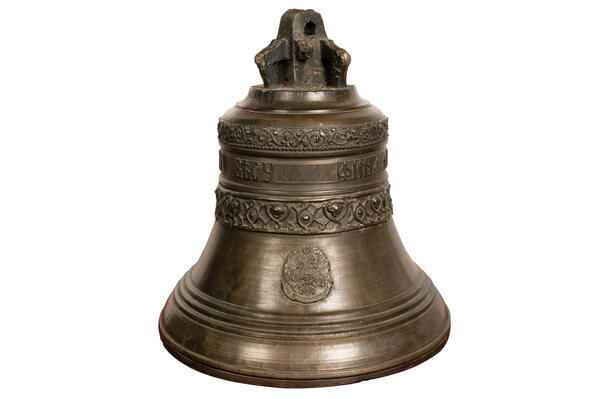
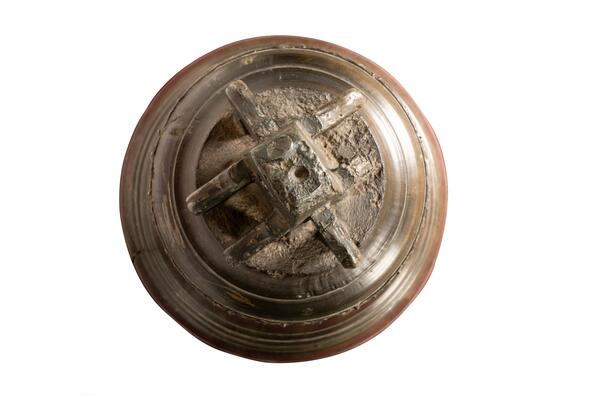
This bronze bell from the collection of the Unecha Local Lore Museum once hung in the bell tower of the Church of the Nativity of the Blessed Virgin Mary in the village of Lyschichi. The village is now part of the Unechsky District of the Bryansk Region. The earliest known record of this church dates from 1628, when it belonged to the Kyiv-Pechersk Lavra. In 1814, to commemorate Russia’s victory over Napoleon Bonaparte, a stone church was erected on the site of the original wooden one. A new bell tower was later added in 1911.
Like countless churches across the Soviet Union, this one was closed in the 1930s during the anti-religious campaigns. Tens of thousands of bells were destroyed during this period. This bell, too, suffered a violent fate — it was thrown from the bell tower. The crack resulting from the impact silenced its voice forever.
Bells hold a central place in Orthodox worship and Russian cultural tradition. Since ancient times, their ringing has marked moments of national joy and sorrow, celebrating victories, mourning disasters, and sanctifying daily liturgical life. They announced the arrival of honored guests or the approach of enemies, guided ships through fog, and helped lost travelers find their way. The sound of bells also summoned communities to fight fires or gather for civic assemblies.
Widely regarded as spiritual protectors, bells were believed to ward off evil forces. Nearly every church, monastery, and even small chapel had its own belfry, equipped with a set of bells of varying sizes and tones. In rural areas, bell ringers were often self-taught, mastering the art through practice and imitation.
Russian bells were named according to their purpose: alarm bells, veche bells (used to call public assemblies), evangelical bells, and more. Many also acquired affectionate or descriptive nicknames based on their sound or history — such as “red” (for a particularly beautiful tone), “gilded”, “captured” (taken in wartime), or even “bast” bells — a term for a broken bell repaired with bast fiber bindings.
Notably, Russia even had an “exiled” bell: the famous Uglich Bell. In 1591, it rang out to announce the death of Tsarevich Dmitry, sparking public outrage that led to the lynching of those accused of his murder. As punishment, the bell was “executed” — its clapper removed — and exiled to Tobolsk in Siberia. It remained there for nearly 300 years before being returned to Uglich in the late 19th century.