Font
Color
Graphics
Изображение точки

To see AR mode in action:

1. Install ARTEFACT app for iOS or Android;

2. Find the exhibition «Life and Legacy of Sergey Sergeyev-Tsensky»

3. Push the «Augmented reality» button and point your phone's camera at the exhibit;

Скрыть точки интересаПоказать точки интереса
Показать в высоком качестве

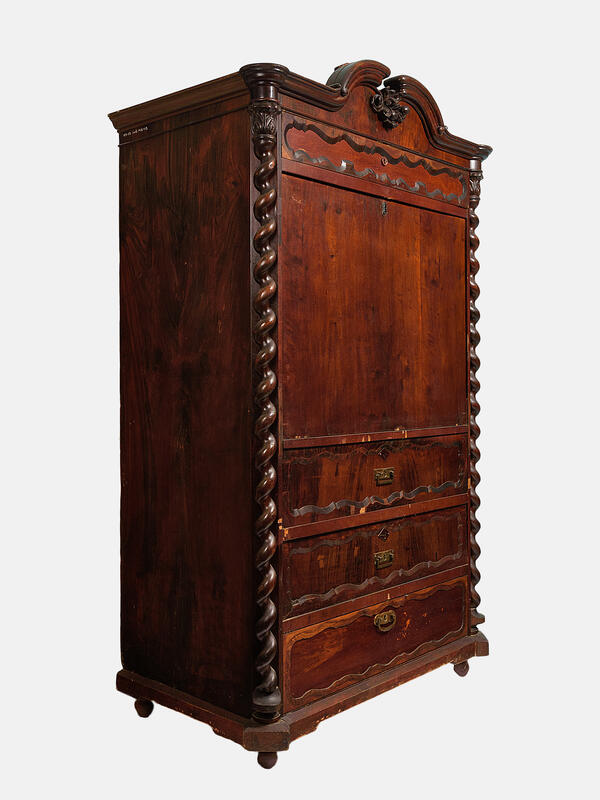
Secretary

Creation period
the first quarter of the 20th century
Place of сreation
the Russian Empire
Dimensions
172x100x58 cm
Technique
wood, lacquering
0
Open in app
#2

The secretary consists of an upper drawer and an inner section with a collapsible tabletop and three drawers at the bottom. It is decorated with carvings and twisted columns on both sides. Twenty small drawers are arranged around the perimeter of the inner section, and there is also some space in the middle for storing larger items. The collapsible tabletop hides the inside of the secretary and can serve as a desk when lowered.

In this secretary, Sergey Sergeyev-Tsensky kept his personal archive — correspondence, documents, and photographs.

In 1964, the writer’s wife donated his personal archive to the Central State Archive of Literature and Art of the USSR (now the Russian State Archive of Literature and Art). A part of the archive, including correspondence with Gorky, is kept at the Gorky Institute of World Literature of the Russian Academy of Sciences.

Sergeyev-Tsensky wrote,

#5

From January 1902, I was published in thick magazines ‘Russkaia Mysl’, ‘Miz Bozhiy’, ‘Sovremennyi Mir’, ‘Obrazovanie’, ‘Novyi Put’, ‘Voprosy Zhizni’, ‘Zhurnal dlya Vsekh’, and others. At that time, I lived in a province, where I worked as a teacher in various towns. During the Russo-Japanese War, I was drafted as a warrant officer of the Army reserve and served in several regiments for almost a year and a half.

I used to send my novels and short stories to the places from where I received offers, and I never met any editors or writers until the end of 1906.

The first writer I saw with my own eyes was Alexander Kuprin, who came in the autumn of 1906 to Alushta, where I had just built my writing studio — a small house on the mountain ˂…˃

Kuprin persuaded me (I had already quit teaching at the time) to come to Saint Petersburg in order to work with the publishing house, organized in his ‘Sovremenny Mir’ magazine, and publish my works, which already amounted to three volumes.

In Saint Petersburg, I got to know some of the editors who had been publishing my works for several years, and some writers, though very few, such as Leonid Andreyev, Mikhail Artsybashev and Fyodor Sologub.

Not growing close with any of the writers, not joining any of the literary movements and showing my face in the capitals every so often for a very short time, I continued to lead quite a lonely and isolated life; you could find me either in my studio or traveling around Russia, visiting the most remote corners of the country.
#6
Secretary
#3
read morehide
00:00
00:00
1x

Secretary

Creation period
the first quarter of the 20th century
Place of сreation
the Russian Empire
Dimensions
172x100x58 cm
Technique
wood, lacquering
0
Point your smartphone camera to open in the app
Share
VkontakteOdnoklassnikiTelegram
Share on my website
Copy linkCopied
Copy
Open in app
To see AR mode in action:
  1. Install ARTEFACT app for 
  2. iOS or Android;
  3. Find and download the «Paintings in Details» exhibition
  4. Push the «Augmented reality» button and point your phone's camera at the painting;
  5. Watch what happens on your phone screen whilst you flip through the pictures.
 
We use Cookies
Cookies on the Artefact Website. We use cookies to ensure that we give you the best experience on our website. If you continue without changing your settings, we'll assume that you are happy to receive all cookies on the Artefact website. However, if you would like to, you can change your cookie settings at any time.
Learn more about useHide
Content is available only in Russian

X

Нашли опечатку?...

%title%%type%