Font
Color
Graphics
Изображение точки

To see AR mode in action:

1. Install ARTEFACT app for iOS or Android;

2. Find the exhibition «Neighbors. The Forest Nenets people»

3. Push the «Augmented reality» button and point your phone's camera at the exhibit;

Скрыть точки интересаПоказать точки интереса
Показать в высоком качестве

Reindeer tendon threads, Nukhuko, Female kisy

0
Open in app
#1
Galina Sergeeva
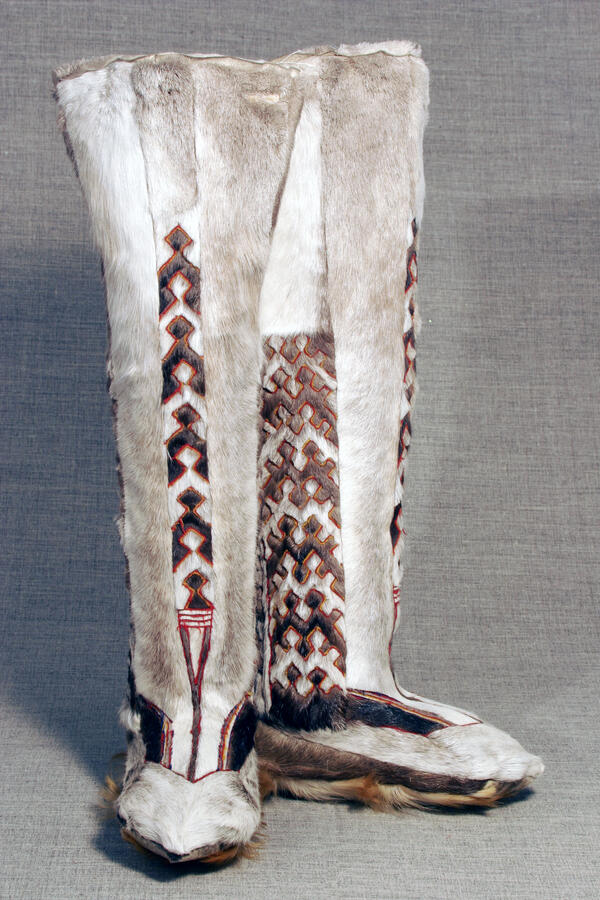
Female kisy
#4
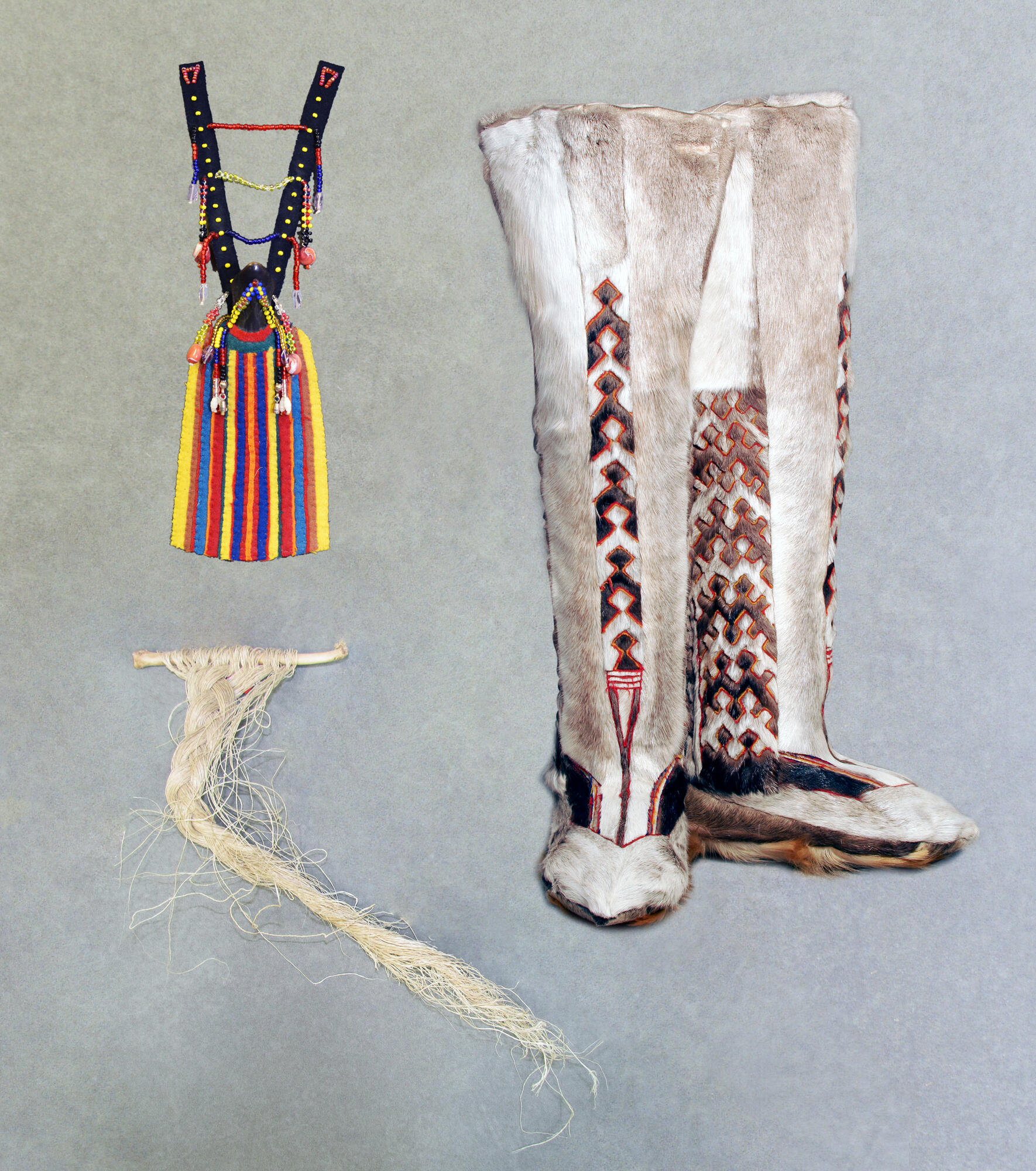
KisY is a traditional winter fur footwear of the Forest NEnets people, fitting severe Northern climate, household activities and Tundra inhabitants’ way of life perfectly. They keep warmth even when it is colder that –40°C. This footwear consists of stockings sewn with fur inside and the outer part made of kamus (reindeer legs skin) with fur out. Female version differs from a male one with tailoring, the front strip of kamus is narrower and ends before the toe cap. Unlike male kisy boots, female ones are a bit shorter, they are not tied up under the knee but only to a belt.

Kisy boot are hand sewn and decorated by dark or light fur, edging made of colorful cloth, traditional ornaments. As the Nenets women’s clothing is much longer than of men, fur ornaments are placed significantly lower to be seen. Besides the pattern on the toe cap, fur ornament of two-colored kamus and cloth is also applied on lateral and back sides. Complicated ornamental motifs serve not only as a decoration, but also as an important symbol. It is a sort of alphabet the Nenets use to communicate with each other.

According to a legend from ‘The House of Winds’ book by Polina Turutina, the Nenets folklore collector, decoration of female footwear is a set of rules a woman must stick to during her whole life. ‘The ornament of your kisy boots isn’t just a pattern. The triangle of kisys is your chum. The crossing strips are taboos. The upper ring is the sky above your head. Strips spread in different directions may mean rays of the Sun above a chum. Ornament around kisy means you are not alone, there are also other people living around you. This is the way to your chum. You’ll bring your future son’s bride with it one day. You’ll take the same road to send your daughter to another family’, the author writes.

The kisy boots displayed in the exposition of the museum are provided by the Forest Nenets Galina Sergeeva, a Gubkinsky town resident.
#3
Full name: Female kisy
Author: Galina Ilmovna Sergeeva 
Date: the 2nd half of the 20th century
Technique: needlework
Dimensions: 66×30×12 cm
Collection: Ethnography, the Forest Nenets people
Copyright: Gubkinsky Museum of the Development of the North
Goskatalog Number: GMOS OF-2897
#5
Fedosiya Vyllo
Reindeer tendon threads
#6
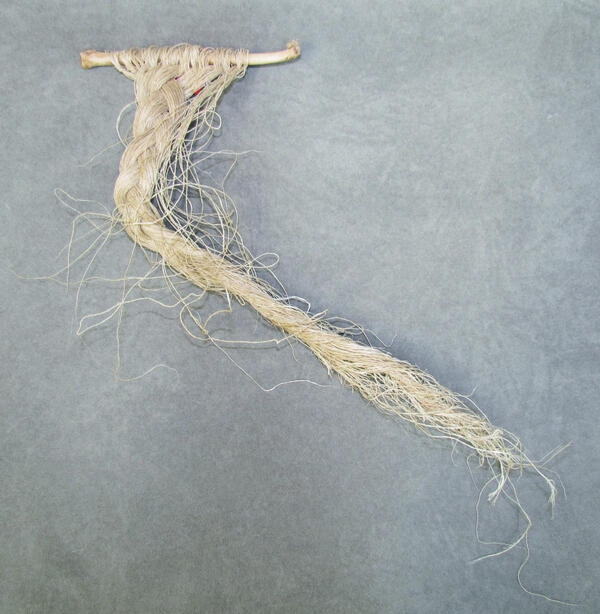
The Nenets women traditionally provide their whole families with clothing, it’s them who sew weatherproof suits that protect from cold even during severe winters. Since early times, the Forest NEnets outfit and footwear is made of processed reindeer skins and fur and sewn with special threads. These threads are produced of animal back or legs tendons left after cutting a carcass.

Female reindeer back tendons are considered to be the best fit for upper clothes as they split well for fibers. Reindeer front legs tendons are mostly used for sewing chum roof covers and summer boots because these threads are thicker and more practical. Making threads takes time and patience. First, tendons are hung by the thick end on a rope for drying. When dried well, they can be stored for a long time. If tendons are overdried, they should be smashed with a hummer before further processing. Then tendons are rubbed: carefully with her fingers, a NEnets woman separates thin fibers and rolls them with her palms against her cheek or her knee so that they are smooth. Every NEnets woman learns how to process reindeer tendons into threads already in her childhood. Thin fibers are rolled together because the thickness should be equal throughout a thread. That is why a thin end of one tendon is connected to a thick end of another one. This work is tedious and takes a lot of patience. To have a required amount of threads by summer, threads are usually made in winter.

The length of threads for clothes is 40–45 cm, they are no thicker than manufactured ones but much firmer. Before sewing, reindeer tendon threads are moisturized with water or saliva. After they get dry, they tighten the seam and it becomes firmer increasing the lifetime of clothing and footwear. Nowadays, the Forest NEnets use manufactured threads too, but gloves and shoes are still made with tendon threads. When get wet, they are not stretched and protect the tight seam from water.

Reindeer tendon threads in the museum exposition were provided by the Forest Nenets Fedosiya Vyllo, a resident of Muravlenko town in Yamalo-Nenets Autonomous Okrug.
#7
Full name: Reindeer tendon threads
Author: Fedosiya Timofeevna Vyllo
Date: the 2nd half of the 20th century
Technique: handmade
Place: Muravlenko town
Dimensions: 44×12×3 cm
Collection: Ethnography, the Forest Nenets people
Copyright: Gubkinsky Museum of the Development of the North
Goskatalog Number: GMOS OF-3418
#8
Nukhuko
#9
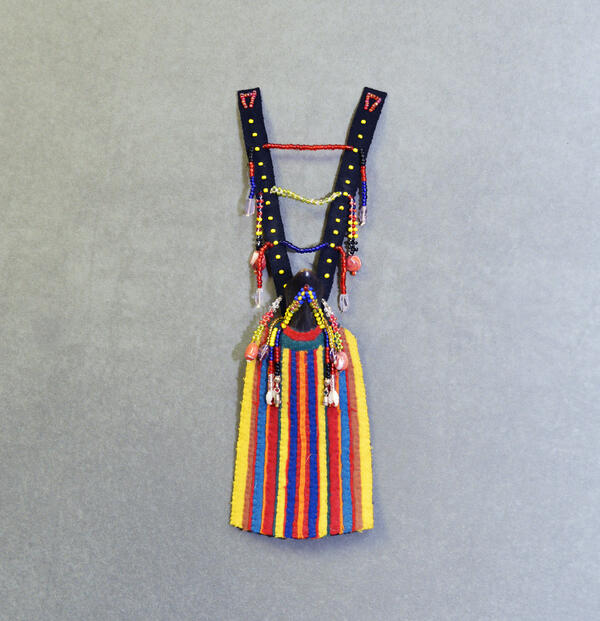
Самостоятельно изготовленные уникальные игрушки — часть традиционной материальной и духовной культуры лесных ненцев. С древности игры и игрушки учат детей труду и правилам поведения, через них они открывают для себя мир и ценности своего народа. Это не просто развлечение или способ подражания взрослым, через игру дети неосознанно готовятся к самостоятельной жизни.

Одна из традиционных кукол, которыми играют в детстве лесные ненки — “нухуко”. Голова такой куклы изготавливается из клюва водоплавающей птицы. У куклы-мальчика головой служит клюв гуся, у куклы-девочки — клюв утки. Ненцы считают, что перелетные птицы ежегодно улетают к богу и поэтому чисты и невинны. Одежду для таких кукол, напоминающую традиционную мужскую малицу или женскую ягушку, мастерят из кусочка сукна или меха и украшают разноцветными лентами.

Ненецких девочек очень рано начинают готовить к роли хозяек, чтобы они могли начать помогать матери. Ведение домашнего хозяства у ненцев полностью ложится на плечи женщины. Уже в пять-шесть лет девочки учатся обращаться с иголокой и ниткой, изготовление одежды для нухуко — одна из первых их попыток кроить, шить и подбирать декоративные элементы. К более старшему возрасту у владелицы собираются целые семьи из нухуко — у них даже могут быть свои чумы, лодки и посуда, которые тоже делают своими руками.

Нухуко — не просто традиционная кукла, для ненцев она имеет сакральное значение. Чтобы уберечь ребенка от враждебных сил и злых духов, куклу делают без лица, рук и ног, то есть всего того, что отождествляло бы ее с человеком. Считается, что человеческие лицо и тело могут наделить игрушку сверхъестественной силой. Сегодня наряду с традиционной “нухуко” ненецкие девочки играют и фабричными куклами, но одевают их, как и прежде, в малицу или ягушку, обувь-кисы и меховой капор.

В экспозиции Губкинского музея освоения Севера представлена кукла “нухуко” в разноцветной суконной ягушке. Голова куклы выполнена из клюва утки, к ней прикреплены традиционные накосные украшения из сукна, украшенные бисером и бусинами. Передняя часть утиного носа также украшена нитками бисера, выполняющими роль налобно-височных украшений.
#10
Full name: Nukhuko
Date: the 2nd half of the 20th century
Technique: handmade
Dimensions: 16×7×2 cm
Collection: Ethnography, the Forest Nenets people
Copyright: Gubkinsky Museum of the Development of the North
Goskatalog Number: GMOS OF-4040
read morehide
00:00
00:00
1x

Reindeer tendon threads, Nukhuko, Female kisy

0
Point your smartphone camera to open in the app
Share
VkontakteOdnoklassnikiTelegram
Share on my website
Copy linkCopied
Copy
Open in app
To see AR mode in action:
  1. Install ARTEFACT app for 
  2. iOS or Android;
  3. Find and download the «Paintings in Details» exhibition
  4. Push the «Augmented reality» button and point your phone's camera at the painting;
  5. Watch what happens on your phone screen whilst you flip through the pictures.
 
We use Cookies
Cookies on the Artefact Website. We use cookies to ensure that we give you the best experience on our website. If you continue without changing your settings, we'll assume that you are happy to receive all cookies on the Artefact website. However, if you would like to, you can change your cookie settings at any time.
Learn more about useHide
Content is available only in Russian

X

Нашли опечатку?...

%title%%type%