Font
Color
Graphics
Изображение точки

To see AR mode in action:

1. Install ARTEFACT app for iOS or Android;

2. Find the exhibition «Alexander Pushkin’s Travels»

3. Push the «Augmented reality» button and point your phone's camera at the exhibit;

Скрыть точки интересаПоказать точки интереса
Показать в высоком качестве

Kazan, Krupenikov

0
Open in app
#1

Kazan

#4

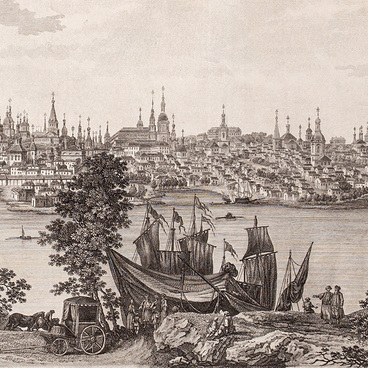
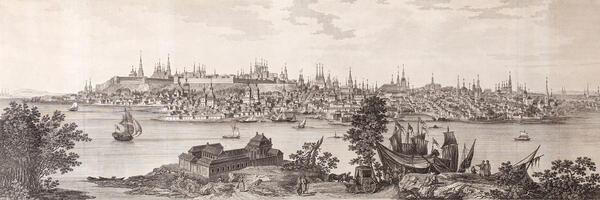
The National Pushkin Museum presents the engraving “Kazan”, one of the 38 engravings in the Atlas attached to the book by Nicolas-Gabriel Leclerc “Notes on the History of Ancient and Modern Russia”.

“Notes on the History of Ancient and Modern Russia” was published in Paris in the 1780s. In addition to the Atlas, statistical tables were also issued with the book. Perspective images were made by French engravers. Louis-Nicolas de Lespinasse (1734–1808) was listed as the draftsman. The artist himself never visited Russia, so as a reference he used engravings by Russian and foreign artists reproducing drawings by Mikhail Ivanovich Makhayev (circa 1717 — 1770). The latter was most highly acclaimed for his architectural landscapes; his drawings and engravings made from them were very popular in Russia and abroad.

In the drawings for the Atlas, Lespinasse copied the architecture quite accurately. However, he paid little attention to staffage and changed the horizon line and the general character of the image. In total, eleven drawings were made based on Makhayev’s originals, among them this view of Kazan. The large-format engraving shows a panorama of the city from the opposite bank of the Volga. The engraving depicts a general view of the city from the side of the Kazanka River. To the left of the center is the Kremlin, surrounded by walls. Cathedrals and the Söyembikä Tower with a cross on the spire are visible from behind the walls. There are numerous residential buildings and churches on the shore. In the foreground near the shore are sailing ships (right) and a wooden building with a high fence (left).

In 1833, Alexander Pushkin’s journey to the places associated with Pugachev’s Rebellion ran through the Volga cities. On September 3, after lunch, he left Nizhny Novgorod and went to Kazan. During his two-day stay there, Pushkin managed to achieve a lot, as he informed his wife, 
#5

Here I was talking to old people, contemporaries of my hero, toured the environs of the city, examined the battlefields, asked questions, took notes, and I am very pleased that I did not visit this site in vain.

#6

For the poet, the city and its surroundings were of great interest as places associated with the main events of the peasant revolt: the shameful flight of General Kar before Pugachev’s approach, the execution of Colonel Yurlov, the attack and resistance of the garrison that had taken refuge in the Kremlin, the murder of the 100-year-old General Kudryavtsev on the porch of the Church of the Holy Mother of God, the defeat of Pugachev’s army and others.

#3
Name: Kazan
Author: Francois Denis Nee
Date of creation: 1783–1794
Place of creation: Paris, France
Technique: engraving
Dimensions: 25,8×68 cm
№: 9400375
#2
Leonty Filippovich Krupenikov
#9

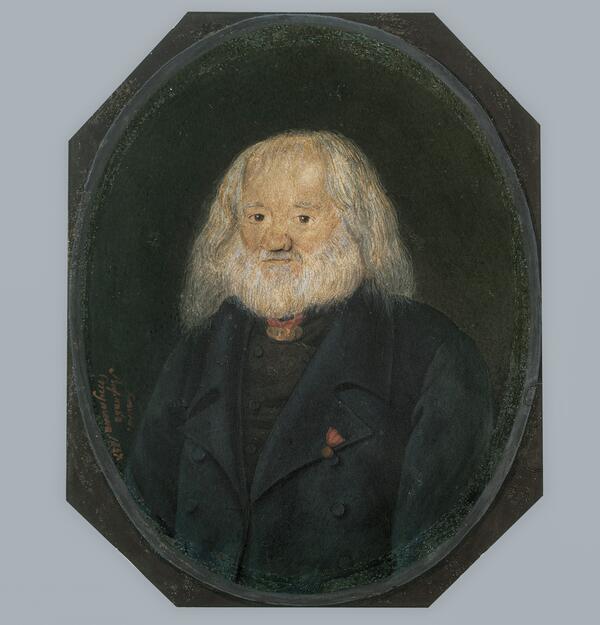
The National Pushkin Museum displays a portrait of the Kazan mayor, merchant of the 1st guild and hereditary honorary citizen Leonty Filippovich Krupenikov.

The portrait was painted by the artist Rafael Alexandrovich Stupin. He was born into the family of a painter, a graduate of the St. Petersburg Academy of Arts, Alexander Vasilyevich Stupin. He headed the first provincial private art school in Russia, founded in 1802 in the city of Arzamas, Nizhny Novgorod Governorate. In 1829, for a painting depicting John the Baptist, Rafael Stupin received a certificate for the title of an artist of history painting, 14th class, with a sword. In the late 1830s, Stupin worked in Kazan, where he lived with his friend, also a student of the Arzamas school and an architect Mikhail Petrovich Korinfsky. There, he painted several portraits of merchants, including a portrait of Leonty Krupenikov.

In 1833, Alexander Pushkin, having received a four-month vacation, went to the places associated with Pugachev’s Rebellion in Orenburg and Kazan, where he stayed from September 5 to 8. According to Alexandra Fuchs,

#10

Pushkin went to Orenburg to collect information for a story about Pugachev and for the same reason stayed for one day in Kazan.” On September 7, “in the morning, in a carriage drawn by three horses, Pushkin went alone to the Trinity Mill, along the Siberian Route, ten versts [10 km] from the city; Pugachev’s camp was there when he was approaching Kazan. Then, after driving around the Arsk Field, he was in the fortress, drove around it and then returned home, where he stayed the entire morning, until two o’clock, writing, ” and in the evening Pushkin and Karl Fuchs “went to the Kazan merchant of the 1stguild Krupenikov, who was a prisoner of Pugachev, and stayed there for an hour and a half.

#11

The next day Pushkin wrote to his wife:

#12

Here I was talking to old people, contemporaries of my hero, toured the environs of the city, examined the battlefields, asked questions, took notes, and I am very pleased that I did not visit this site in vain.

#13

The story about Pugachev, recorded from the words of Leonty Filippovich Krupenikov, was published in 1843 in the Kazan Provincial Gazette under the title “The Story of Merchant L.F. Krupenikov about Pugachev’s Stay in Kazan.”

#8
Name: Leonty Filippovich Krupenikov
Author: Rafael Stupin
Date of creation: 1837
Place of creation: Kazan, the Russian Empire
Technique: paper, gouache, pencil
Dimensions: 24,5×19,5 cm
№: 2370860
#7
read morehide

Kazan, Krupenikov

0
Point your smartphone camera to open in the app
Share
VkontakteOdnoklassnikiTelegram
Share on my website
Copy linkCopied
Copy
Open in app
To see AR mode in action:
  1. Install ARTEFACT app for 
  2. iOS or Android;
  3. Find and download the «Paintings in Details» exhibition
  4. Push the «Augmented reality» button and point your phone's camera at the painting;
  5. Watch what happens on your phone screen whilst you flip through the pictures.
 
We use Cookies
Cookies on the Artefact Website. We use cookies to ensure that we give you the best experience on our website. If you continue without changing your settings, we'll assume that you are happy to receive all cookies on the Artefact website. However, if you would like to, you can change your cookie settings at any time.
Learn more about useHide
Content is available only in Russian

X

Нашли опечатку?...

%title%%type%