Font
Color
Graphics
Изображение точки

To see AR mode in action:

1. Install ARTEFACT app for iOS or Android;

2. Find the exhibition «Pogar: The Last City of Magdeburg Law»

3. Push the «Augmented reality» button and point your phone's camera at the exhibit;

Скрыть точки интересаПоказать точки интереса
Показать в высоком качестве

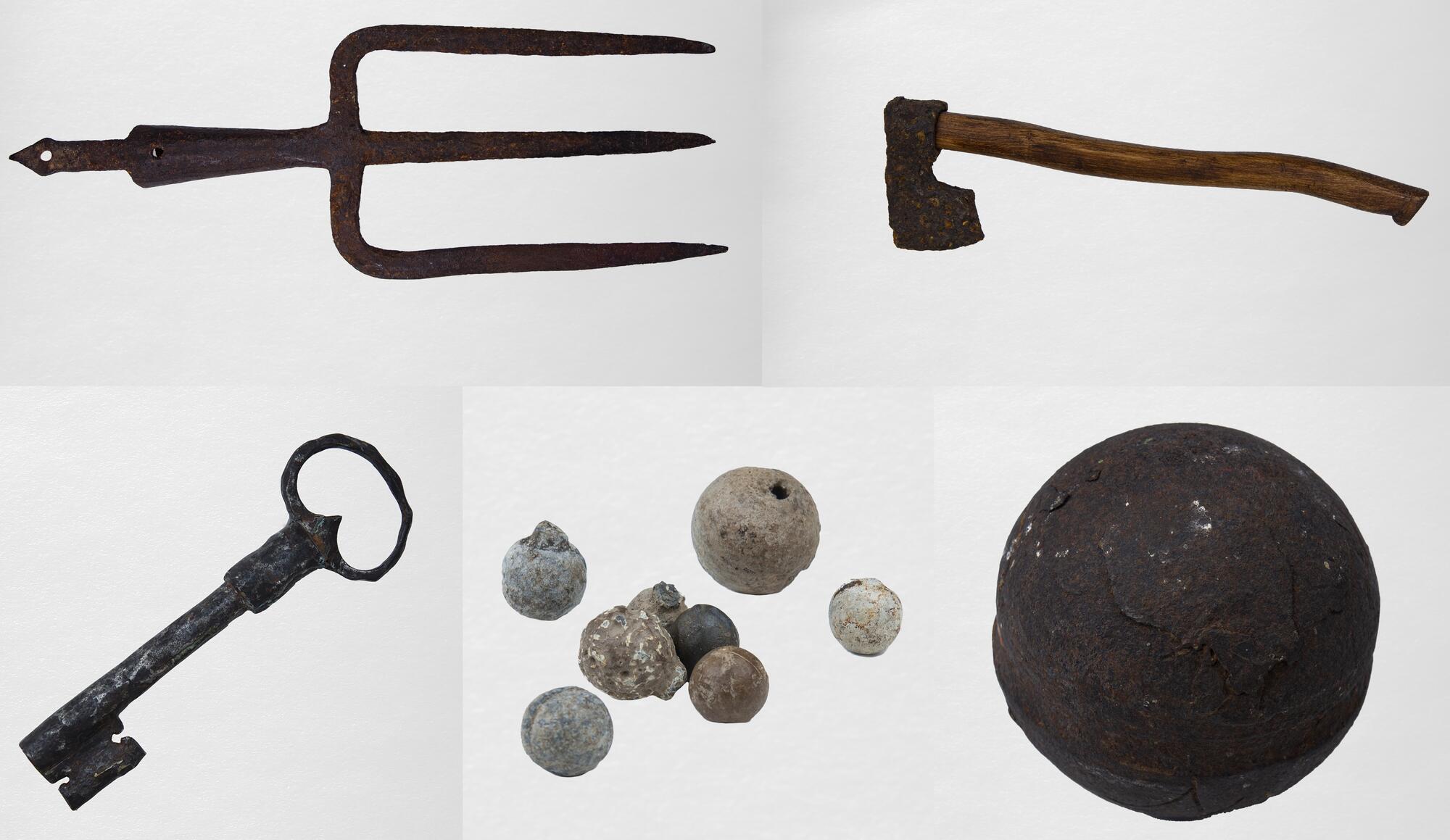
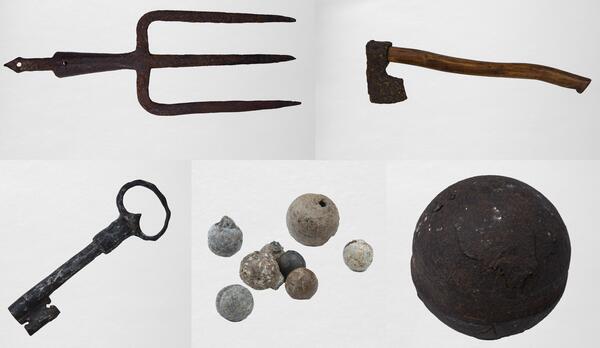
Bullets, Key, Battle axe, Cannonball, Trident

0
Open in app
#1
Bullets, Key, Battle axe, Cannonball, Trident
#2
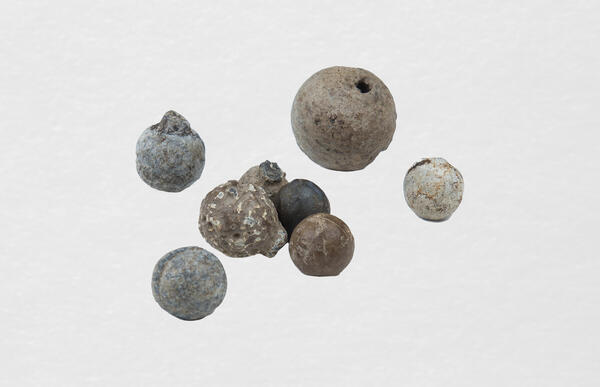
Bullets for Cossack rifles
#3
The history of the Cossacks in the Pogarsky land dates to the 17th century. The Cossacks guarded the southern borders of the country. The Cossack army was self-sufficient. Upon a call-up, a Cossack had to come to a sotnik with his own horse, outerwear and underclothing, a saddle, provisions for six months, food for the horse, as well as his own rifle.

The Cossacks made their own bullets from tin or lead. Bullets had no single standard and were often cast individually for rifles. The mold could be a stone with drilled holes that matched the size of the gun. The molten lead or tin, flowing through the holes, took on a spherical or cylindrical shape and fell into the cooled water. The bullets had different purposes and were divided into hunting and fighting bullets — they differed in size and shape.

A separate caste of the Cossacks were “ptashniki” (wildfowl hunters) and “bobrovniki” (beaver hunters), who used small bullets. They supplied the Hetman’s and even the Emperor’s court with prey.

The beaver’s business existed in the Bryansk region since the 14th — 15th centuries. The banks of the Sudost and Vablya Rivers, where beavers lived, had difficult forests and bushes. Beavers were mainly hunted in the fall and spring, and bullets were prepared in advance. Once a year the community delivered 20 otters and 10 beavers to the authorities. In 1753, there were three communities of beaver hunters in the Pogar Sotnya.

In the military campaigns, the Cossacks used combat bullets, which more often had a cylindrical shape. The Pogar Cossacks as part of the Starodubsky Regiment repulsed the act of aggression by the Polish-Lithuanian detachments and participated in the Great Northern War and the Crimean campaigns. During the Crimean campaign of 1738, Semen Galetsky, the general esaul, standard-bearer and a former sotnik from Pogar, and part of the Cossacks of the Pogar Sotnya died heroically.

The bullets for Cossack rifles are presented in the Radogoshch Museum. They were made back in the 18th century. They were also cast in different molds, and therefore they are not of the same diameter. Small tails that were obtained by cutting off the cast bullet from the remaining lead can be seen on the bullets. They are called sprues.
#4
Дата создания: 18th century
Полное наименование: Bullets for Cossack rifles
Техника: casting
Место создания: Pogar
Размеры: spheres with the diameter from 1 to 2.5 cm
Коллекция: Archeology
Правообладатель изображений: Radogoshch Museum
#5
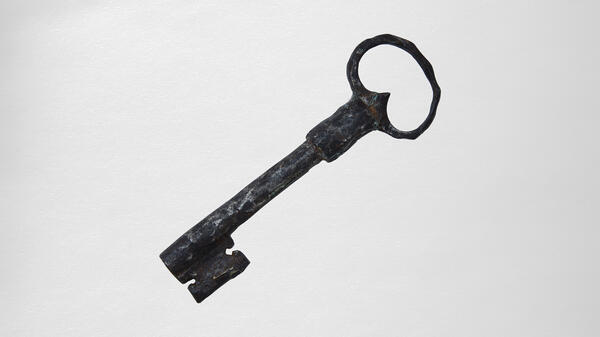
Kalaurnya key
#6
The Radogoshch Museum houses an old key, which was used to open a guardroom of the Pogar fortress in the 17th century. This key was made by Pogar craftsmen from the kovaly (blacksmiths) craft guild from a copper and steel alloy. The key shape was traditional: the key had a round barb and was crowned with an ornately shaped head.

An earthen log fortress was built in the second half of the 17th century in Pogar. It was located in a picturesque place on the bank of the Sudost River. The building was erected on high hills, surrounded by moats and ravines. The fortress wall had four towers with gates, which were closed at night. On the approaches to the fortress, there were guardrooms. Pogar residents called them “kalaurnya”.

The Pogar Sotnya Cossacks maintained a patrol in the guardrooms. In case of an unexpected attack by haidamak units or the Poles, the watchmen warned the other Cossacks. The haidamaks were the military units positioned on the right bank of the Dnieper River in Ukraine. They raided the Polish gentry, local citizens who collaborated with the Polish-Lithuanian Commonwealth authorities, Turkish officials, and boyars of Bessarabia, as well as participated in Cossacks campaigns and incursions. Initially, the units set up bases over the Dniester River. They identified themselves as the free Cossacks. The word “haidamaks” was first mentioned in the documents of 1737, before that the units were known as “leventsy”.

The kalaurnya watchmen also alerted citizens to fires. Usually, they kept fire extinguishing equipment: buckets, axes, and pike poles.

The Pogar fortress was an important bastion during the Great Northern War. The Russian army used the fortress as the headquarters, headed by count Boris Sheremetev, Field Marshal General. In that war, the Pogar Sotnya Cossacks fought on the side of the Russian Empire.

Nowadays, the patch in Pogar, where a guardroom was once located, is called Kalaurnya and is located at the intersection of Uritsky and Shchors streets. Some Pogar residents, the ancestors of Cossacks who patrolled the city, are called kalaurs.
#7
Полное наименование: Pogar fortress guardroom (“kalaurnya”) key
Техника: forging, casting
Дата создания: 17th century
Место создания: Pogar
Размеры: 18×6 cm
Коллекция: Other
Правообладатель изображений: Radogoshch Museum
#8
Battle axe
#9
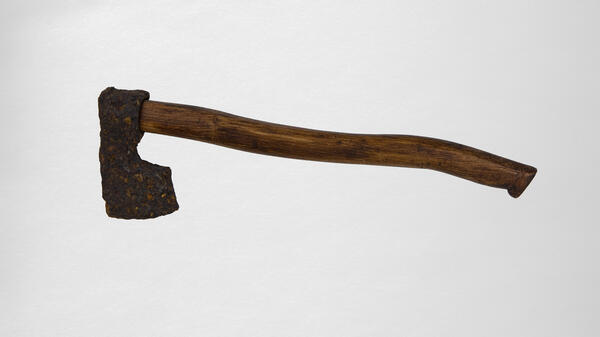
The Radogoshch Museum houses a battle-ax made around the 16th — 17th centuries, presumably in the Polish-Lithuanian Commonwealth. This country appeared in 1569 because of the unification of the Kingdom of Poland and the Grand Duchy of Lithuania.

The ax was used for close combat. The Polish axes could look like Czech chekan (a military hammer) or South Scandinavian cutting weapons. The ax with a short hilt was a light fighting ax. In addition, warriors used heavy armor-piercing axes.

The Starodub territory, which included Pogar, was numerously attacked by neighboring countries during the 16–17th centuries. It was also burned down by Zaporozhian Cossacks and Crimean Tatars.

In 1618, according to the Truce of Deulino, Radogoshch (modern Pogar) and its surroundings became part of the Polish-Lithuanian Commonwealth.
#18
“The resumption of Radogoshch under the name of Pogar is fairly attributed by the legend to Pyasochinsky, in whose possession Pogar was.”
Historian Alexander Lazarevsky wrote
#19
The Polish chronicles preserved records that the Poles did not conquer Starodub but reclaimed it because earlier they had “repossessed it from the Tatars by the sword.” It is known that in early 1620, Polish commissars came to Starodub “for the ordination of the castles reclaimed from Moscow” that is to take away palaces of the Polish rulers. The headman Baltazar Stravinsky and royal secretary Wojc Glembocki were appointed as commissars in Starodub. Other Polish noblemen, the minor landed gentry, received from the king the right to own and build on the local lands. The residence of Alexander Pyasochinsky was located in Pogar. The citizens called it a castle and the place around it — Zamkovaya Gora. Pyasochinsky populated Pogar with freemen.

In 1648, the Zaporozhian Cossacks, who supported the uprising of Bogdan Khmelnitsky, ravaged and burned Pogar down, wiping out the entire Polish population. The small Polish military post, which guarded the city of Pogar, was not able to repel the attack of the Cossacks.

Researchers suggest that, during those events, one of the soldiers lost an ax, which is now housed by the Radogoshch Museum. The weapon was found by residents in the area near Zamkovaya Gora. The ax could have been lost in 1662-1663 when the city was attacked by detachments of Cossack Yuri Khmelnitsky, son of hetman Bogdan Khmelnitsky.
#10
Полное наименование: Polish battle axe
Дата создания: 16th — 17th centuries
Техника: forging
Место создания: Polish-Lithuanian Commonwealth
Размеры: 13×6.5×4 cm
Коллекция: Ethnography
Правообладатель: Radogoshch Museum
#11
Cannonball
#12
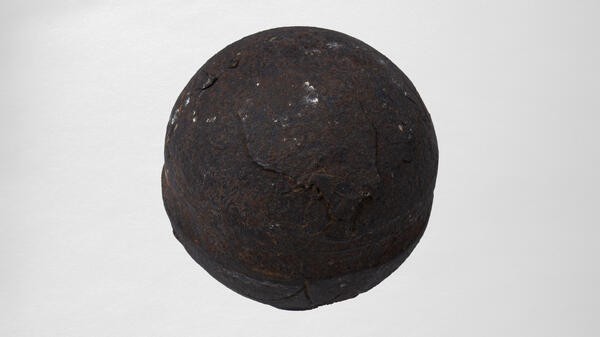
Cannonballs were among the first shells used in fire weapons. They were considered the most convenient for firing smoothbore cannons. They were used to destroy the bodies of ships, the walls of forts and field fortifications.

There was no single standard for making cannonballs. Nobody even thought about the caliber of it. The only condition was that the cannonballs had to be smaller than the cannon barrel. The first attempts to unify the caliber were made by Western European casters. In Russia, the requirements appeared under Peter the Great: it was believed that the gap between the cannonball and the barrel for field artillery should be no more than 1/29 of the diameter of the barrel.

Twelve copper cannons of different caliber and weight were installed in the Pogar fortress. They were served by Cossack gunners. Mentions of Cossacks and the Pogar fortress can be found in one of the documents of 1726,
#20
“Long ago… there was a fortress on a hill for those attacking the Pogar gunners… The fortress walls had gateways and towers covered with thin planks… under the hill, there was a moat.”
#21
The territory of the fortress was surrounded by a fortress wall and towers with gates — bramas. The towers had 14 loopholes with cannons. The largest loophole tower was called Promachinskaya and was located in the direction of the town of Starodub — to the southwest. Four large loopholes faced southeast. Ammunition was stored in a stone armory near the city administration building.

In the first half of the 17th century, the Pogar artillery fired several times at the arrays that tried to take the town. The Pogar gunners also participated in numerous military campaigns of the Pogar Sotnya as part of the Starodubsky Regiment. In the train of artillery, they carried armatas (one of the first names of artillery in Russia), kuli (bags of gunpowder), cannonballs and buckshot of various calibers and for different purposes. The Pogar artillery was preparing to reflect the attack of the Swedes in 1708 during the war with Sweden, but eventually, the enemy did not storm the town.

For many years, until the late 17th century, Pogar residents had a tradition to greet Cossacks returning from military campaigns with gun salutes. When the important dignitaries of Russia, Cossack colonels and other important guests visited the city, a salute using the fortress guns was made.

In the late 18th century, when the Pogar fortress lost its strategic importance, all the cannons and cannonballs were taken to the city of Bryansk to the Arsenal factory. They were melted down for civilian products.
#13
Полное наименование: Cannonball
Дата создания: 17th century
Правообладатель изображений: Radogoshch Museum
Техника: casting
№ Госкаталога: 14692485
Размеры: 8 cm in diameter
#15
Cossack trident
#16
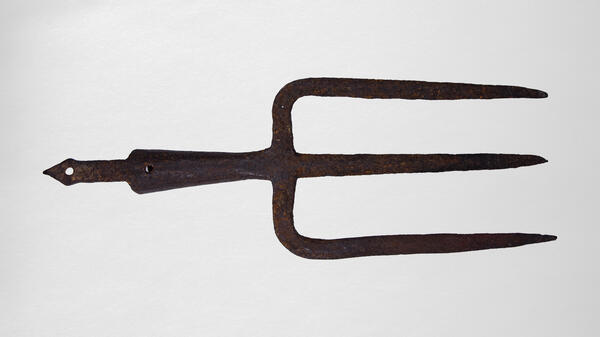
A trident is an ancient stabbing weapon. It has a long shaft, crowned by an iron tip with three barbs. The trident was made like a fishing tool — a gaff. Each barb of the gaff, unlike the trident, ended with a point and had serrations that held the fish. A gaff was used for fishing in spring: during the spawning season pikes, common carps and pike perches were caught directly from the shore. Also in winter, people were used to hit fish in the ice-hole with it. Gaffs with two barbs were called “sadovya” or “sandovya”.

The trident was used in the same way as a spear: to strike the enemy with it or to take away the weapon.
 
The Pogar people used tridents in battle when they fought against the Polish nobility (the minor landed gentry).

In 1648, Bogdan Khmelnitsky, hetman of the Zaporizhian Sich, gathered Cossack armies on left-bank Ukraine for a rebellion against years of Polish rule. In June 1648, Cossacks occupied Pogar and Pochep. On 23 July, provincial governors of Sevsk (100 km from Pogar) informed Moscow about the events,
#22
“4000 Cossacks are coming to Starodub and Pochep, and in the Novgorod uyezd they, the Cossacks, took the Pogar fortress and Poles and Jews and spilled the blood of their 70 families.”
#23
The residents of Pogar supported the Cossacks from the Zaporizhian Sich. In addition to tridents, in the fights, they used improvised tools like scythes and axes. That time there was a mass “Cossack-conversion” of the population: everyone who supported the rebels could become a Cossack and join the army. However, even ordinary citizens, who did not become Cossacks, carried “shablas” (sabers) and kept battle tridents in their dwellings. Later the citizens of Pogar took an oath of allegiance to Tsar Alexei Mikhailovich Romanov in February 1654, when Ukraine became part of Russia. 462 people took the oath: a colonel, a clerk, an esaul (Cossack captain), a standard-bearer (Cossack rank equal to second lieutenant), 24 atamans (title of the supreme military commanders of the Cossack armies), 344 Cossacks, a headman and 89 petty bourgeois.

The trident, which is presented in the Radogoshch museum, was kept in the Cossack family Kraevoy as a family relic. One of the representatives of the Cossack family donated this trident to the collection.
#17
Полное наименование: Combat Cossack trident
Дата создания: 17th century
Размеры: 45×17 cm
Правообладатель изображений: Radogoshch Museum
Техника: forging
Место создания: Pogar
Коллекция: Other
#14
read morehide
00:00
00:00
1x

Bullets, Key, Battle axe, Cannonball, Trident

0
Point your smartphone camera to open in the app
Share
VkontakteOdnoklassnikiTelegram
Share on my website
Copy linkCopied
Copy
Open in app
To see AR mode in action:
  1. Install ARTEFACT app for 
  2. iOS or Android;
  3. Find and download the «Paintings in Details» exhibition
  4. Push the «Augmented reality» button and point your phone's camera at the painting;
  5. Watch what happens on your phone screen whilst you flip through the pictures.
 
We use Cookies
Cookies on the Artefact Website. We use cookies to ensure that we give you the best experience on our website. If you continue without changing your settings, we'll assume that you are happy to receive all cookies on the Artefact website. However, if you would like to, you can change your cookie settings at any time.
Learn more about useHide
Content is available only in Russian

X

Нашли опечатку?...

%title%%type%