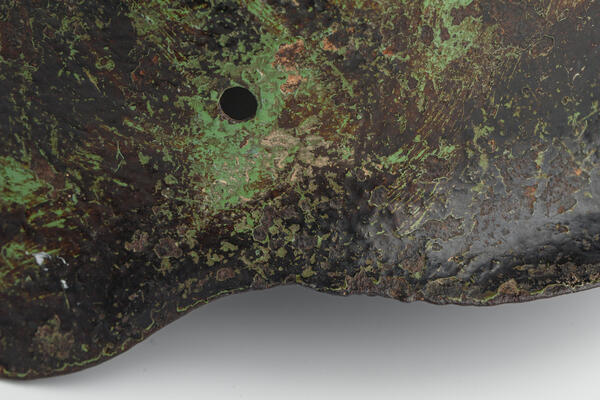
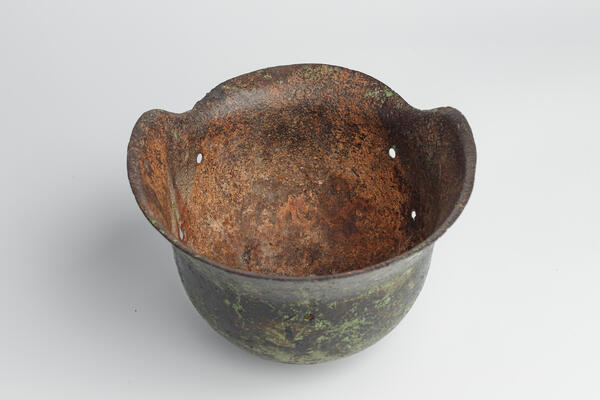
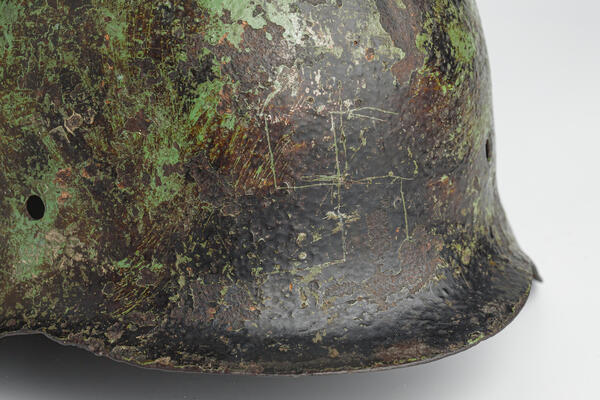
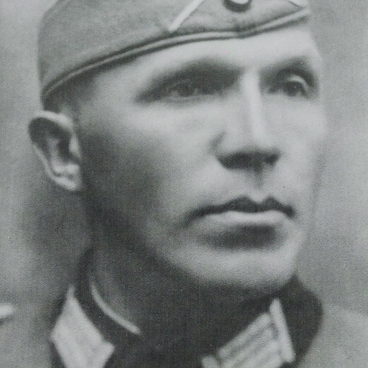
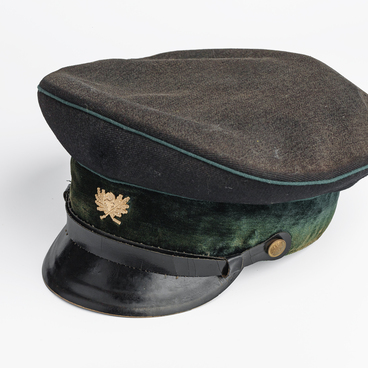
The Museum of Intelligence Officer Nikolai Ivanovich Kuznetsov houses a German helmet. In 1935, the Wehrmacht adopted a lighter, streamlined version of the earlier M1916/18 helmet, finished in a matte charcoal-gray paint. Known as the M35, it became the standard and most widely produced German steel helmet of the Second World War. It was issued not only to the Wehrmacht and Waffen-SS but also to police units, firefighters, and various Nazi Party organizations.
Collectors typically distinguish three main production variants: the M35, M40, and M42. The M35 is the original model, featuring ventilator lugs and a neatly rolled edge. The M40 is a simplified version that used a more efficient manufacturing process. Finally, the M42 was the most economical to produce, eliminating the rolled rim entirely in favor of a raw, unrolled edge.
Initially, officers’ helmets were painted in a semi-gloss “apple green”, slightly darker than standard field-gray (Feldgrau) uniforms. As the war progressed, however, helmet colors varied widely — from dark green and slate gray to near-black or olive tones — depending on factory batches and theater of operations. In North Africa, helmets with a sandy yellow finish were used. To reduce reflectivity, matte or textured paint became increasingly common.
The right side of earlier versions featured the Wehrmacht national emblem: a black eagle clutching a swastika in its talons, set against a white oval on a red background. This symbol denoted allegiance to the Nazi state and was worn by all branches of the Wehrmacht. Some units added supplementary insignia.
By 1943–1944, as material shortages worsened and frontline conditions deteriorated, external insignia were gradually phased out. Later models — especially those issued to rear-echelon and reserve units — were often left completely unmarked.
Inside the steel shell, the helmet featured a leather liner and an aluminum or steel band. The liner was cut from a single piece of leather into eight “petals”, each perforated with ventilation lugs, and gathered at the crown with a drawstring. This assembly was mounted to the shell via three metal rivets: two on the sides and one at the rear, securing the internal band to the helmet’s interior.