Folk masters played a major role in reviving the art of Mari embroidery. Among them, particularly fascinating was Elena Arkadyevna Kozhina (1957–2005) — an artist who worked in decorative and applied arts, a teacher, a member of the Artists’ Union of Russia, and a recipient of the Alexander Grigoriev State Prize of the Mari El Republic. Her works, which follow the traditions of Mari embroidery, are distinguished by the exquisite harmony of colors and the depth of images, the beauty and richness of color palettes and pronounced national features. Her profound knowledge and undoubted talent allowed Elena Arkadyevna to find her niche in Mari embroidery and to develop her own artistic style. Elena Kozhina’s works are a vivid example of the preservation and development of the traditional art of Mari embroidery of the second half of the 20th century. They are kept in the State Museum of Ethnography of the Peoples of Russia and the Center for Art Exhibitions of the Russian Ministry of Culture.
Elena Kozhina taught the subject “Mari Embroidery” at the Presidential School of Arts in Yoshkar-Ola. At the Yoshkar-Ola Art School, she supervised the preparation of student graduation works on embroidery, and also delivered embroidery courses at the Mari Institute of Education. After graduating from the Kalinin Moscow College of Industrial and Applied Arts, she worked at the Yoshkar-Ola factory “Truzhenitsa” (“Female Toiler”) as an embroidery artist in an experimental laboratory. In the 1980s, Elena Arkadyevna went to Podolsk. For the Podolsk Cossacks, she embroidered the “Regimental Banner”, a panel with horses and temples and a banner decorated with the Monomakh’s Cap.
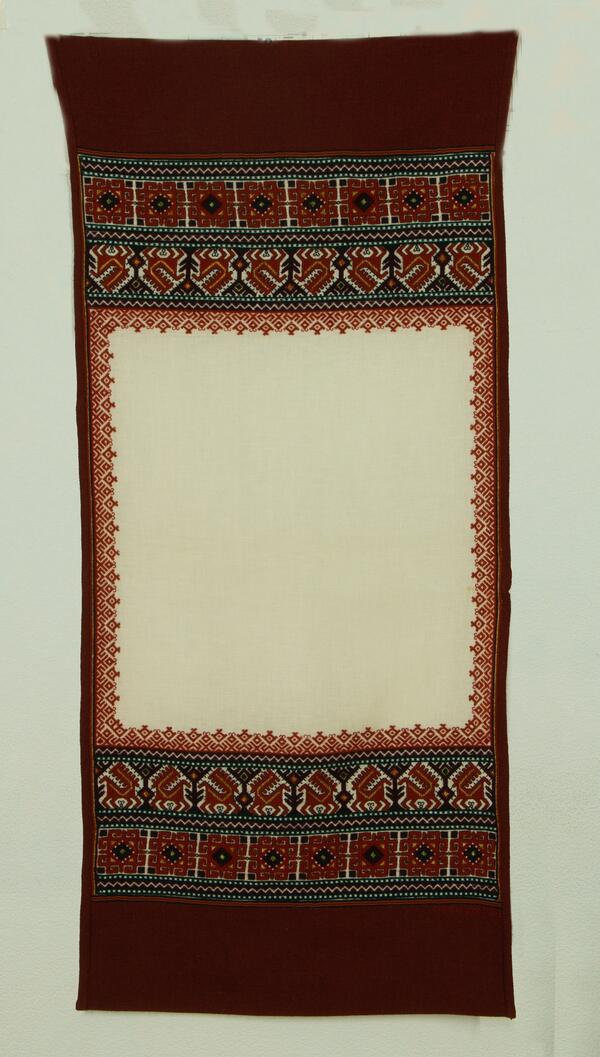
In the tablecloth “Deer” Elena Kozhina turns to ancient symbols. In mythology, the image of the “moose-deer” is associated with the theme of the family world and the connection of the feminine and masculine principles. These images originated in ancient times and are represented both in traditional embroidery and in archaeological artifacts found on the territory of the Mari El Republic. Traditional Mari embroidery conceals in itself encrypted information, the ancient origins of which were laid in the ornaments of household items and tools. The main embroidery techniques and the placement of decorations were subordinated to the shape, size and purpose of the embellished objects.
Elena Kozhina taught the subject “Mari Embroidery” at the Presidential School of Arts in Yoshkar-Ola. At the Yoshkar-Ola Art School, she supervised the preparation of student graduation works on embroidery, and also delivered embroidery courses at the Mari Institute of Education. After graduating from the Kalinin Moscow College of Industrial and Applied Arts, she worked at the Yoshkar-Ola factory “Truzhenitsa” (“Female Toiler”) as an embroidery artist in an experimental laboratory. In the 1980s, Elena Arkadyevna went to Podolsk. For the Podolsk Cossacks, she embroidered the “Regimental Banner”, a panel with horses and temples and a banner decorated with the Monomakh’s Cap.
In the tablecloth “Deer” Elena Kozhina turns to ancient symbols. In mythology, the image of the “moose-deer” is associated with the theme of the family world and the connection of the feminine and masculine principles. These images originated in ancient times and are represented both in traditional embroidery and in archaeological artifacts found on the territory of the Mari El Republic. Traditional Mari embroidery conceals in itself encrypted information, the ancient origins of which were laid in the ornaments of household items and tools. The main embroidery techniques and the placement of decorations were subordinated to the shape, size and purpose of the embellished objects.