The paintings of ethnofuturist artists usually urge to reevaluate historical heritage by taking into account modern cultural traditions. Alexander Ivanov was one of those who stood at the origins of ethnofuturism. As a student at the Moscow Higher School of Arts and Industry, he began to study the Finno-Ugric ornament and Permian animal style, and took part in archaeological expeditions. Therefore, his paintings include elements of ornament, most often ancient and geometric ones, as well as motifs of the Permian animal style which is distinguished by images that combine parts of human bodies, animals, birds and fantastic creatures in one.
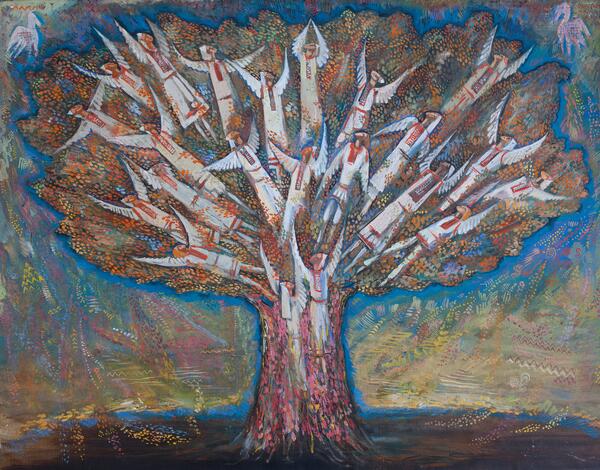
In the painting “The Tree of Life” Alexander Ivanov offers a symbolic version of the development of the Finno-Ugric peoples who stem from one shared root. The idea of the painting is not novel: back in the 17th century, the artist Simon Ushakov created the icon “Implantation of the Tree of the Russian State”, and Ivanov interpreted it to correspond to his own idea. In the crown of the tree of life, Ivanov depicts female and male figures in national clothes. At the base of the trunk there are two figures of the progenitors, then the figures multiply and, fanning out, fill the entire crown. Their number — 22 in total — is equal to the number of Finno-Ugric peoples currently living in the world. Hence, this is the tree of life of the Finno-Ugric peoples.
The painting by Alexander Ivanov shows the viewers how space is organized in the mythological world. In its center is the World Tree, or the tree of life, and it generates the universe around itself. Vertically, it forms three levels: the roots shape the Lower world, the ancestral world; the trunk makes up the Middle world, earthly and human; the branches form the Upper world, the world of the heavenly gods. In the painting by Alexander Ivanov, the viewer’s gaze is fixed on the crown, that is, on the upper, spiritual world. The figures of people with bird wings refer the viewer to the cast artifacts of the Neolithic era, which include figures of birds in the form of cast plaques, hollow figurines and rattling pendants.
The tree of life in the picture is the sacred center of the world. Psychologically, it symbolizes the integrity of the subconscious (the roots), conscious (the trunk) and superconscious mind (the branches).
In the painting “The Tree of Life” Alexander Ivanov offers a symbolic version of the development of the Finno-Ugric peoples who stem from one shared root. The idea of the painting is not novel: back in the 17th century, the artist Simon Ushakov created the icon “Implantation of the Tree of the Russian State”, and Ivanov interpreted it to correspond to his own idea. In the crown of the tree of life, Ivanov depicts female and male figures in national clothes. At the base of the trunk there are two figures of the progenitors, then the figures multiply and, fanning out, fill the entire crown. Their number — 22 in total — is equal to the number of Finno-Ugric peoples currently living in the world. Hence, this is the tree of life of the Finno-Ugric peoples.
The painting by Alexander Ivanov shows the viewers how space is organized in the mythological world. In its center is the World Tree, or the tree of life, and it generates the universe around itself. Vertically, it forms three levels: the roots shape the Lower world, the ancestral world; the trunk makes up the Middle world, earthly and human; the branches form the Upper world, the world of the heavenly gods. In the painting by Alexander Ivanov, the viewer’s gaze is fixed on the crown, that is, on the upper, spiritual world. The figures of people with bird wings refer the viewer to the cast artifacts of the Neolithic era, which include figures of birds in the form of cast plaques, hollow figurines and rattling pendants.
The tree of life in the picture is the sacred center of the world. Psychologically, it symbolizes the integrity of the subconscious (the roots), conscious (the trunk) and superconscious mind (the branches).