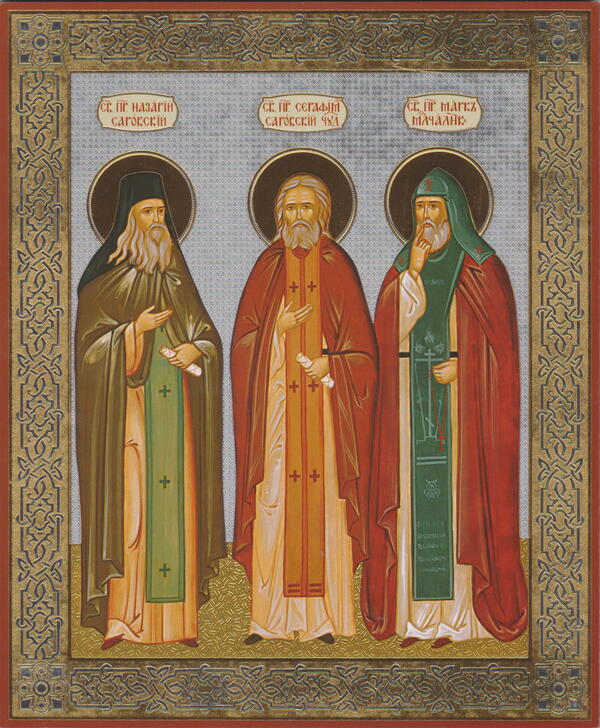
This icon type originated quite recently. Such an image of three elders — Nazarius of Valaam, Seraphim of Sarov, and Mark the Silent — appeared after the revival of the Sarov Monastery in 2006.
St. Nazarius started his ministry at the Sarov Monastery. His fame as one of the great devout monks of Sarov reached the attention of Right Reverend Gabriel, the Metropolitan of Novgorod and St. Petersburg. Wishing to restore “a settlement of saints in the deserted Valaam and thus offer a sacrifice to the Savior of the world, Jesus Christ, ” he was looking for an elder who could “guide the monks towards a life of salvation” and become the reverend father of the Valaam Monastery. After learning about Elder Nazarius, he summoned him to St. Petersburg.
During that time, the Valaam monastery was in poor condition. It did not receive funding from the government and had no funds of its own. Its buildings were dilapidated. The brethren were made up of elderly people only.
Elder Nazarius introduced the charter of the Sarov Monastery at the Valaam Monastery. Based on this charter, with the guidance of an experienced mentor, the monks soon excelled in all three types of asceticism: cenobitic monasticism, hermitage life, and reclusion. During the several years that Elder Nazarius served as the head of the Valaam Monastery, he improved both its external and internal state.
The life of Saint Seraphim is characterized by several remarkable facts. For example, for three and a half years, the ascetic ate only grass. Later, Father Seraphim spent a thousand days and nights praying on a stone boulder. Some people who came to him for spiritual advice saw him hand-feeding a large bear.
One of the ascetics of the Sarov Monastery was Schemamonk Mark the Silent. He is considered to be the predecessor and spiritual forerunner of Seraphim of Sarov. He was greatly revered by the worshippers.
Schemamonk Mark was born in 1737 into the merchant
family of the Aksenovs in Kursk. His parents gave him the name Mikhail. The
young man grew up withdrawn and quiet, not adapting to worldly life. When he
turned 20, he joined the Sarov Monastery. There, it became evident that he had
some traits typical of being a fool for Christ. Moreover, he was unable to sit
still: he would live in a monastery and then leave and settle in the forest. However, people noticed that he was a wise man. The abbot of the Sarov
Monastery gave him a separate cell in the monastery.