#1
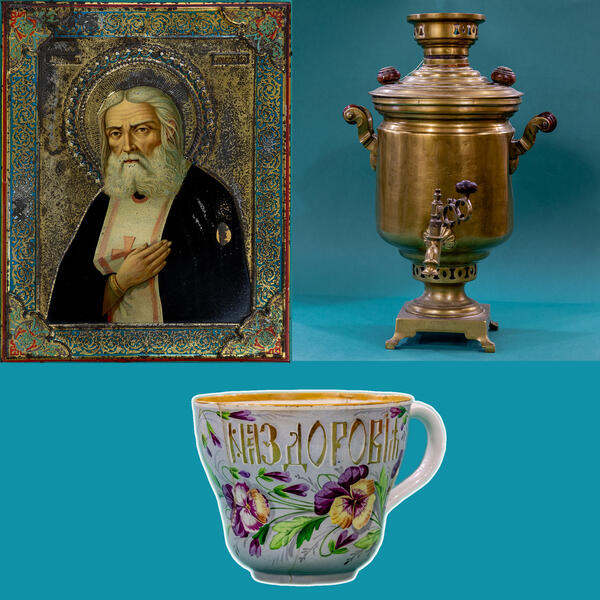
Icon, Samovar, Bowl
#2
#5
#3
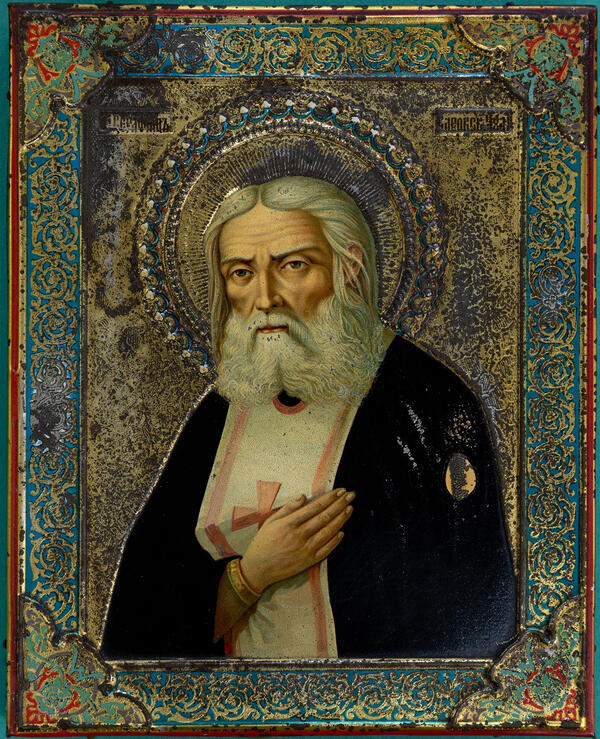
The icon was made in 1903 at the Moscow factory Zhako. It is made from wood and stamped brass in the chromolithography method. The icon is framed in percale, a very fine fabric. In the late 19th century, the Moscow factory Zhako was the first to start making icons on brass. Alongside with the Bonaker factory, they were the main manufacturers of stamped brass icons. Zhako factory invited the best masters from Mstera and Palekh, storied centers of icon painting, to work on their steel icons.
Apart from stamped brass, Zhako factory used another method called chromolithography —multicolored stamping. For each color on the icon, they took an individual stamping mold. Twenty or even more molds were needed to make an icon. The molds were made from stone or a zinc slab with a contour of the colored parts. The combination of artistic techniques helped make these icons not too pretentious and drowning in gold.
Seraphim of Sarov was a saint and a hieromonk (priest-monk) at the Sarov Monastery. He founded the Diveyevo Monastery in Nizhny Novgorod. Seraphim of Sarov is one of the most venerated monks in the history of the Russian Church. The icon made at Zhako factory has very well calibrated dimensions, a perfectly treated wooden slab onto which the brass icon is attached. The stamping and imprinting are done with great precision.
The icon is distinctly clear and colorful which makes it stand out among older icons painted by hand.
Images on icons are always precise and expressive. They impress with exquisite ornaments and vivid stylized patterns. This product resembles hand-painted icons in expensive enameled plating with sparkling gilding and imitation jewels.
One could buy an icon like this one in Moscow and other cities across Russia. Manufacturers of brass icons used all the latest technology in their production, such as electroplating, stamping, chromolithography, and imprinting. These new works of religious art fascinated people of the early 20th century who weren’t used to seeing such richly decorated and elegant icons.
Apart from stamped brass, Zhako factory used another method called chromolithography —multicolored stamping. For each color on the icon, they took an individual stamping mold. Twenty or even more molds were needed to make an icon. The molds were made from stone or a zinc slab with a contour of the colored parts. The combination of artistic techniques helped make these icons not too pretentious and drowning in gold.
Seraphim of Sarov was a saint and a hieromonk (priest-monk) at the Sarov Monastery. He founded the Diveyevo Monastery in Nizhny Novgorod. Seraphim of Sarov is one of the most venerated monks in the history of the Russian Church. The icon made at Zhako factory has very well calibrated dimensions, a perfectly treated wooden slab onto which the brass icon is attached. The stamping and imprinting are done with great precision.
The icon is distinctly clear and colorful which makes it stand out among older icons painted by hand.
Images on icons are always precise and expressive. They impress with exquisite ornaments and vivid stylized patterns. This product resembles hand-painted icons in expensive enameled plating with sparkling gilding and imitation jewels.
One could buy an icon like this one in Moscow and other cities across Russia. Manufacturers of brass icons used all the latest technology in their production, such as electroplating, stamping, chromolithography, and imprinting. These new works of religious art fascinated people of the early 20th century who weren’t used to seeing such richly decorated and elegant icons.
#4
Author: unknown
Date: 1903
Technique: stamping
Dimensions: 22×7,8 cm
Collection: Art
Copyright: Municipal Budget Cultural Institution “Mytishchi History and Art Museum”
Date: 1903
Technique: stamping
Dimensions: 22×7,8 cm
Collection: Art
Copyright: Municipal Budget Cultural Institution “Mytishchi History and Art Museum”
#6
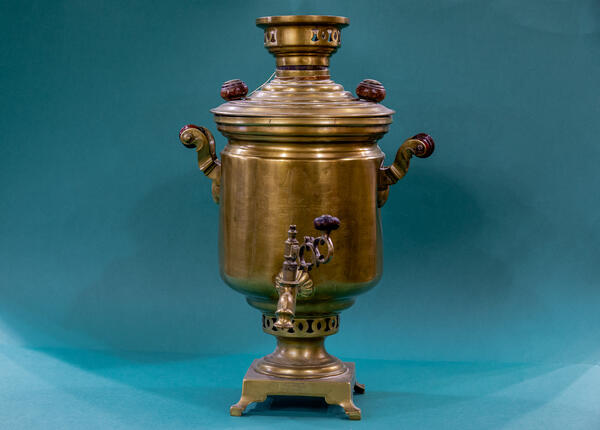
Samovar of N. I. Batashev’s Trading House
#7
#8
A samovar was an indispensable part of any Russian tea party. Tula was the center of samovar manufacturing. Nikolai Batashev was a famous samovar manufacturer from Tula, the son and heir of Ivan Batashev. In 1848, Ivan Batashev was granted the title of the Purveyor to His Imperial Majesty’s Court. In 1850, for high quality of his products and long-standing participation in samovar manufacturing, Batashev was awarded with the right to stamp the image of the National Emblem of Russia on his samovars.
In 1880, his son Nikolai Ivanovich Batashev became the sole owner of his factory. At the World’s Fair in Moscow in 1882 he received a golden medal for exceptional quality of his samovars and hardware.
Batashev’s new factory was finished at the end of the 19th century in Tula. In the early 20th century, the factory produced 54 different types of samovars. Batashev’s samovars, famous for their high quality and decoration, were highly valued and quickly sold out, which brought considerable profit. Not a single Russian exhibition, in or out of Russia, was held without the Tula samovar, manufacturing on Batashev’s factory. At the end of the 19th century, Vasily Batashev received a golden medal in New York. His products were praised for their great quality and functionality.
His company’s products were much better than analogues manufactured by competitors. His samovars were extremely durable, made from metal of outstanding quality. Batashevs' samovars quickly became popular all over Russia: both in cities and in the countryside. High-qualified employees who got decent salary also contributed to the quality of the product.
In 1906, the Batashev brothers opened an elementary school where they shared the secrets of making a really good samovar. On a real Tula samovar made on the Batashevs' factory you will always find numerous engravings of medals. Only the purveyors to the Russian Imperial Court or to the royal courts of Europe had the right to put such stamps on their products. This way, they could make their craft stand out.
Batashevs' samovars were extremely popular a few centuries ago, and even today, they remain highly sought-after among collectors. On average, a real Batashevs' samovar costs from 30,000 to 100,000 rubles.
In 1880, his son Nikolai Ivanovich Batashev became the sole owner of his factory. At the World’s Fair in Moscow in 1882 he received a golden medal for exceptional quality of his samovars and hardware.
Batashev’s new factory was finished at the end of the 19th century in Tula. In the early 20th century, the factory produced 54 different types of samovars. Batashev’s samovars, famous for their high quality and decoration, were highly valued and quickly sold out, which brought considerable profit. Not a single Russian exhibition, in or out of Russia, was held without the Tula samovar, manufacturing on Batashev’s factory. At the end of the 19th century, Vasily Batashev received a golden medal in New York. His products were praised for their great quality and functionality.
His company’s products were much better than analogues manufactured by competitors. His samovars were extremely durable, made from metal of outstanding quality. Batashevs' samovars quickly became popular all over Russia: both in cities and in the countryside. High-qualified employees who got decent salary also contributed to the quality of the product.
In 1906, the Batashev brothers opened an elementary school where they shared the secrets of making a really good samovar. On a real Tula samovar made on the Batashevs' factory you will always find numerous engravings of medals. Only the purveyors to the Russian Imperial Court or to the royal courts of Europe had the right to put such stamps on their products. This way, they could make their craft stand out.
Batashevs' samovars were extremely popular a few centuries ago, and even today, they remain highly sought-after among collectors. On average, a real Batashevs' samovar costs from 30,000 to 100,000 rubles.
#9
Date: late 19th — early 20th century
Technique: bronze
Place: Tula, Russia
Dimensions: 37×27×18 cm
Collection: Metal
Copyright: Municipal Budget Cultural Institution ‘Mytishchi History and Art Museum’
Technique: bronze
Place: Tula, Russia
Dimensions: 37×27×18 cm
Collection: Metal
Copyright: Municipal Budget Cultural Institution ‘Mytishchi History and Art Museum’
#10
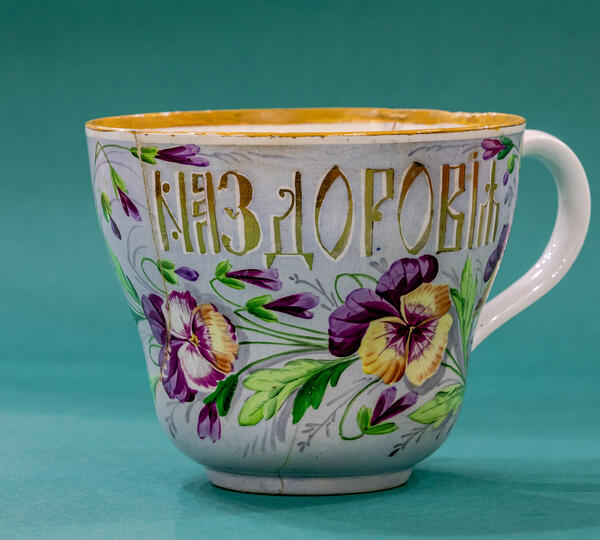
Bowl with a 'For Good Health' inscription
#11
#12
This bowl with floral patterns and a gilded 'For Good Health' inscription was made by M. S. Kuznetsov’s Partnership For Production of Porcelain, Dutchware, and Majolica Items. It was one of the largest porcelain and Dutchware manufacturing facilities in the Russian Empire during the late 19th–early 20th centuries. Kuznetsov’s Partnership was established in 1887 by the Russian industrialist and businessman Matvey Sidorovich Kuznetsov. With time, the Partnership comprised the largest Russian tableware factories: the Riga Porcelain and Dutchware Factory, Dulevo Porcelain Factory, and Franz Gardner’s Porcelain Factory in Verbilk of the Moscow Governorate (est. in 1766, purchased by Kuznetsov in 1891). The Partnership also included the Budyansk Porcelain Factory and the porcelain factory in Slavyansk, Kharkov Governorate, factories in the Yaroslavl, Tver, and Kaluga Governorates.
The dishes manufactured at Kuznetsov’s factories reflect numerous painting and shape traditions accumulated over the two-centuries-long history of porcelain in Russia. By 1898, Kuznetsov’s Partnership grew to become the largest in Europe, and in the early 20th century, the factories of the Partnership produced about two-thirds of all Russian porcelain. In 1902, Kuznetsov was awarded the title of the Purveyor to His Imperial Majesty. The factories manufactured tableware, vases, interior and facade decorations, Dutch tiles, and oven details.
The dishes manufactured at Kuznetsov’s factories reflect numerous painting and shape traditions accumulated over the two-centuries-long history of porcelain in Russia. By 1898, Kuznetsov’s Partnership grew to become the largest in Europe, and in the early 20th century, the factories of the Partnership produced about two-thirds of all Russian porcelain. In 1902, Kuznetsov was awarded the title of the Purveyor to His Imperial Majesty. The factories manufactured tableware, vases, interior and facade decorations, Dutch tiles, and oven details.
Russian people fell in love with tea they had discovered in the East. The introduction of tea to the high society jump-started the formation of tea etiquette. Rich families invited guests to a cup of tea served in porcelain cups. Apart from porcelain, there were always a shiny samovar and sweet treats on the table. A tea party filled with heartfelt discussions could last for hours. It was not allowed to smoke, sing, laugh, or discuss something loudly at the tea table. Ambiguous topics were also banned to make sure everything was orderly and calm. The matron of the house served tea to the guests. The honorable place at the table was near the icons. It was reserved for the hosts or the most respected guests. When the hostess passed tea to a guest, she said “For good health, ” and the guests responded with a thank you.
#13
Author: unknown
Date: early 20th century
Technique: porcelain, painting, glazing, gilding
Dimensions: 15,3×7×13,3 cm
Collection: Municipal Budget Institution of Culture “Mytishchi History and Art Museum
Copyright: Municipal Budget Institution of Culture “Mytishchi History and Art Museum
Date: early 20th century
Technique: porcelain, painting, glazing, gilding
Dimensions: 15,3×7×13,3 cm
Collection: Municipal Budget Institution of Culture “Mytishchi History and Art Museum
Copyright: Municipal Budget Institution of Culture “Mytishchi History and Art Museum
#14
Municipal Budget Cultural Institution “Mytishchi History and Art Museum”
read morehide
00:00
00:00
1x
1
 Point your smartphone camera to open in the app
Open in app
Share