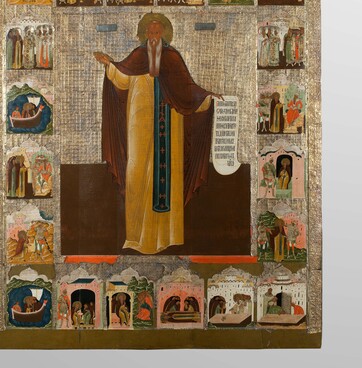
The Great Martyr Nikita (Nicetas the Goth) was born in the land of the Goths near the Danube River during the reign of Emperor Constantine the Great, Equal to the Apostles. Saint Nikita was baptized by the Gothic Bishop Theophilus, who took part in the First Council of Nicaea, professed the Orthodox doctrine, and signed the decisions of the Council.
During that time, the Goths were ruled by King Athanaric who was a fervent opponent of Christianity. The spread of the new faith was also opposed by Goth pagans. This resulted in a civil war. The Goths were divided into two camps. The army of Christians was led by the chieftain Fritigern, and the pagans were headed by Athanaric.
A bloody battle resulted in Athanaric’s victory. After the defeat, Fritigern went to Greece where he sought aid from the Roman Emperor Valens. The latter ordered the entire army, which was stationed in Thrace, to help the leader of the Christians.
During the crossing of the river Ister (Danube), Fritigern ordered his soldiers to make an image of the Holy Cross and carry it in front of his regiments. In the battle that followed, the Christians won a victory over the pagans. From that time on, the Christian Orthodox faith began to spread among the Goths.
After Bishop Theophilus passed away, Ulfilas became his successor. He helped further spread Christianity among the Goths. Saint Nikita also contributed to the advancement of the Christian faith. With his piety and God-inspired teachings he led many to Christ, including his own family.
Over time, however, Athanaric returned, gained power, and started persecuting Christians. Saint Nikita started fighting both the invisible and visible enemy. He fought against the invisible enemy by converting non-believers to true faith and denounced the visible enemy — the torturer Athanaric — for his godlessness and cruelty and for torturing many believers.
The saint was severely tortured, but nothing could make him deny Christ. The enraged Athanaric decided to kill the saint by throwing him into the fire, but according to the hagiography,