Font
Color
Graphics
Изображение точки

To see AR mode in action:

1. Install ARTEFACT app for iOS or Android;

2. Find the exhibition «Peoples of the North»

3. Push the «Augmented reality» button and point your phone's camera at the exhibit;

Скрыть точки интересаПоказать точки интереса
Показать в высоком качестве

Nenets clothes and toys

0
Open in app
#1
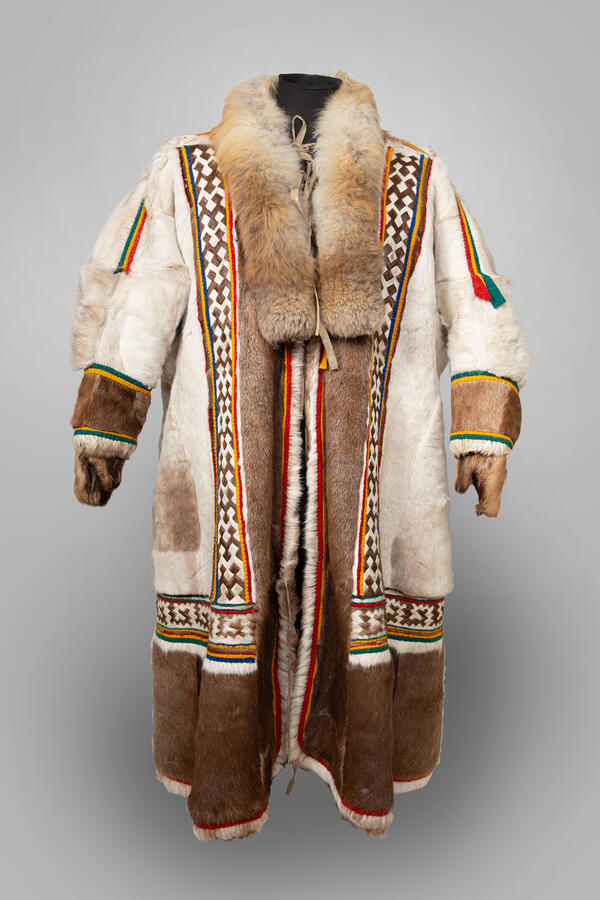
Winter women’s clothes — yagushka
#3
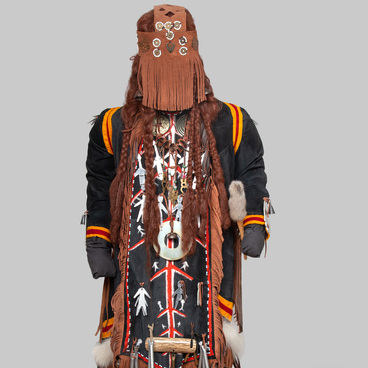
A yagushka, or panitsa, is a type of the traditional Nenets women’s clothing. In winter, it is sewn from fur, and in summer — from bright cloth. Unlike a men’s malitsa, the yagushka has an opening in front. The two main types of panitsa differ in design, decoration and trimming techniques. Usually, it takes four summer deer hides to make one yagushka, the same number of autumn hides for lining, and one hide for the collar.

The upper part of the panitsa, from the shoulders to the waist, is sewn from pieces of squirrel, beaver and fox fur. Craftswomen twisted strips of fur with inserts made from multi-colored cloth and use them to decorate the seams. The ends of these patches hang loosely on the chest, back and sleeves, embellishing the clothes. The sleeves of the yagushka are straight, wide at the shoulder and tapering to the wrist. The upper part of the sleeve is sewn together with the shoulder part of the bodice, so a yagushka has no seams on the shoulders. In this type of clothing, all seams are horizontal, and the needlewomen begin to sew this type of clothes from above.

The hem of the yagushka is sewn separately. The lower part of the garment consists of several horizontal stripes of deer and dog fur, and there are cloth inserts in between. The pattern is usually 4–5 cm wide. Various traditional patterns can be used in one yagushka: “deer antlers”, “fox elbows”, and “heads”. Each pattern has its sacred meaning. Triangles are often depicted on women’s clothing — this is a symbol of the Nenets dwelling, the chum, which is traditionally set up by women.

The lining of the yagushka is sewn with fur inside. Usually it is not sewn to the yagushka, but simply put on under it. The second type of yagushka is sewn entirely from reindeer fur in the vertical direction; the collar is made from the tails of Arctic and red foxes. Festive women’s clothing is richly decorated with a sewn-in ornament of white and dark colors made of the hard pile from a deer’s lower leg. The shoulders, sides and cuffs also get decorated with a layer of colored cloth. Craftswomen embroider clothes with beads, metal rings and colored ribbons. A yagushka is complemented by mittens and a warm hood, which fit tightly or are sewn to clothes. Nenets women wear a yagushka with a bright braided belt, with the right front half on top of the left one.
#2
Name: Winter women’s clothes — yagushka
Date of creation: the 20th century
Place of creation: Yamalo-Nenets Autonomous Okrug, the USSR
Technique: sewing, fur, embroidery
Dimensions: 86×62 cm
#5
Nenets doll nuhuko
#4
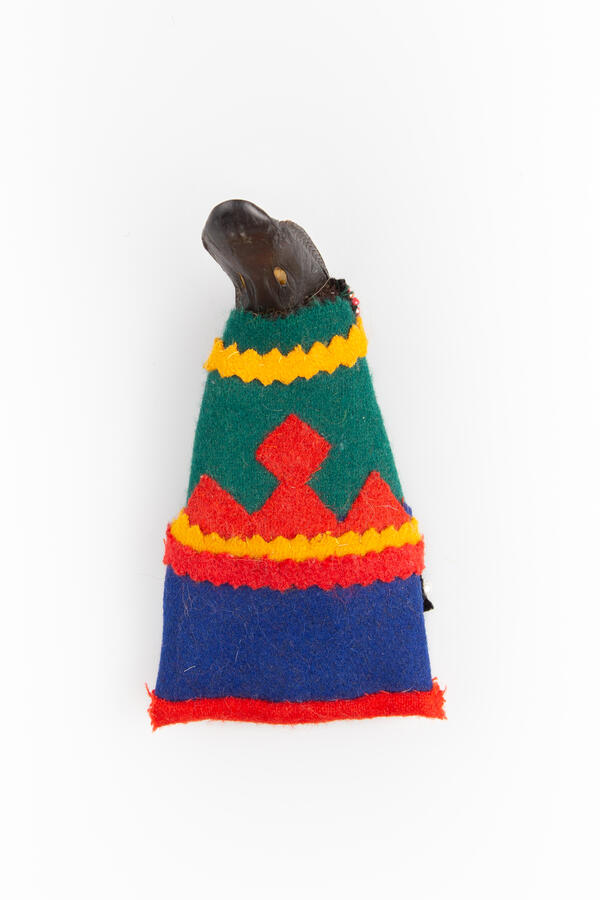
A nuhuko is a traditional Nenets toy. The custom of making dolls is associated with the historical past of the people, their worldview, way of life and spiritual values. A nuhuko doll is made from the upper portion of a bird’s bill. A male doll is made from a goose’s beak, and a female doll — from a duck’s beak. The beak of small waterfowl is used to make “children” dolls. The image of a duck is associated with the mythology of the northern tribes. Legend has it that the world arose from a pinch of earth, which was raised by a duck from the bottom of the oceans, and the first two supreme gods appeared from the duck’s eggs. The duck has always been a symbol of female power, childbearing, family and purity, because every year the bird flew away to the god Num.

The body of the nuhuko doll is made of a piece of fabric, tied with a ribbon to the base of the beak. Nuhuko dolls have neither arms nor legs. The Nenets were afraid to draw the eyes: they believed that then the doll would begin to see, come to life and take the child’s soul. The doll’s clothes are also subject to the ritual: the number of multi-colored ribbons should be odd. A female doll also gets braids that are made from laces or beads. From an early age, Nenets girls are taught to cut out doll outfits, sew them together and choose appropriate decorative elements. The girls receive help from their mothers, older sisters or grandmothers and prepare for their future role of homemakers, who have to sew clothes and shoes for a large family.

Over time, a child accumulated a whole family of dolls: adults, children of different ages, and old people. The clothes on the dolls looked like the ones that the Nenets wore themselves. Apart from clothes, doll families had their own tent, boat, kitchen utensils, household and deer. All this was made from fish vertebrae, birch bark and other natural materials. When an adult girl got married and brought her large doll family with accessories to a new home, this was a good sign that promised many children and well-being.

In the 21st century, the Nenets people carefully preserve the traditions of their national art. They use the doll to convey spiritual strength, national wealth and faith to children. Nuhuko dolls reflect the Nenets lifestyle and traditional crafts, and prepare children for the future life. Today, the nuhuko is replaced by factory-made toys and becomes a rare collectible item. However, artisans continue to make nuhuko dolls according to old technologies, and Nenets children dress new dolls in traditional northern costumes.
#6
Name: Nenets doll nuhuko
Date of creation: the second half of the 20th century
Place of creation: Yamalo-Nenets Autonomous Okrug, the USSR
Technique: sewing, assembly
Dimensions: 12×6 cm
#7
Nenets winter women’s hood
#9
In the Yamalo-Nenets Autonomous Okrug, winter lasts up to eight months, and frosts reach 50 degrees Celsius. Making warm outerwear is part of the traditional Nenets culture, a prerequisite for surviving in the Arctic climate. Women pass down sewing techniques and skills from generation to generation. Men’s outerwear is called a “malitsa”, and women’s — a “panitsa” or “yagushka”. This is a long shirt, made of cloth or fur, with a slit in the front. It takes up to ten reindeer skins to make one winter panitsa.

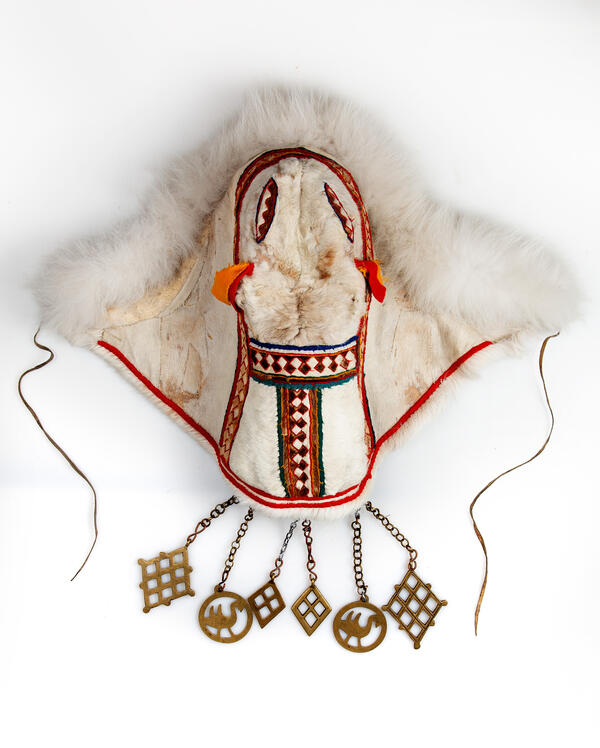
A women’s hat or hood is an addition to the winter panitsa. Elderly Nenets women wear high hats made of young reindeer skins, lined with calfskin. The hats are round at the top and have short ear flaps, they are similar in cut to men’s headwear. Festive hats are trimmed with cloth: square or triangular patches of different colors are sewn along the seams — around the top and on the sides. The ends of the fabric bands hang loosely. Two long strips made of the hard skin from the lower leg of a deer are sewn at the back. They are lavishly decorated with mosaic ornaments of white and dark furs, as well as cloth inserts. In the middle, the ears flaps are connected to each other with copper chains or threads.

Young Nenets women and teenage girls wear a different type of hats. This is a high headdress of a semicircular shape, sewn from the fur of a young deer with a lining from the abdominal part of the deer hide. The top of the hood is made from the skin removed from the deer’s forehead. The hood is sewn with the eye sockets on the back — they are decorated with the fur of a contrasting color. Bright strips of cloth are inserted along the semicircular seam, and additional ear flaps are sewn on the back — this is a attribute of festive clothes. The long ear flaps are not tucked into the belt, they hang loosely over the panitsa reaching below the waist.

A lot of copper and iron jewelry with slotted and embossed patterns, as well as large beads, are sewn on leather straps or chains from the back to the lower edge of the hood. These ornaments pull the sides of the hat back, pressing them against the fur coat, so that cold air does not get under the fur. When walking, the pendants make a gentle rattling sound. The front of the hat is tied under the chin with leather straps. The Nenets hat is soft, light, warm and big enough. Modern Nenets wear a warm hood for riding deer, and when working outdoors they prefer fur shawls.
#8
Название: Ненецкий женский зимний капор
Дата создания: XX–XXI века

Место создания: Ямало-Ненецкий АО, Россия
Техника: шитье, мех, бисер, сукно, металл
Размеры: 51×48 см

Name: Nenets winter women’s hood
№: 19059645
Date of creation: the 20th–21st centuries
Place of creation: Yamalo-Nenets Autonomous Okrug, Russia
Technique: sewing, fur, beads, cloth, metal
Dimensions: 51×48 cm
#10
Nenets toy kyylys
#12
National toys help to understand the character of the people, their history and worldview. Children have always been a great joy for the Nenets people — they were greeted as a gift from the gods. Cozy cradles were made for children and clothes were sewn from the softest skins and rawhide. Each children’s toy had and still has its own purpose, it educates children and helps them develop an understanding of their culture.

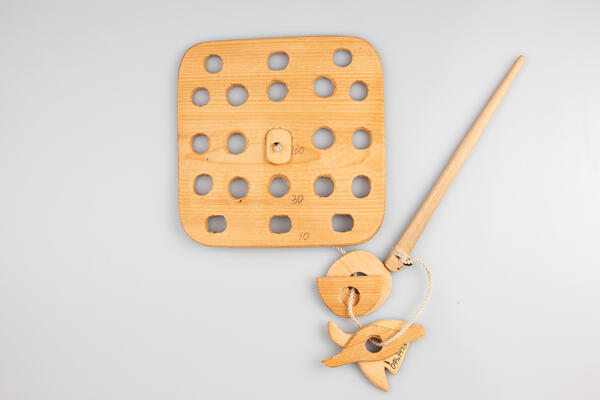
The Nenets willingly devote their free time to board games. They borrowed checkers, chess and cards from Russian settlers, and the Nenets learned to carve wooden boards and figurines themselves. Children and adults love to solve homemade puzzles, one of them is “kyylys”, presented in the collection of the Purovsky Museum. Translated from the Nenets language, this word means “who”, “which”. There is another name for the toy — “throwing a lasso”.

The kyylys consists of a square board with round holes, which symbolizes the starry sky. There is a thread with various figurines, and at the end of the thread there is a pointed wooden rod. The sun personifies a beautiful woman, the goddess of fertility, as well as the cult of the sun, which is important for the Nenets. In ancient times, the northern tribes celebrated the appearance of the sun in January after a long polar winter as the onset of a new year. The moon is a night luminary that reflects sunlight. According to the Nenets, the moon dies and is born in heaven just like living beings on earth.

A kyylys player takes the rod in one hand, catches a figurine and hits a hole on the board. Each hole has its own prize points: the closer to the center, the better. The number of figurines that the player managed to put on before falling into the hole is also taken into account. The winner is the one who caught all four figurines and hit the center hole of the board.

The game kyylys develops dexterity and reaction speed. According to the testimony of the Forest Nenets, more than a hundred years ago, kyylys was a gambling game in which men competed at the fair and bet their property: deer, chums, and even wives.
#11
Name: Nenets toy kyylys
Date of creation: the second half of the 20th century
Place of creation: Yamalo-Nenets Autonomous Okrug, Russia
Technique: wood processing, assembly
Dimensions: 17×17 cm
#13
read morehide
00:00
00:00
1x

Nenets clothes and toys

0
Point your smartphone camera to open in the app
Share
VkontakteOdnoklassnikiTelegram
Share on my website
Copy linkCopied
Copy
Open in app
To see AR mode in action:
  1. Install ARTEFACT app for 
  2. iOS or Android;
  3. Find and download the «Paintings in Details» exhibition
  4. Push the «Augmented reality» button and point your phone's camera at the painting;
  5. Watch what happens on your phone screen whilst you flip through the pictures.
 
We use Cookies
Cookies on the Artefact Website. We use cookies to ensure that we give you the best experience on our website. If you continue without changing your settings, we'll assume that you are happy to receive all cookies on the Artefact website. However, if you would like to, you can change your cookie settings at any time.
Learn more about useHide
Content is available only in Russian

X

Нашли опечатку?...

%title%%type%