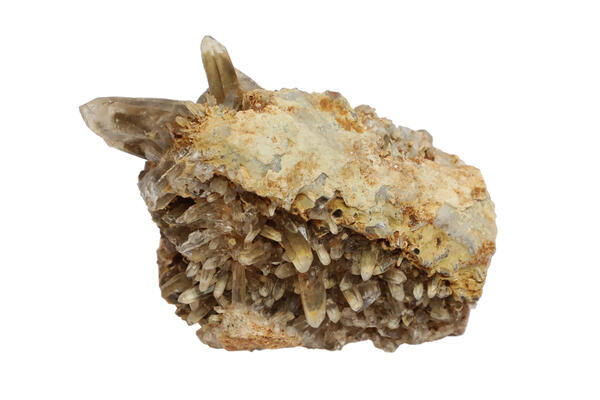
Quartz is often found on the territory of the Verkhnepyshminsky region. The museum houses a stone with crystals measuring 8 by 13 centimeters.
Quartz is formed in cracks and voids of ore veins, where minerals are deposited. Such places are called ‘quartz cellars’ in Russian. Over time, underground waters grind the boulders, and the mineral gets its distinctive natural shape.
The form of quartz crystals resembles pieces of ice. Crystals can be transparent with pinkish, lilac, greenish and golden hues. They have a natural glass gloss and let sunlight pass through.
Quartz is considered a hard and durable stone: its surface is resistant to mechanical damage and it is quite difficult to scratch it. Therefore, quartz is used to make optical lenses, radio equipment and jewelry.
The mineral has been known for a long time. In Ancient Greece, there was a belief that quartz was the gods’ tears that fell from heaven, and in Japan it symbolized the dragon’s frozen breath.
In many cultures, quartz was considered a mystical stone and was used in rituals. For example, in Ancient Egypt, the mineral was used to carve the portraits of the deceased to facilitate their transition to the world of the dead. In China, quartz was an attribute of clairvoyants, it was believed to help predict the future.
In Russia, quartz deposits are located in the Urals and Yakutia. Abroad, the mineral is mined in Brazil, Kazakhstan, and China. The most valuable quartz of the highest quality is considered to be the one found in the Middle Urals and in the Alps in Switzerland and France. Large crystals are rare in nature, so items made from quartz are expensive.
Since the early 20th century, chemists have tried to grow quartz in laboratories by mixing table salt and sodium silicate. Experiments helped to find out that the mineral is formed in a carbonic-water solution upon cooling, and confirmed the hypothesis that crystal can be obtained artificially. Then academician Alexander Fersman wrote:
Quartz is formed in cracks and voids of ore veins, where minerals are deposited. Such places are called ‘quartz cellars’ in Russian. Over time, underground waters grind the boulders, and the mineral gets its distinctive natural shape.
The form of quartz crystals resembles pieces of ice. Crystals can be transparent with pinkish, lilac, greenish and golden hues. They have a natural glass gloss and let sunlight pass through.
Quartz is considered a hard and durable stone: its surface is resistant to mechanical damage and it is quite difficult to scratch it. Therefore, quartz is used to make optical lenses, radio equipment and jewelry.
The mineral has been known for a long time. In Ancient Greece, there was a belief that quartz was the gods’ tears that fell from heaven, and in Japan it symbolized the dragon’s frozen breath.
In many cultures, quartz was considered a mystical stone and was used in rituals. For example, in Ancient Egypt, the mineral was used to carve the portraits of the deceased to facilitate their transition to the world of the dead. In China, quartz was an attribute of clairvoyants, it was believed to help predict the future.
In Russia, quartz deposits are located in the Urals and Yakutia. Abroad, the mineral is mined in Brazil, Kazakhstan, and China. The most valuable quartz of the highest quality is considered to be the one found in the Middle Urals and in the Alps in Switzerland and France. Large crystals are rare in nature, so items made from quartz are expensive.
Since the early 20th century, chemists have tried to grow quartz in laboratories by mixing table salt and sodium silicate. Experiments helped to find out that the mineral is formed in a carbonic-water solution upon cooling, and confirmed the hypothesis that crystal can be obtained artificially. Then academician Alexander Fersman wrote: