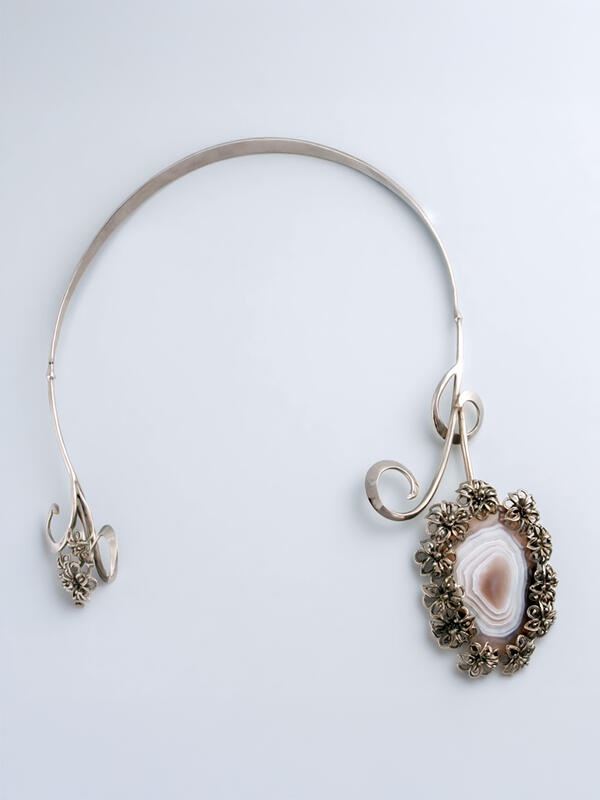
A torc, or hryvnia, is a rigid neck ornament whose name, according to one theory, derives from the Old East Slavic word “griva”, meaning “mane” or “neck”. A defining feature of the torc is its rigid hoop, designed to be worn snugly around the neck. Due to its rigid design, the piece typically requires no clasp — it is simply compressed or expanded slightly to fit. Torcs could be smooth or twisted.
In many ancient societies, the torc held deep symbolic significance, often linked to beliefs about the soul residing in the throat and upper chest. Known since the Bronze Age, these ornaments were not limited to women — they were worn by both men and women as markers of status, badges of honor, or even military distinctions. Traditionally crafted from bronze, copper, or silver, torcs reflected both aesthetic values and social hierarchy.
In Rus, by the 12th century, the torc had become an accessible ornament across all social classes and genders. It experienced a revival in the mid-20th century, when it reemerged as a prominent feature in designer jewelry collections. Ural jewelers embraced this resurgence with particular enthusiasm. A striking example is the torc “Sail” by the artist Vladimir Mikhailovich Fomin, now part of the Irbit Museum of Fine Arts collection.
This piece features a large pendant made from a lilac fine-crystalline amethyst druse, secured on a melchior hoop. The amethyst druse is framed by a metal structure of triangular plates that evoke the shape of a sail. Arranged in tiers — three above and four below — the slightly convex, polished plates create a dynamic visual balance with the delicate, shimmering cluster of lilac amethyst.
In the “Sail” torc, the stone becomes the figurative and aesthetic centerpiece, fully in line with the traditions of the Ural jewelry school. The natural stone’s unique color, crystal structure, and textural variety allow the artist to fully realize his artistic vision. The emotional expressiveness of the piece is further enhanced by Fomin’s deep commitment to natural motifs.
Through the image of sails mirrored in water, Vladimir Fomin evokes one of the most romantic themes in poetry and folklore — the image of a brigantine gently bobbing on the waves.