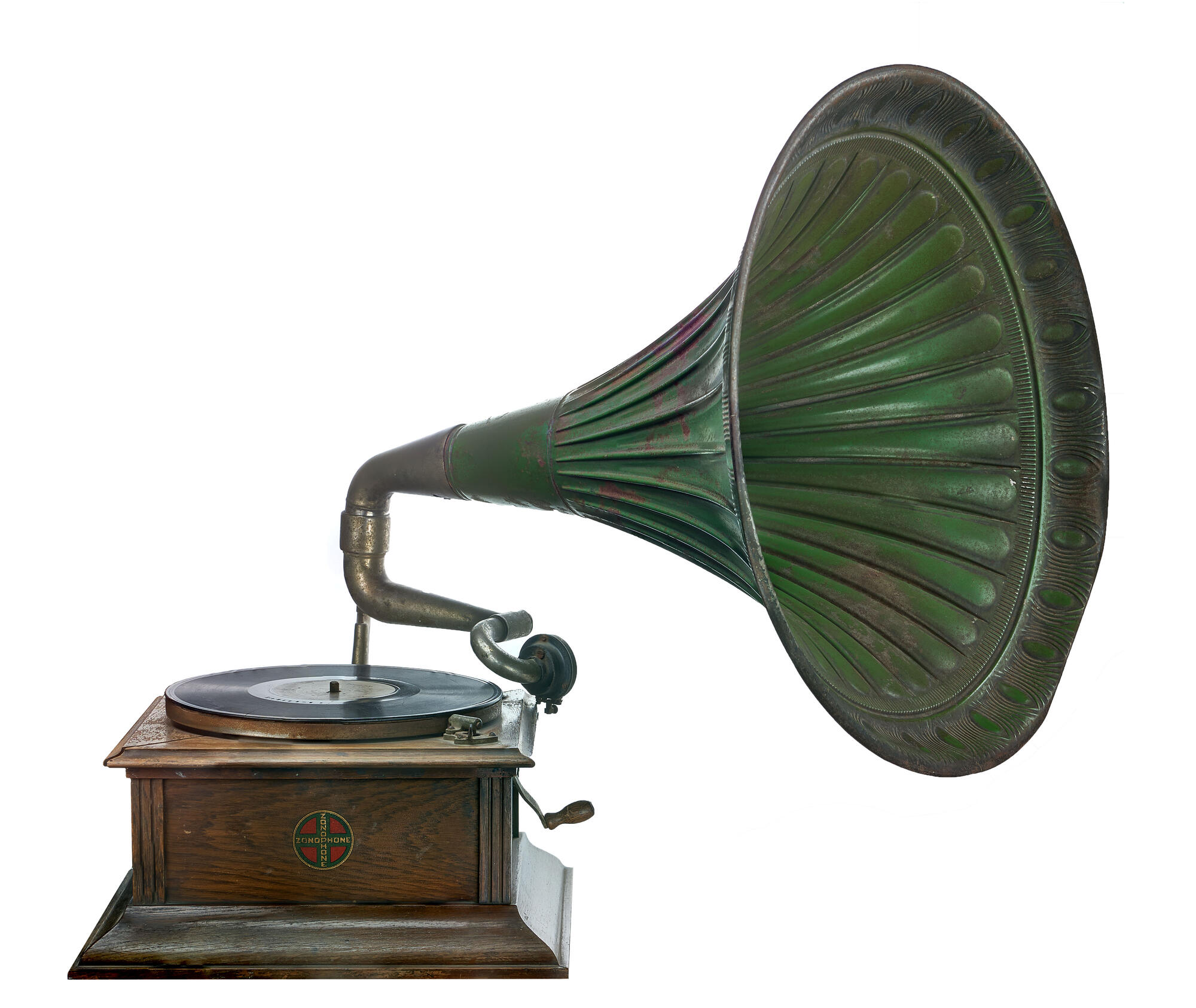


In the collection of the Urazovo Local History Museum you can see a gramophone dating from the late 19th century.
The gramophone is a hand-operated musical device for reproducing sound. It is a wooden box decorated with metal plates. Under the cover there is a sound-reproducing mechanism and a bell for sound amplification, which is covered by doors from the outside. A metal handle with a wooden tip is attached to the body.
The earliest attempts to design an apparatus for recording and reproducing music began in 1877. It was then that the American inventor Thomas Edison created a tin foil phonograph in which recorded sounds were reproduced. Edison tried to make arrangements for mass production of phonographs, which were very expensive. Therefore, only wealthy people or organizations bought them in limited quantities. For example, the traveler Nikolas Miklouho-Maclay recorded the speech of the Papuans on the phonograph of the Russian Geographical Society.
However, a more modernized gramophone could have appeared before the phonograph in France. But this did not happen due to the irresponsibility of local officials. In April 1877, almost six months before the first test of the American phonograph, the poet, musician and scientist Charles Cros sent to the Paris Academy of Sciences a description of the device called ‘paleophone’ — ‘the voice of the past.’ In December, Cros, learning about Edison’s invention, came to the academy and demanded to answer about the prospects of his technical proposal. It turned out that the envelope with his papers had not even been opened. After studying the description of the gramophone, the academy recognized Charles Cros’s ideas as correct, but refused to fund it.
The ideas of Charles Cros were developed and implemented 10 years later by the German-American inventor Emil Berliner. Using a photochemical method, he obtained a zinc plate, along which a needle connected to the membrane slid. On September 26, 1887, Berliner patented the device and called it a gramophone. After that, for five years he still worked on improving both the gramophone itself and the technology for making records.
Following America, the production of gramophones was also established in Europe. The first ones were the Pathe brothers, who founded the Pathe company in France. It was here that the first gramophones were produced — miniature gramophones with an acoustic bell, which was located in the body of the playing device.
The gramophone is a hand-operated musical device for reproducing sound. It is a wooden box decorated with metal plates. Under the cover there is a sound-reproducing mechanism and a bell for sound amplification, which is covered by doors from the outside. A metal handle with a wooden tip is attached to the body.
The earliest attempts to design an apparatus for recording and reproducing music began in 1877. It was then that the American inventor Thomas Edison created a tin foil phonograph in which recorded sounds were reproduced. Edison tried to make arrangements for mass production of phonographs, which were very expensive. Therefore, only wealthy people or organizations bought them in limited quantities. For example, the traveler Nikolas Miklouho-Maclay recorded the speech of the Papuans on the phonograph of the Russian Geographical Society.
However, a more modernized gramophone could have appeared before the phonograph in France. But this did not happen due to the irresponsibility of local officials. In April 1877, almost six months before the first test of the American phonograph, the poet, musician and scientist Charles Cros sent to the Paris Academy of Sciences a description of the device called ‘paleophone’ — ‘the voice of the past.’ In December, Cros, learning about Edison’s invention, came to the academy and demanded to answer about the prospects of his technical proposal. It turned out that the envelope with his papers had not even been opened. After studying the description of the gramophone, the academy recognized Charles Cros’s ideas as correct, but refused to fund it.
The ideas of Charles Cros were developed and implemented 10 years later by the German-American inventor Emil Berliner. Using a photochemical method, he obtained a zinc plate, along which a needle connected to the membrane slid. On September 26, 1887, Berliner patented the device and called it a gramophone. After that, for five years he still worked on improving both the gramophone itself and the technology for making records.
Following America, the production of gramophones was also established in Europe. The first ones were the Pathe brothers, who founded the Pathe company in France. It was here that the first gramophones were produced — miniature gramophones with an acoustic bell, which was located in the body of the playing device.