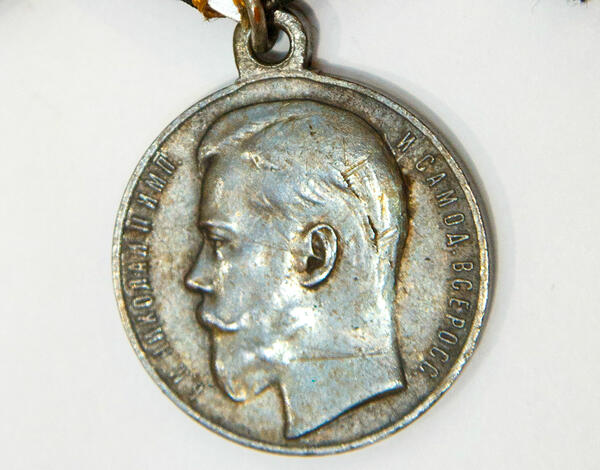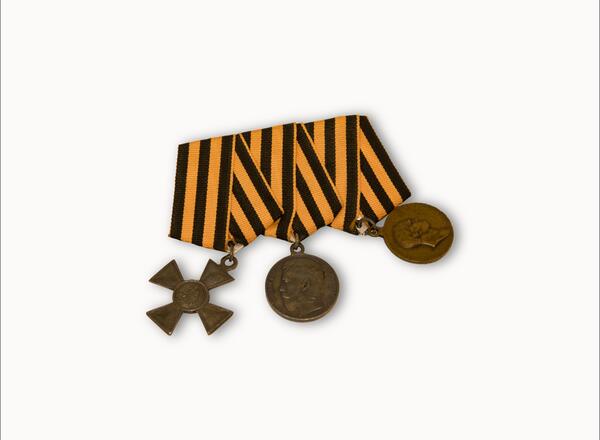
The Cross of Saint George was established in 1807 to decorate the lower ranks, including soldiers and non-commissioned officers, for service in battle. Initially, there was only a single class with no restriction as to the number of awards per person.
Half a century later, a royal decree divided the Decoration of the Military Order of Saint George into four classes. The first- and second-class orders were made of gold, while the third- and fourth-class orders were made of silver. The lowest class of the order was the fourth class. After 1916, the crosses were no longer made of precious metals. However, it was still a great honor to receive a Saint George Cross.
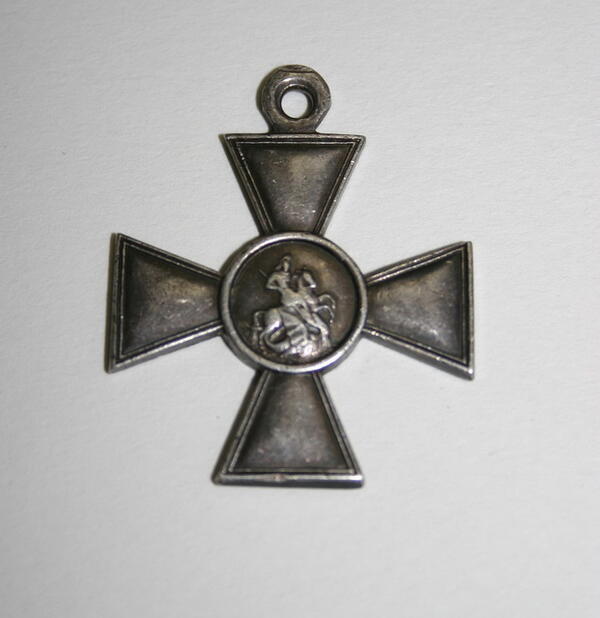
The award is a cross pattée. In the center, it has a round medallion, with the obverse bearing a relief sideway image of Saint George slaying a dragon with his spear.
The reverse of the medallion features the Cyrillic monogram of the Order of Saint George “СГ” (“SG”). The horizontal arm of the cross bears the serial number of the award, with the class of the award embossed on the lower arm: for the fourth class.
Grigory Melekhov is the main character of Mikhail Sholokhov’s epic novel “And Quiet Flows the Don”. He was the first Cossack in the Tatarsky hamlet to receive this award. He earned it for his service during World War I in 1914. The text of the novel features an excerpt from orders, saying, “For saving the life of Colonel Gustav Grosberg, commander of the 9th Dragoon Regiment, Grigory Melekhov, 12th Don Cossack Regiment, is promoted to the rank of corporal and recommended for the Saint George cross, 4th class” (Chapter 20).
After the October Revolution of 1917, the Cross of Saint George was abolished, but older people did not change their sentiments toward this award and took great pride in it. Stalin repeatedly received suggestions to legalize pre-Soviet awards, and even a corresponding draft act of the Council of People’s Commissars was prepared. However, the Order of Glory with a similar ideology had already been established in the Soviet Union, which is why the Cross of Saint George was not legalized.
The award was reinstated in 1992 by the Decision of the Supreme Soviet of the Russian Federation.