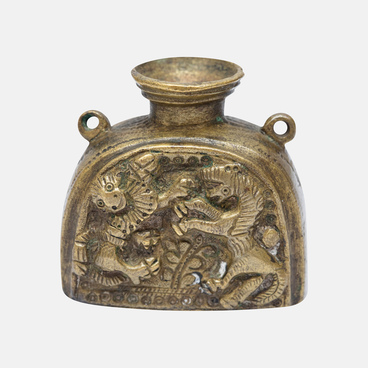
This fragment of a bell was given to the museum in 2009 by a Kargopol resident Alexander Koposov. According to him, it was discovered by chance while digging a drainage ditch on the territory of an estate. Long-term residents recalled that once there was a large clean pond in that area, called the Monastery Pond, which they used as a water source and for rinsing laundry. When the monastery was looted, the bells were thrown into the water so that they would not be taken by the Bolsheviks.
The bell tower of the Dormition Monastery was a square three-tiered structure, plastered and whitewashed inside and outside, covered with iron sheets and oil paint. A passage gate to the monastery was made at the bottom; the southern part was occupied by monastic cells, and a staircase leading to the belfry was located in the northern part. In the second tier there was a gate church, consecrated in the name of the Venerable Anthony and Theodosius, the founders of the Kyiv-Pechersk Lavra. There were eight bells on the belfry in the third tier.
The “anti-bell campaign” began in Russia (which was then the RSFSR) after the revolutionary events of 1917. First of all, it was prohibited to ring church bells as it was deemed to be dangerous for the government — it could be a call to speak out against the Bolsheviks. In 1926, by the instruction of the People’s Commissariat of Justice “On the Procedure for Using Bells”, the right to regulate bell ringing passed from the church to the local authorities. In 1929, church bells were declared antithetical to the “principle of separation of church and state” and banned.
In parish churches, the fight for belfries was waged for several more years after the campaign ended in large cities. Until the 1930s, there were more than 120 bells in the Kargopol region in both closed and open chapels and churches. Some of them were managed by collective farms.
However, in 1934, the chairmen of the regional
village councils were ordered to report on the total number and weight of the
available “bells and bronze” for their subsequent confiscation. At the same
time, it was dictated to speed up the process of closing still operating
churches. Probably, at that time, the bells of the Dormition Monastery that
were to be sent to Kargopol and Nyandoma for melting, were dumped into the
pond.