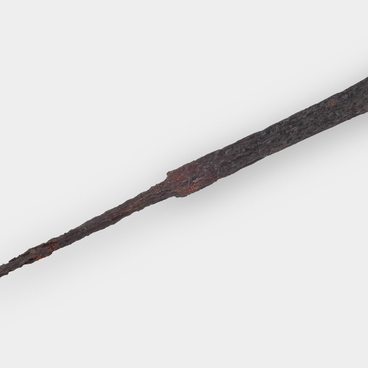
The bracelet fragment is an accidental find, discovered in 2005 in the settlement of Sosnovy Bor in the Belovsky District of Kursk Region. It has a rounded cross-section both in the middle and at the end. Near the end of the fragment, there is a visible decorative pattern — two parallel circular lines. These lines are shallowly and unevenly inscribed, making them difficult to discern in some places. The item on display was once part of a whole piece, cast from a copper alloy.
The surviving fragment is 5.5 centimeters long, with the diameter of the widened end measuring one centimeter. The item belongs to the category of women’s artifacts from the “Antiquities of the Antes” group, dated to the 6th–7th centuries CE, and is associated with the Kolochin archaeological culture, whose bearers are considered by scholars to be early Slavs. Bracelets with widened ends were used to fasten the cuffs of a tunic on the wrists of the wearer. They were one of the most important elements of the early Slavic women’s jewelry sets, forming a unified system that carried not only decorative but also significant semantic meaning.
In the early Middle Ages, such bracelets, along with other jewelry items made of copper alloys and silver, were mostly affordable to members of the tribal aristocracy of the time — women with a high social standing. Among the “Antiquities of the Antes, ” bracelets are not uncommon. They are often found in hoards, including those discovered in the Kursk region. This is one of the most common categories of items.
A direct analogy to this fragment comes from a
hoard discovered in 2009 in the settlement of Zamostye near the city of Sudzha
in the Kursk region. Among the 1,500 items in the hoard, there are four
bracelets with widened ends, one of which has exactly the same decorative
pattern on the ends. These patterns are known not only in the area of the
Kolochin culture, which covers vast territories of the Upper and Middle Dnieper
region, but also are found in many Early Medieval sites. They were part of the
metal adornments of people belonging to various cultures in the forest and
forest-steppe zones of Europe.