Font
Color
Graphics
Изображение точки

To see AR mode in action:

1. Install ARTEFACT app for iOS or Android;

2. Find the exhibition «Manor House in the 19th — Early 20th Centuries»

3. Push the «Augmented reality» button and point your phone's camera at the exhibit;

Скрыть точки интересаПоказать точки интереса
Показать в высоком качестве
#33
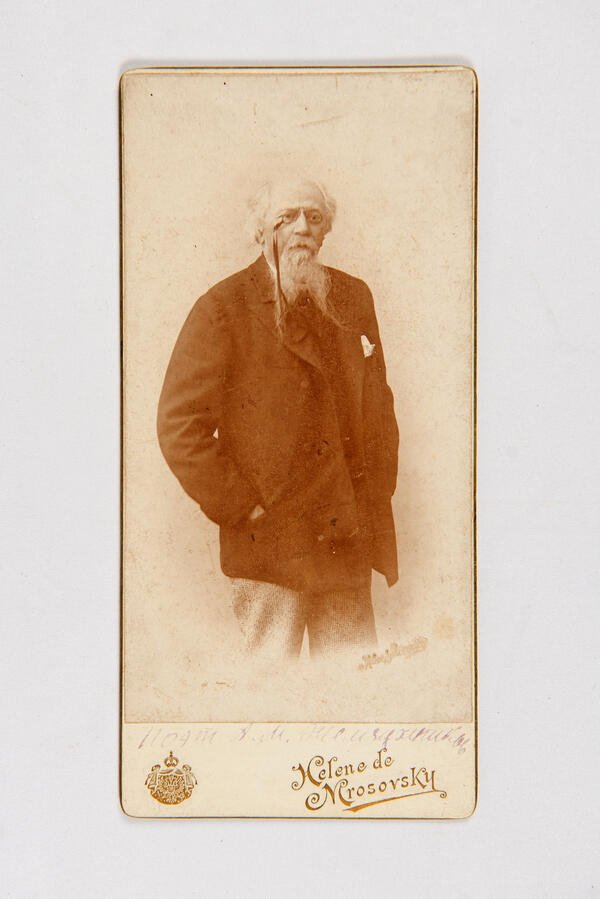
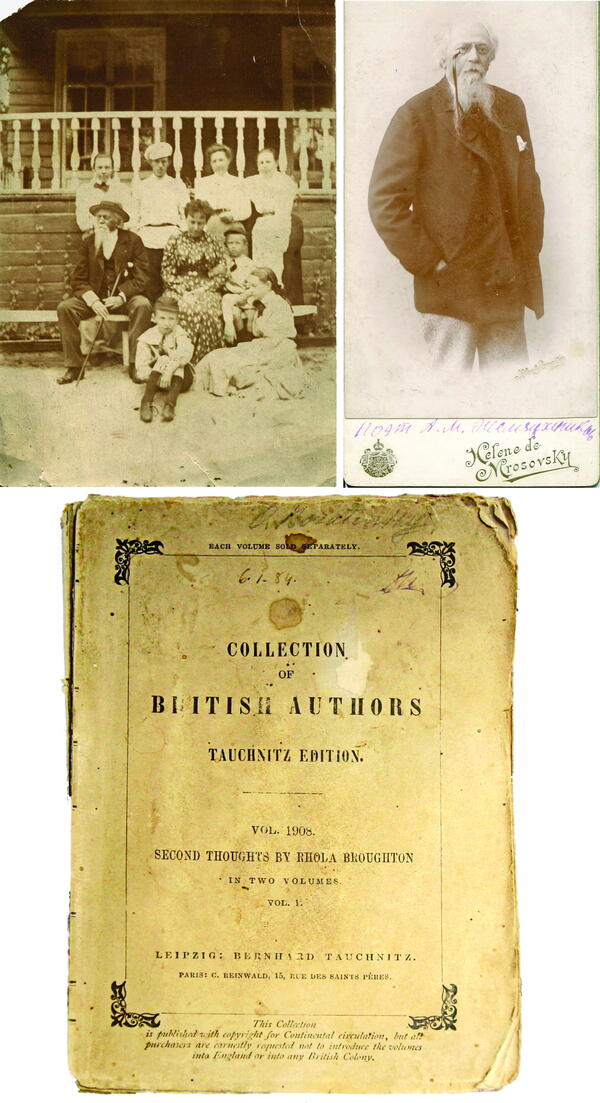
Photo of the poet A.M. Zhemchuzhnikov
#16
Aleksey Mikhailovich Zhemchuzhnikov abandoned his brilliant career as a civil servant and devoted himself entirely to poetry, but his literary destiny was not an easy one. He began to write poems in his childhood but they first appeared in print towards the end of his life. Prutkov’s parodies brought more fame to Kozma than to Zhemchuzhnikov. The poet’s works, while appearing in print, were rare. It was for various reasons: living abroad, where he did not feel inspired to write; illness and death of his wife — there were long pauses in work. The inscription on the back of the cabinet card reads “Photographer of His Highness Prince Chernogorsky’s Court E. Mrozovskaya. St.-Petersburg, Nevsky, near the Police Bridge, number 20”.

Elena Lukinichna Mrozovskaya, or Hélène de Mrozovski (née Knyazhevich), was one of the first Russian professional photographers of Montenegrin origin. Mrozovskaya’s brother, Vladimir Pavlovich Mrozovsky, was a mechanical engineer and artist, and her uncle Joseph Ivanovich Mrozovsky was Military Governor General of Moscow from 1915 to 1917.

Mrozovskaya studied photography at the Russian Technical Society, completing the course in 1892. She then continued her studies with the French photographer and caricaturist Nadar in Paris. Returning to Saint Petersburg she opened a studio there in 1894. She died in 1941 in Repino (a district of Saint Petersburg).

Elena Mrozovskaya photographed many famous people: Nikolay Rimsky-Korsakov, Matilda Kshesinskaya, Vera Komissarzhevskaya and other famous artists, writers and actors of the time. Mrozovskaya won a bronze medal at the Stockholm General Art and Industry Exhibition and a silver medal at the World Exhibition in Paris, and participated in an international exhibition in Liège. One of her photographs, a hand-painted image of Princess Olga Orlova wearing a kokoshnik at a ball in the Winter Palace in 1903, is in the Hermitage collection. Elena Mrozovskaya’s shaded photograph “Portrait of a Girl in Malorussian Costume” is in the collection of the Moscow House of Photography. Many of Mrozovskaya’s photographs are in the collection of the Saint Petersburg Conservatoire and several more are in the collection of the Russian State Archive of Literature and Art.
#17
Name: Photo of the poet A.M. Zhemchuzhnikov
Author: Elena Mrozovskaya
Date of creation: 1900
State catalog number: 6687687
Place of creation: Saint Petersburg, the Russian Empire
Technique: photography
Dimensions: 20,8×9,8 cm
#19
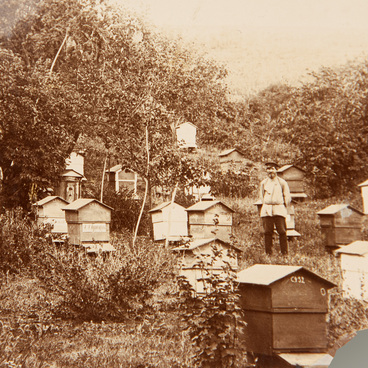
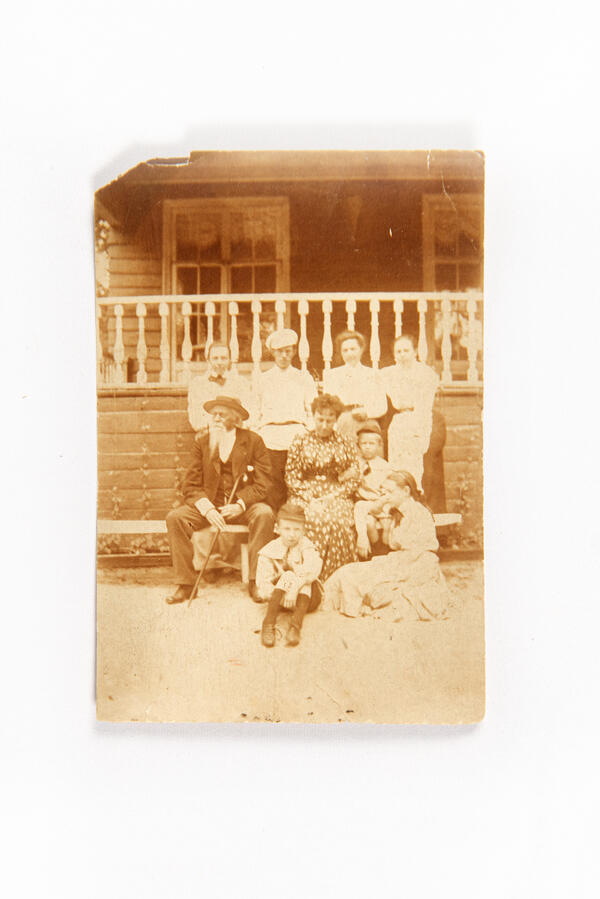
A.M. Zhemchuzhnikov with his daughter’s family
#20
Aleksey Mikhailovich Zhemchuzhnikov (10.02.1821–25.03.1908), the poet and co-author of the character of Kozma Prutkov, spent the last years of his life in the village of Ilyinovka, Kirsanov District, Tambov Governorate, on the estate of Mikhail Andreevich Boratynsky — the husband of his eldest daughter Olga.

Mikhail Andreevich recalled, “Aleksey Mikhailovich was 71 when I met him, but he looked young for his age — always cheerful, loving and enjoying life with gratitude. He was not in good health but led a very healthy and modest life. He liked my estate, Ilyinovka, very much for its picturesque location and enjoyed his stay with my family, which had already become his own. He already had a grandson — little Volodya, my son from my second marriage.”

In the summer, I managed to take some amateur photographs, which immortalized some episodes from our life. Here Aleksey Mikhailovich met my neighbors, my relatives the Chicherins, the Boratynskys and Baroness Delvig. The two old ladies Boratynskys and the wife of Vladimir Nikolayevich Chicherin, brother of Boris Nikolayevich Chicherin, were the nieces of the poet Evgeny Abramovich Boratynsky, and their half-sister Elizabeth Antonovna Baroness Delvig was the daughter of the poet A. A. Delvig, a friend of Pushkin. The old Boratynskys and Delvig lived 5 versts from my estate, in the Mara manor, where the poet Eugene Abramovich and his mother once lived. The Chicherins lived on their Sergievka estate, two versts from Ilyinovka. Since these neighbors belonged to the same generation as Aleksey Mikhailovich Zhemchuzhurnikov, we shared friends and interests. In general, there was a feeling that Aleksey Mikhailovich was pleased and happy in our places — he was still strong enough to take long walks with us.

He particularly liked to go to the Lopatnya grove and talk to the forest guards. He loved this life in the woods among the birds and the silence, and often said that if he were a poor peasant, he would choose to be a forest ranger.”
#36
Name: A.M. Zhemchuzhnikov with his daughter’s family
Author: Mikhail Andreevich Boratynsky
Date of creation: the early 20th century
Place of creation: Kirsanov District, the Russian Empire
Technique: photography
Dimensions: 11,5×7,8 cm
#7
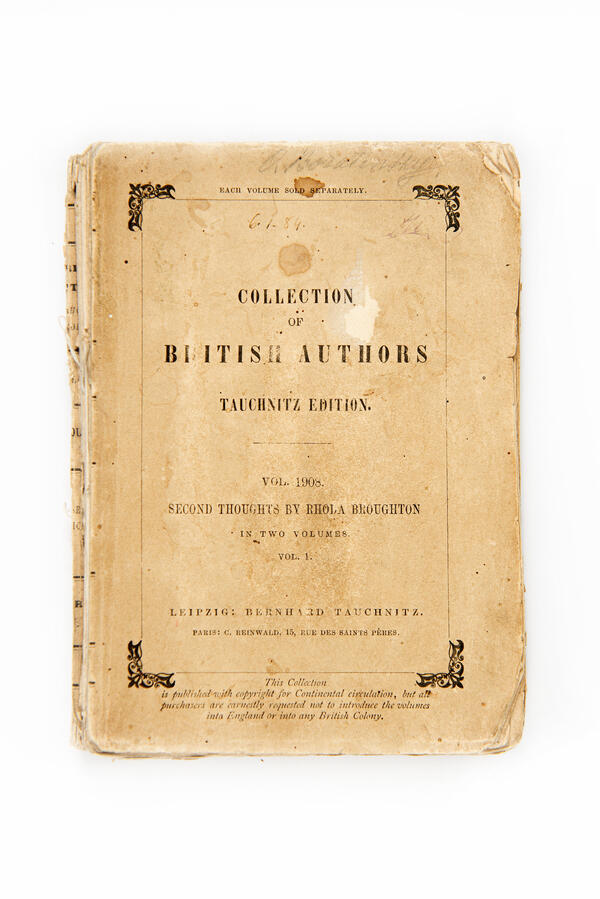
Novel “Second Thoughts”
#8
The Kirsanov Local History Museum houses books from the estates of major landlords of Kirsanov District: Yevgeny Abramovich Boratynsky, Mikhail Andreevich Boratynsky, Nikolay Lvovich Markov, Nikolay Ivanovich Krivtsov. One of the books is Rhoda Broughton’s novel “Second Thoughts”. The book belonged to Olga Alexeevna Boratynskaya (née Zhemchuzhnikova), and has her autograph on the cover. On the front page of this novel is a dedicatory inscription in French, “To Mr. Albert de Rorets from Nastia. 6.1.84”.

Alfred August von Rorets was the first husband of Olga Alekseevna Zhemchuzhnikova, who later, widowed, married Mikhail Andreevich Boratynsky, grandnephew of the poet Yevgeny Abramovich Boratynsky. The mysterious Nastia, who gave the book to Alfred (or, in French parlance, Albert) in January 1884, three months before his marriage to O. A. Zhemchuzhnikova, remains unknown. It can only be assumed that it was the sister of his future wife, Anastasia Alexeyevna Zhemchuzhnikova.

Rhoda Broughton was a well-known British novelist, a contemporary of the Zhemchuzhnikov sisters and Alfred von Rorets. The daughter of a priest, the Reverend Delves Broughton of Broughton Hall in Staffordshire, Rhoda wrote some 25 popular novels. By 1880 her literary fame had reached its zenith. The novel “Second Thoughts” was published in 1880 — thus the book, which was presented to Alfred von Rorets, was the latest novel of the popular contemporary writer in 1884. Rhoda Broughton was something of a trailblazer among women novelists, as she introduced a plucky, unconventional heroine into the very prim 60s of the Victorian era. Broughton truly shocked many readers. In her books she legitimized the kissing of characters, her characters knew quite physical feelings of love and anguish. There is a story, probably fictional, according to which Miss Broughton was forbidden by her father to read her own book. It supposedly concerned her first novel, written in secret and printed anonymously. The priestly father was therefore unaware that the author was his daughter.

Rhoda Broughton’s book was published by Tauchnitz Publishers in Leipzig. This publisher was founded by the German printer Christian Bernhard Tauchnitz in 1837. For one hundred years in a row, since 1841, books in the series “Tauchnitz Edition. Collection of British authors” were published there. A total of 5,390 books were published in this series, which was later expanded to include works by American authors.
#31
Name: Novel “Second Thoughts”
Author: Rhoda Broughton
Date of creation: 1880
Place of creation: Leipzig, Germany
Technique: typographic printing
Dimensions: 16,5×12 cm
#34
read morehide
00:00
00:00
1x

Photos, Novel of A.M. Zhemchuzhnikov

1
Point your smartphone camera to open in the app
Share
VkontakteOdnoklassnikiTelegram
Share on my website
Copy linkCopied
Copy
Open in app
To see AR mode in action:
  1. Install ARTEFACT app for 
  2. iOS or Android;
  3. Find and download the «Paintings in Details» exhibition
  4. Push the «Augmented reality» button and point your phone's camera at the painting;
  5. Watch what happens on your phone screen whilst you flip through the pictures.
 
We use Cookies
Cookies on the Artefact Website. We use cookies to ensure that we give you the best experience on our website. If you continue without changing your settings, we'll assume that you are happy to receive all cookies on the Artefact website. However, if you would like to, you can change your cookie settings at any time.
Learn more about useHide
Content is available only in Russian

X

Нашли опечатку?...

%title%%type%