Mikhail Andreyevich Zaveryachev served as the manager of the Boratynsky estate in Ilyinovka, Kirsanovsky District, from 1880 to 1917. The photo of M. Zaveryachev in the Kirsanov museum probably is taken probably in the early 20th century.


#66

Photograph of M.A. Zaverachev
#6
#67
And we were all called ‘dvornya’, probably from the word ‘dvor’ (court in Russian), ‘courtiers’. The manor house was like a king’s palace, the center, and we, the people around it, were the court.
The godson of M. A. Zaveryachev, Metropolitan Veniamin (born Ivan Afanasievich Fedchenkov), a native of Ilyinovka, wrote in his memoirs
#61
The memoirs of Metropolitan Veniamin reveal that there was a hierarchy among the household servants. The lowest position was held by the shepherd. The most privileged group included the housekeeper, gardener and majordomo, while the most privileged group were the “administrators”: the steward (obyezhchik), the clerk and the steward (burmister). The estate manager was in charge of all economic affairs and had an exceptional position of proximity to the “masters”.
The black and white photograph from the Kirsanov Local History Museum depicts M. A. Zaveryachev late in his life. Judging by the inscription on the cabinet card, the photograph was taken in the photo studio of Khrisanf Danilovich Brovkin, located on Bolshaya Street in Tambov. At that time the owners of photographic institutions had to abide by the trade regulations and Oberpolitsmeister. Photographic workshops were subject to the general rules for printing houses, that is why the Print Law of April 6, 1865 applied to all the photographic workshops in Russia. Their owners were obliged to put their name and address on the products. Cabinet cards or stamps were used for that purpose. All photoproducts were subject to censorship and two copies of each photograph were left at the photographer’s studio for submission to the policeman.
Although prices for photographic services had become more affordable by the early 20th century, only the well-to-do could still afford to have their pictures taken to keep them as souvenirs. The demand for such services, however, continued unabated, as the fashion for photography flourished.
It was common practice to be photographed in photo studios in order to present a picture of oneself to those close to one’s heart. Mikhail Andreevich Zaveryachev probably visited Brovkin’s photo studio when traveling to Tambov on business, although his son, Vladimir Zaveryachev, was an amateur photographer and captured his father more than once in Ilyinovka.
#69
Name: Photograph of M.A. Zaverachev
Author: Khrisanf Brovkin
Date of creation: the early 20th century
Place of creation: Kirsanovsky District, the Russian Empire
Technique: photography
Dimensions: 16,5×11 cm
Author: Khrisanf Brovkin
Date of creation: the early 20th century
Place of creation: Kirsanovsky District, the Russian Empire
Technique: photography
Dimensions: 16,5×11 cm
#59

Diary of the manager M.A. Zaveryachev
#39
Mikhail Andreevich Zaveryachev was the manager of the Boratynsky estate in Ilyinovka. For three years (from September 1, 1887 to July 15, 1890) he kept his diary, which is now at the Kirsanov Local History Museum. He became the manager of Ilyinovka, succeeding his deceased father Andrey Nesterovich.
The diary of Mikhail Zaveryachev is not just a description of the daily routine at the Boratynsky estate and its manager’s household chores. Mikhail Andreevich created an evocative image of his era. A large part of the diary is taken up by everyday events in the life of Mikhail Andreevich: field work, weather forecasts, snapshots of village life, illness and death of the estate inhabitants, his acquaintances and relatives. Among them there are some special events of interest for modern readers as well: the threshing of grain with a steam hammer, the collapse of the bridge over the Vyazhlya River when a wedding cortege was on it, the unprecedented flood in December due to continuous rain showers, the arson in the village of Sergievka in July 1888 which resulted in the burning of 12 households.
Zaveryachev’s diary includes notable events in the district and provincial towns: the visit of Grand Duke Nikolay Nikolaevich to Kirsanov in 1889, the tour of the Thomson circus in Tambov, the typhoid fever epidemic in July 1889. It also covered events of a national scale: the derailment of the Imperial train near Borki station in 1888, and the resettlement of Molokans to the Amur River.
Zaveryachev was close to the Boratynsky family, who valued him not only as a hardworking servant but also as an intelligent, thinking man. Mikhail Andreevich kept books autographed by members of the Boratynsky family. Among them was the work by Mikhail Andreevich Boratynsky entitled “The Boratynsky Noble Family”. There was also a collection of poems by Alexey Mikhailovich Zhemchuzhnikov entitled “Songs of Old Age” with a dedicatory inscription, “To Mikhail Andreevich Zaveryachev from the author. June 18, 1901. Ilyinovka”. These books are also kept in the Kirsanov Local History Museum.
After the division of the estates between Boratynsky’s sons, Zaveryachev remained in his position. In 1909 he bought a plot of land of 30 dessiatinas located on the border between the villages of Sergievka and Ilyinovka. It was part of the Ilyinovka estate mortgaged in the bank. After the revolution Mikhail Zaveryachev lived in Kirsanov.
#71
Name: Diary of the manager M.A. Zaveryachev
Author: M.A. Zaverachev
Date of creation: 1890
Place of creation: Kirsanovsky District, the Russian Empire
Technique: manuscript
Dimensions: 20×16 cm
Date of creation: 1890
Place of creation: Kirsanovsky District, the Russian Empire
Technique: manuscript
Dimensions: 20×16 cm
#5

Passport of Mikhail Andreevich Zaveryachev
#36
Mikhail Andreevich Zaveryachev, the manager of the large Boratynsky estate in Ilyinovka, was often away on business. According to his diary, he regularly traveled to Kirsanov for the fair, to Tambov to pay interest on bills, and to the neighboring estates for household needs. At the end of the 19th century a passport was required for all travel. At various times the documents which allowed movement around the country were called “peasant’s passports”, “roadways letters” and “traveler’s letters”.
Printed passports were introduced in Russia in 1803. The word “passport” was borrowed from the French language. It denoted permission to pass through a port. The law obliged all citizens to show their passports when traveling from one governorate to another at the outposts set up in towns, and to produce them to the police upon arrival at their destination.
From 1833 to the end of the 19th century, the main law stipulating the rights and duties of the police in implementing the passport regime in the Russian Empire was the “Statute on passport holders and fugitives”.
The main provision of the Charter stated that no one was to leave their place of permanent residence without a legitimate document or passport. Noblemen who were not in civil service did not have to hold passports; instead, they were entitled to a certificate of nobility. For peasants and bourgeoisie there were three categories of passports, which were issued depending on the distance a person had to travel from the permanent place of residence and their period of validity (up to three years at the most).
If a person with an expired passport was detained, the police sent them back to their place of registration after placing them under administrative arrest for two or three days. If a detainee did not have a legal residence permit and failed to prove his identity, he was treated as a vagrant. In Russia, vagrancy was treated as a criminal offense and punished by deportation to Siberia (Article 950 of the Penal Code).
The passport on display in the Kirsanov museum was issued to a petty bourgeois of Tambov Governorate, Kirsanov District, Mikhail Andreevich Zaveryachev in 1879 for a period of one year. This passport reveals the age of Mikhail Zaveryachev at that time — 25 years, marital status — single, his features: height — 2 arshin 7 inches (173 cm), gray eyes, dark brown hair. The passport is signed by the petty bourgeois headman Zabozlaev. The photo of M. A. Zaveryachev is also housed in the Kirsanov Local History Museum.
#68
Name: Passport of Mikhail Andreevich Zaveryachev
Date of creation: 1880
Place of creation: Kirsanovsky District, the Russian Empire
Technique: typographic printing, manuscript
Dimensions: 23,5×29 cm
Date of creation: 1880
Place of creation: Kirsanovsky District, the Russian Empire
Technique: typographic printing, manuscript
Dimensions: 23,5×29 cm
#20

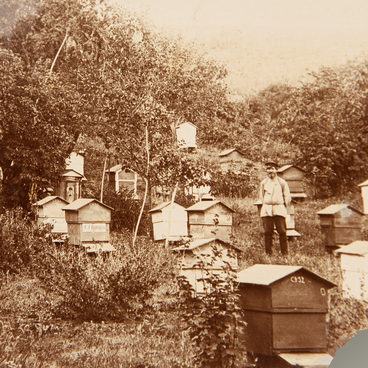
Photo of the apiary in Ilyinovka
#48
At the end of the 19th century, manors of the nobility were transformed into a kind of agricultural complexes, where peasants were engaged in crop growing, cattle breeding and forestry. Bee-keeping was an important part of the estate economy. According to the statistics published in 1901 in the book of P. G. Chefranov “Russian apiculture by the beginning of the 20th century”, there were 328,000 apiaries, or 5, 289,000 bee families in the Russian Empire in the year 1900. Of these, only 13% were kept in frame hives, while the rest were kept in unassembled hives according to old technology (bee-trees, log hives, skeps). The bee-trees and log hives housed the bees inside a hollowed-out tree trunk. A skep is a hive made of wicker or straw, often coated in clay for better insulation. It is depicted on the coat of arms of Tambov and the Tambov region.
Initially, beekeeping originated as wild-honey farming, i.e. collecting honey and wax from wild bees. Later, bees began to be kept in apiaries. Many estates at that time had their own apiaries. Apiculture on the landowners’ estates was not very different from that on the peasants’ ones, but the apiaries of the first were, of course, better organized, because the landlords had more money to maintain them. The care of the apiary was entrusted to a professional beekeeper, whose diligence and conscientiousness determined both the condition of the apiary and the level of income from it.
The Boratynskys’ apiary in Ilyinovka in the late 19th and early 20th centuries was managed by Mikhail Nesterovich Zaveryachev, an uncle of M. A. Zaveryachev, the manager of the estate. The photo shows that the apiary on the Boratynskys’ estate was state-of-the-art for its time: most of the hives are of modern design, with frames; there are only a few log hives in the apiary.
The system of log hive beekeeping survived in Russia until the 20th century. The world’s first collapsible frame hive was invented by our compatriot P. I. Prokopovich in January 1814. But, despite its ease of use, the frame beehive was introduced in apiaries very slowly in Russia. Even in 1910, almost a hundred years after the invention of the frame hive, only 35% of almost 6 million bee families in Russia were kept in such hives.
#45
Name: Photo of the apiary in Ilyinovka
Date of creation: the early 20th century
Place of creation: Kirsanovsky District, the Russian Empire
Technique: photography
Dimensions: 9,9×11,2 cm
Date of creation: the early 20th century
Place of creation: Kirsanovsky District, the Russian Empire
Technique: photography
Dimensions: 9,9×11,2 cm
#72

Diploma of V.M. Zaveryachev
#29
The estates of the Boratynskys and Chicherins in Kirsanov District were home to a whole dynasty of managers — the Zaveryachevs. The ancestor of the dynasty, Andrey Nesterovich Zaveryachev, was valet to the Boratynskys at Ilyinovka. Noted by his lords for being literate, honest and efficient, he was later appointed the manager of the estate. Andrey Nesterovich had nine children. Two of his sons later became managers as well: Ivan Andreevich worked for the Chicherins in Karaul, Tambov Governorate, and Mikhail Andreevich — in Ilyinovka, after his father retired.
The brother of Andrey Nesterovich, Mikhail, also worked for the Boratynskys: he was a beekeeper in Ilyinovka. Mikhail Andreeevich had three sons: Vladimir, Sergey and Vasily. The eldest son Vladimir was an amateur photographer. While studying at the Technological Institute of Emperor Nicholas I in Saint Petersburg he was involved in the activities of the photographic society of that institute.
The Kirsanov Local History Museum houses awards of Vladimir Mikhailovich — diplomas for the competition organized by the photographic society in 1913. At the exhibition arranged by the photographic society in December 1913 the photographer was awarded the First Degree Diploma (silver badge) for his work entitled “Portrait in the Room — Portrait”, the Second Degree Diploma (large silver badge) for his color photograph (autochrome) “Dawn is Fading”. He also received commendation for his color photography works “Etude” and “Nature Morte” and his excellent skill of using the technique of autochrome process.
Vladimir Zaveryachev’s hobby was quite in the spirit of that age. Russia’s first contact with the art of photography occurred in 1839, after the Russian scientist Joseph Christian Hamel visited London to see the inventor William Talbot. Since then, photography in Russia gained popularity and was rapidly developing. At the turn of the 20th century, Russian photographers were full-fledged participants of international exhibitions and salons, as well as members of international photographic societies. At the same time, their works received the most prestigious prizes and awards.
The owner of the Ilyinovka estate, Mikhail Andreevich Boratynsky, was known to be passionate about photography too. He created a photo chronicle of his family. In 1912, he took part in an international photo exhibition, as evidenced by the archival documents and the catalog of his works.
#73
Name: Diploma of V.M. Zaveryachev
Date of creation: October 1913
Place of creation: Saint Petersburg, the Russian Empire
Technique: printing, manuscript
Dimensions: 22×27 cm
Date of creation: October 1913
Place of creation: Saint Petersburg, the Russian Empire
Technique: printing, manuscript
Dimensions: 22×27 cm
#46
Ministry of Culture of the Russian Federation
read morehide
00:00
00:00
1x
Photos and documents of M.A. Zaveryachev
Collection
0
 Point your smartphone camera to open in the app
Open in app
Share