The first technical device that allowed people to capture images of the world around them was the pinhole camera, also known as the camera obscura. This simple device served as the foundation for all modern cameras. Essentially, a pinhole camera was just a box with a small hole in one of its walls.
In the 1820s, the French inventor Joseph Nicéphore Niépce began experimenting with heliography, a technique that used light to create images on a surface. It is his 1826 photograph “View from the Window at Le Gras” that is the earliest surviving heliographic engraving. The French artist and inventor Louis Daguerre continued to improve the technique. He developed his own photographic process using the vapor given off by mercury. Another Englishman, William Henry Fox Talbot, also made significant advancements in the quality of photographic images.
In 1861, the English photographer and inventor Thomas Sutton created the first single lens reflex camera. In 1883, George Eastman replaced glass plates with a film roll. Several years later, he founded the Kodak company in the United States.
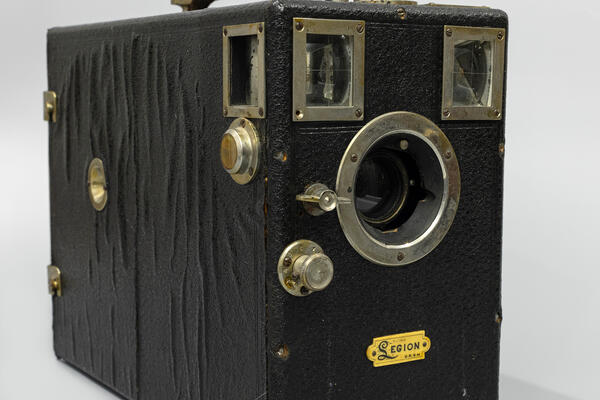
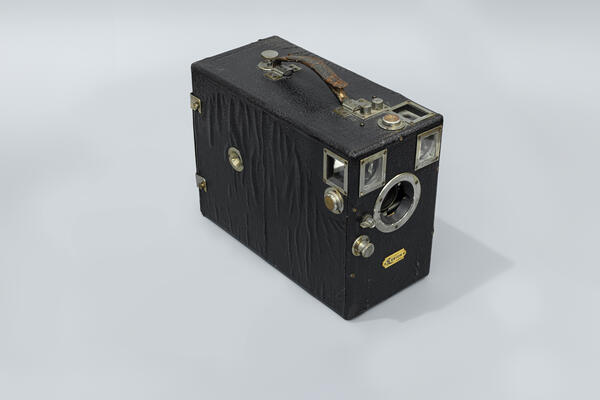
The box camera from the museum collection was made in the early 20th century. Its body was constructed from wood and covered in leatherette. Such cameras were commonly used for taking pictures of landscapes and portraits. Instead of plates, they used a film roll.
The first series of such cameras was released by the American company Eastman Kodak and was known as “the Brownie”. The name was chosen because the camera was initially aimed at children. It was inspired by the popular illustrated stories by the Canadian writer Palmer Cox. The Brownies were creatures from British mythology who were believed to appear at night. The camera was invented by Frank A. Brownell.
The Brownie was introduced to the market in 1900. In 1901, such a camera cost only two dollars. To put this into perspective, two dollars were enough to buy about six kilograms of beef in the United States. Travelers often took cameras on their trips. For example, one such camera was used to photograph the iceberg that sank the Titanic. The Russian Imperial Family also owned a Brownie camera, which Nicholas II used frequently.
Box cameras were
produced by various companies for many years. In the 1930s, such cameras were manufactured
by German companies in Munich, Braunschweig, and Berlin.