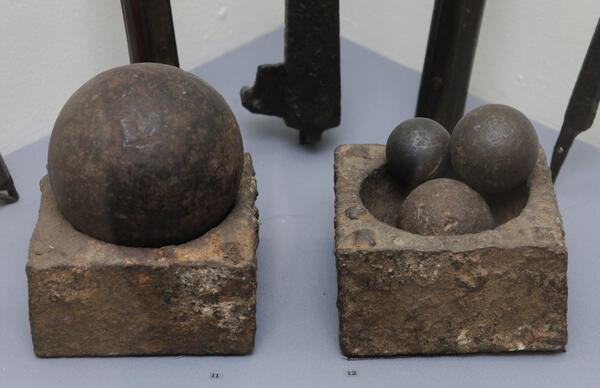
The 15th and 16th centuries saw a rapid development in artillery. In just these two centuries, the effectiveness of gunfire was significantly increased, cast iron production expanded and the methods of casting guns greatly improved. The metal molds for casting cannonballs presented in the Historical and Memorial Museum of the Demidovs are also directly linked to the history of cast iron production and stood witness to the advancement of the technologies and craft of making castings.
With the emergence of cast artillery weapons in Russia, came the demand for a huge number of cannonballs of exact size and mass. The existing method of casting cannonballs in sand no longer met the increased requirements (sand casting is the oldest technology of casting metals into a special sand-and-clay mixture, actively used in both small and large factories). This was when a new and original process of producing cast-iron cannonballs appeared in 16th-century Russia. It was based on casting into metal molds called coquilles.
It was a multi-step process. The first step was to pour the molten metal into a casting mold, where it would solidify and retain the shape of the mold. Metal would flow inside the mold cavity, where its outer surfaces would form. The mold cavity is an imprint of the model. After the mold is made, the model is extracted from it, and the cavity is formed in the mold. The sections of the mold corresponding to the internal elements of the casting (holes, recesses, etc.) should be closed and not let the molten metal in. This is achieved by installing rods that remain in place when pouring metal. In addition, the casting mold must have a gating system — a set of channels through which the molten metal from the casting ladle enters the inner cavity. Molding is a set of technological operations for the production of a mold. The main molding operations are filling the molding frame with a molding mixture, compacting it, removing the model, installing rods and assembling the mold. The lower half-mold is turned over, the surface of the mold connector is sprinkled with fine separating sand. The upper half is laid on top of the molded lower half and their mutual positions are fixed with the help of spikes with corresponding holes on the top and the lower halves.