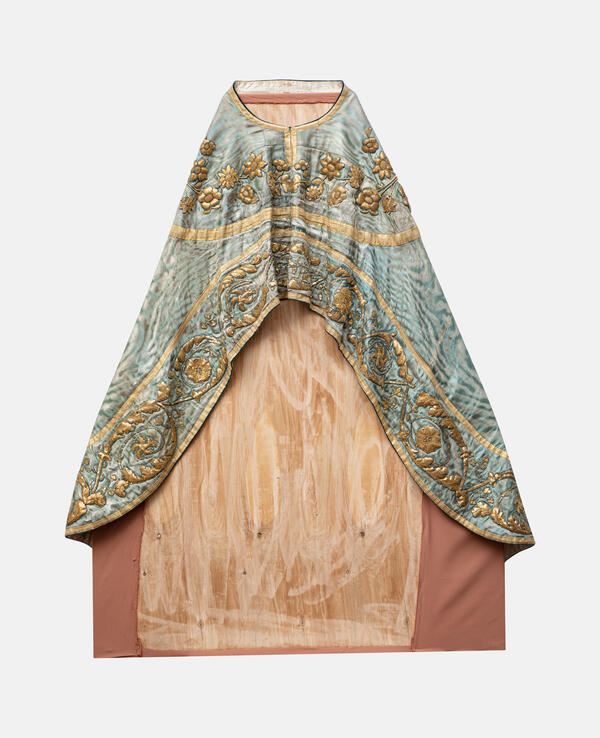
A phelonion, or a chasuble, is a liturgical vestment, which is worn over other garments for the performance of divine services.
During the earthly life of Christ, chasubles were everyday outerwear, worn by Jesus Himself and His disciples. A chasuble resembles the phelonion and the scarlet robe, in which the soldiers clothed the Savior and about which lots were cast at the cross. Thus, these vestments serve as a reminder of the Sacrifice of Christ. The significance of the chasuble is described in a psalm as follows: “Let Your priests be clothed with righteousness, and let Your saints shout for joy” (Ps. 131:9).
Initially, the phelonia were soft capes with a round neckline. In the 16th–17th centuries in Russia, the rear, upper edge of the phelonion began to be made of rigid brocade or lighter fabric with a hard lining, so that it had the form of a truncated triangle, rising above the shoulders.
Several phelonia and sticharia entered the museum’s collection in the 1920s, when the monasteries were being closed down. A set of two sticharia and a phelonion from the Dormition Convent came to the museum in 1929.
In museum documents, this set is listed as a “gift of the empress to the monastery, ” however, it does not name the donor. Presumably, she could have been the wife of Nicholas II, Alexandra Feodorovna. Shortly after the death of Alexander III, Nicholas II was proclaimed Emperor of Russia and married Alexandra Feodorovna in the Grand Church of the Winter Palace in 1894. After the wedding the mourning period was reinstated.
At that time, by order of Alexandra Feodorovna, the sets of vestments could be commissioned from workshops run by monks and sent to monasteries as a donation.
The general appearance of the phelonion symbolizes the radiance of Divine glory and the fortress of Divine light: the Greek word φαιλόνιο (φαινόλης) means “to shine”. For this reason, in ancient times, phelonia were made exclusively of white fabrics. In the presented exhibit, gold and silver brocade was used to make the garment shine.
Light-blue (as well as darker blue) is traditionally
considered by the Church to be the color of the Theotokos, the highest purity
and innocence, and is associated with a number of feasts: the Nativity of the
Most Holy Theotokos, the Presentation, the Annunciation, the Deposition of the
Robe, the Dormition of the Mother of God, the Intercession, as well as the days
of veneration of Theotokos icons.