

#19
Photos Of Yelets
#34
#21
#22
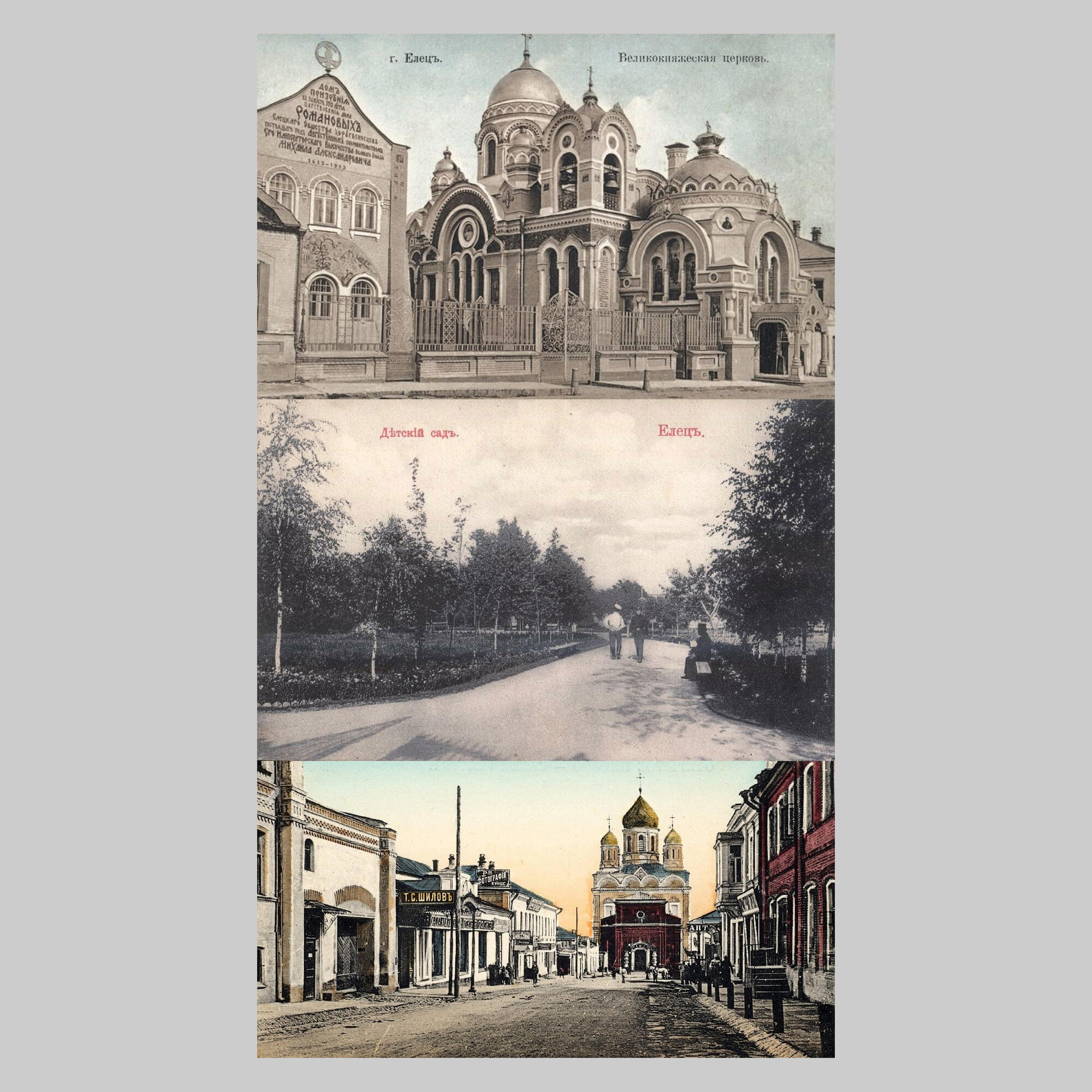
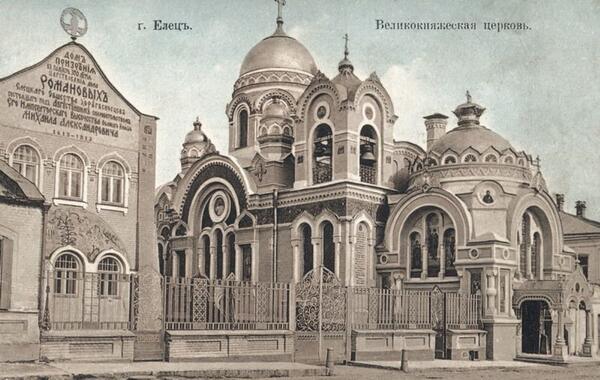
Velikoknyazheskaya Church was built thanks to the honorary citizen of Yelets, merchant and manufacturer Alexander Zausaylov. He contributed a lot to make the city look more beautiful in many locations, but the Velikoknyazheskaya Church and the House of Charity became truly the best landmarks of Yelets. In 1883, the Tsar’s Chapel was built in Uspenskaya street according to the project of Alexander KamInsky in memory of Alexander II, called the Liberator, who was killed by the rebels, later this chapel became a kind of a back of the Church.
The idea of building a church in the name of the Holy Princes MikhaIl Tverskoy and AlexAnder Nevsky came to Zausaylov after the brother of Nicholas II, MikhaIl Romanov, visited Yelets on 2 October 1909. Russia was preparing to celebrate the 50th anniversary of the 1861 Peasants Liberation Manifest issued by his grandfather Alexander II. The project of the church was developed by the architect Wilford, from OryOl. The construction was completed within a surprisingly short period — a year and three months. The construction was not interrupted even in the cold season: a huge heated tent was erected over the construction site. All the technical innovations of the early 20th century were also used: concrete arches, electricity, automatically removable seats, water heating, water supply. The northern and western entrances to the church were decorated with openwork cast-iron porches on the pillars. The boiler room was located under a neighboring building, and radiators were installed in the basement to heat the air which was raising up, through the wall channels, to the church.
The idea of building a church in the name of the Holy Princes MikhaIl Tverskoy and AlexAnder Nevsky came to Zausaylov after the brother of Nicholas II, MikhaIl Romanov, visited Yelets on 2 October 1909. Russia was preparing to celebrate the 50th anniversary of the 1861 Peasants Liberation Manifest issued by his grandfather Alexander II. The project of the church was developed by the architect Wilford, from OryOl. The construction was completed within a surprisingly short period — a year and three months. The construction was not interrupted even in the cold season: a huge heated tent was erected over the construction site. All the technical innovations of the early 20th century were also used: concrete arches, electricity, automatically removable seats, water heating, water supply. The northern and western entrances to the church were decorated with openwork cast-iron porches on the pillars. The boiler room was located under a neighboring building, and radiators were installed in the basement to heat the air which was raising up, through the wall channels, to the church.
The interior of the temple looks even more impressive, the church walls and arches are completely covered with majolica tiles that imitate mosaics. The iconostasis was also made of majolica. The Sanctuary Doors were silver, and the icons were made with the use of oil painting technique. Along with colored stained glass windows, the interior, especially at night, when candles are lit in the temple, flickers and shimmers with the lights making its fabulous beauty. The floor was parquet, and the walls were paneled with oak slats. The church was consecrated on 11 February 1911. The parishioners were members of the banner bearers society. For the 300th anniversary of the Romanov dynasty, in just a year, from 1912 to 1913, Zausaylov built a Charity House next to the church - a shelter for the poor, designed by the famous painter and muralist Viktor Vasnetsov.
The idea of building a church in the name of the Holy Princes MikhaIl Tverskoy and AlexAnder Nevsky came to Zausaylov after the brother of Nicholas II, MikhaIl Romanov, visited Yelets on 2 October 1909. Russia was preparing to celebrate the 50th anniversary of the 1861 Peasants Liberation Manifest issued by his grandfather Alexander II. The project of the church was developed by the architect Wilford, from OryOl. The construction was completed within a surprisingly short period — a year and three months. The construction was not interrupted even in the cold season: a huge heated tent was erected over the construction site. All the technical innovations of the early 20th century were also used: concrete arches, electricity, automatically removable seats, water heating, water supply. The northern and western entrances to the church were decorated with openwork cast-iron porches on the pillars. The boiler room was located under a neighboring building, and radiators were installed in the basement to heat the air which was raising up, through the wall channels, to the church.
The idea of building a church in the name of the Holy Princes MikhaIl Tverskoy and AlexAnder Nevsky came to Zausaylov after the brother of Nicholas II, MikhaIl Romanov, visited Yelets on 2 October 1909. Russia was preparing to celebrate the 50th anniversary of the 1861 Peasants Liberation Manifest issued by his grandfather Alexander II. The project of the church was developed by the architect Wilford, from OryOl. The construction was completed within a surprisingly short period — a year and three months. The construction was not interrupted even in the cold season: a huge heated tent was erected over the construction site. All the technical innovations of the early 20th century were also used: concrete arches, electricity, automatically removable seats, water heating, water supply. The northern and western entrances to the church were decorated with openwork cast-iron porches on the pillars. The boiler room was located under a neighboring building, and radiators were installed in the basement to heat the air which was raising up, through the wall channels, to the church.
The interior of the temple looks even more impressive, the church walls and arches are completely covered with majolica tiles that imitate mosaics. The iconostasis was also made of majolica. The Sanctuary Doors were silver, and the icons were made with the use of oil painting technique. Along with colored stained glass windows, the interior, especially at night, when candles are lit in the temple, flickers and shimmers with the lights making its fabulous beauty. The floor was parquet, and the walls were paneled with oak slats. The church was consecrated on 11 February 1911. The parishioners were members of the banner bearers society. For the 300th anniversary of the Romanov dynasty, in just a year, from 1912 to 1913, Zausaylov built a Charity House next to the church - a shelter for the poor, designed by the famous painter and muralist Viktor Vasnetsov.
#25
Full name: Velikoknyazheskaya Church. Photocopy
Author: Ivanov Sim Egorovich
Date: 2010 year
Technique: photography
Dimensions: 10×15 cm
Collection: Yelets Local History Museum
Copyright: Yelets Local History Museum
Author: Ivanov Sim Egorovich
Date: 2010 year
Technique: photography
Dimensions: 10×15 cm
Collection: Yelets Local History Museum
Copyright: Yelets Local History Museum
#35
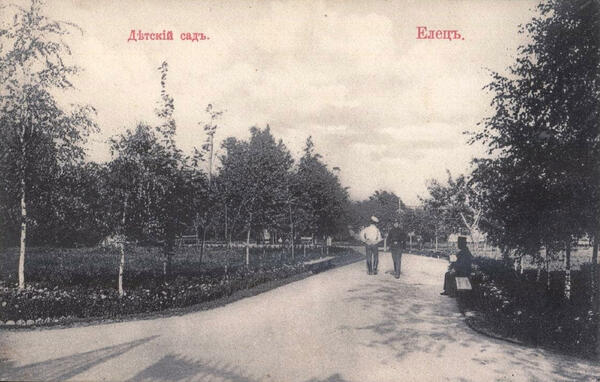
Children’s Park
#26
#27
Children’s park is a favorite place for any child. Carousels, swings, all kinds of amusements, beautifully trimmed bushes, nice flower beds. In Bunin’s days, the Truzzi Circus often gave their performances here, even in winter. The circus was founded and maintained by a family of talented jugglers and horse trainers, descendants of one of the oldest Italian circus families. At that time, the three Truzzi brothers performed in the circus: Rudolfo — an outstanding horse trainer and excellent administrator, Gigetto was a talented jockey and Enrico was a first-class juggler on a horse. It was him who began to juggle with burning torches when standing on the horse back, for the first time in the history of circus. From 1881 to 1896, the circus gave performances in Oryol, Yelets, Kursk, Mogilyov, and Moscow. Contemporaries noted that Truzzi Circus had very good discipline, like none of the circuses that worked in Russia had. The performance began as a sacrament. The program was arranged in a way to have each artist engaged several times during one performance, so that no one in the circus remained idle. This circus began the history of the Durov circus dynasty and the career of the famous strongman Ivan PoddUbny. The lion tamer Miss Cora also performed at the Truzzi Circus.
#28
‘We spent that evening inside the huge and cold circus tent of the Truzzi brothers… Clowns with flour-white faces and orange hair, wearing huge trousers briskly, like parrots, rushed into the stage and awkwardly fell on the sand: behind them a white horse was running heavily, on its wide back there was a short-legged woman in a pink leotard, with tight thighs under a ballet skirt. Music was hammering out with a carefree prowess: “Ivushka, Ivushka, my green one”, a handsome black-bearded director wearing a tailcoat, boots, and a top hat was standing and turning round in the middle of the stage, he had a long whip, and smacked it evenly and wonderfully, the horse sharply arching its neck, all leaning on one side, galloped heavily along the very edge of the circle, the woman was springing on its back, and suddenly with a short cry, she made a huge leap up and with broke through the paper shield raised in front of her by the stall masters.’ When, after the applause of the audience, the rider was leaving the stage, the music stopped, ‘and the circus froze in sweet horror: the stall masters ran behind the arena, dragging a huge iron cage behind them. And behind the scene suddenly the terrible roar was heard… and then such a powerful royal breath-out followed, that the entire Truzzi circus tent was shaking to its foundations…’
Bunin I.A. ‘Arseniev’s life’
#29
Full name: Children’s Park. Photocopy from a post card
Author: Ivanov Sim Egorovich
Date: 2010 year
Technique: photography
Dimensions: 10×15 cm
Collection: Yelets Local History Museum
Copyright: Yelets Local History Museum
Author: Ivanov Sim Egorovich
Date: 2010 year
Technique: photography
Dimensions: 10×15 cm
Collection: Yelets Local History Museum
Copyright: Yelets Local History Museum
#36
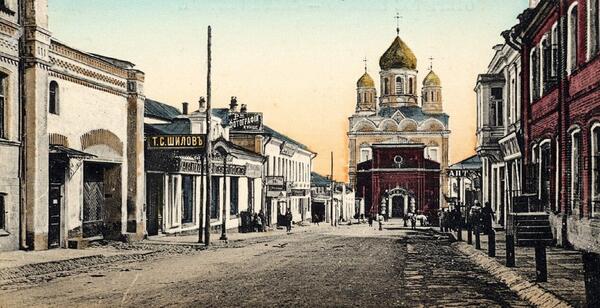
Orlovskaya street
#31
#32
OrlOvskaya street is one of the central streets of our city. It begins from the Ascension Cathedral and goes to the west to the exit out of the city. The City Garden and the Children’s Park, the fire tower, the hospital and the prison, the fence and the bell tower of the former Trinity Monastery are all situated in this street.
In his famous novel, Bunin calls it, apparently because of its length, Dolgaya street (Dolgaya means “long” in Russian), and gives a description of this street in a warm Saturday evening: “Dolgaya street was straight as an arrow, it was leading out of the city - up to the prison and the monastery, it was sinking in the dust and the blinding glare of the sun, which was going down just at the end of its span, and in this dusty gold flows there are people walking and riding, returning from the trotting races for which the city is also famous — and how many dandies are there, among calligraphists and clerks, how many young ladies dressed up like paradise birds, how many smart carriages, in which there are young merchants sitting next to their young wives and holding back their trotters! And in the Cathedral the bells are ringing for the Vigil, and bearded, dignified coachmen sitting on the heavy and quiet carriages, …are carrying old merchant wives with wax candles in their hands, looking strange either because of their yellow plumpness and abundance of jewelry, or with their sepulchral whiteness and thinness… “
Bunin I.A. “Arseniev”s Life”
Nataly, a home-serf maid from Sukhodol, whom her lords sent to a distant farm as a punishment, saw this street looking like this: “What she could remember were the places in the city streets paved with stones, on which the carriage was rattling in a strange way, and the smell of iron roofs all over the streets… Natasha was sitting sat motionlessly, and kept looking at the dome of the newly built cathedral, which burned like a huge silver star somewhere far behind the houses … Ahead there was a white, bare street, white pavement, white houses — and all this was enclosed with a huge white Cathedral under a new white-tin dome, and the sky above it became pale blue, dry…. And Natashka was looking astonishingly at all those well-dressed people walking up and down the stones near the houses, gates, and shops with their doors open… “And why did Yevsei decided to go here, ” she thought, “ how did he decide to make so much noise with his rattling carriage here?”
Bunin I.A. “Dry valley”
In the evening there usually were festivities in the city park: “… I was stunned by the huge crowd, slow-moving along the main alley with, smelling with dust and cheap perfume, meanwhile in the end of the alley, inside a shell-shaped pavilion there was a military orchestra playing waltz, with its snarling and rattling copper pipes and drums”.
Bunin I.A.“Arseniev’s Life’
In various Bunin’s stories the Orlovskaya street was mentioned under different names - Cathedral street, Monastery street, Prison street.
In his famous novel, Bunin calls it, apparently because of its length, Dolgaya street (Dolgaya means “long” in Russian), and gives a description of this street in a warm Saturday evening: “Dolgaya street was straight as an arrow, it was leading out of the city - up to the prison and the monastery, it was sinking in the dust and the blinding glare of the sun, which was going down just at the end of its span, and in this dusty gold flows there are people walking and riding, returning from the trotting races for which the city is also famous — and how many dandies are there, among calligraphists and clerks, how many young ladies dressed up like paradise birds, how many smart carriages, in which there are young merchants sitting next to their young wives and holding back their trotters! And in the Cathedral the bells are ringing for the Vigil, and bearded, dignified coachmen sitting on the heavy and quiet carriages, …are carrying old merchant wives with wax candles in their hands, looking strange either because of their yellow plumpness and abundance of jewelry, or with their sepulchral whiteness and thinness… “
Bunin I.A. “Arseniev”s Life”
Nataly, a home-serf maid from Sukhodol, whom her lords sent to a distant farm as a punishment, saw this street looking like this: “What she could remember were the places in the city streets paved with stones, on which the carriage was rattling in a strange way, and the smell of iron roofs all over the streets… Natasha was sitting sat motionlessly, and kept looking at the dome of the newly built cathedral, which burned like a huge silver star somewhere far behind the houses … Ahead there was a white, bare street, white pavement, white houses — and all this was enclosed with a huge white Cathedral under a new white-tin dome, and the sky above it became pale blue, dry…. And Natashka was looking astonishingly at all those well-dressed people walking up and down the stones near the houses, gates, and shops with their doors open… “And why did Yevsei decided to go here, ” she thought, “ how did he decide to make so much noise with his rattling carriage here?”
Bunin I.A. “Dry valley”
In the evening there usually were festivities in the city park: “… I was stunned by the huge crowd, slow-moving along the main alley with, smelling with dust and cheap perfume, meanwhile in the end of the alley, inside a shell-shaped pavilion there was a military orchestra playing waltz, with its snarling and rattling copper pipes and drums”.
Bunin I.A.“Arseniev’s Life’
In various Bunin’s stories the Orlovskaya street was mentioned under different names - Cathedral street, Monastery street, Prison street.
#33
Full name: Orlovskaya street. Photocopy
Author: Ivanov Sim Egorovich
Date: 2010 year
Technique: photography
Dimensions: 10×15 cm
Collection: Municipal budgetary institution of culture ‘Yelets Local History Museum’
Copyright: Municipal budgetary institution of culture ‘Yelets Local History Museum’
Author: Ivanov Sim Egorovich
Date: 2010 year
Technique: photography
Dimensions: 10×15 cm
Collection: Municipal budgetary institution of culture ‘Yelets Local History Museum’
Copyright: Municipal budgetary institution of culture ‘Yelets Local History Museum’
read morehide
00:00
00:00
1x
0
 Point your smartphone camera to open in the app
Open in app
Share