Font
Color
Graphics
Изображение точки

To see AR mode in action:

1. Install ARTEFACT app for iOS or Android;

2. Find the exhibition «The Music Ark»

3. Push the «Augmented reality» button and point your phone's camera at the exhibit;

Скрыть точки интересаПоказать точки интереса
Показать в высоком качестве

Four-stringed prima domra, Prima balalaika

Exhibition
0
Open in app
#1

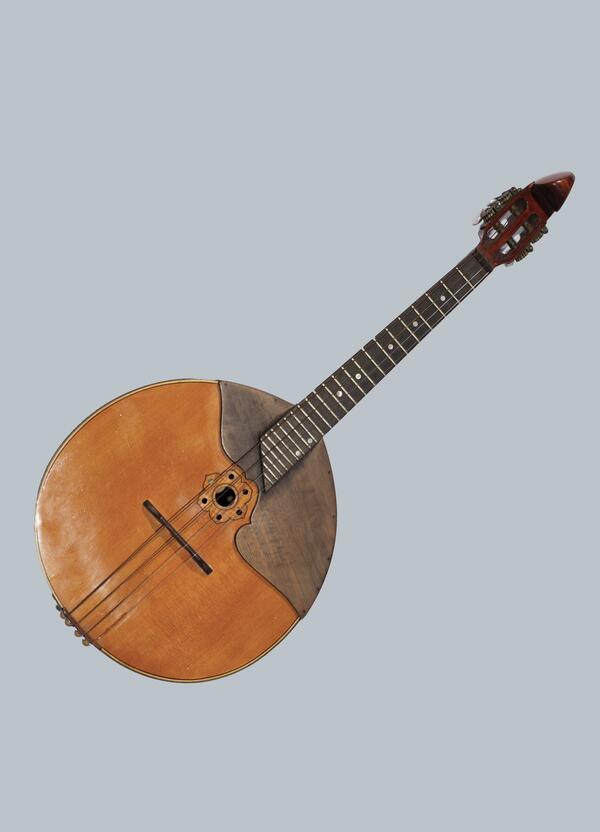
Four-stringed prima domra

#5

Igor Yemelyanov (1930–1991) belonged to a dynasty of musical instrument makers which had been made famous by his father Vladimir Yemelyanov, Sergey and Matvey Burovs, and Yevgeny Grachev. Several generations of this family produced balalaikas, guitars, domras, and mandolins.

Having received initial training at his father’s workshop, Yemelyanov created his first four-string domra at the age of 17. The instrument was accepted by the Moscow Experimental Music Workshop. Yemelyanov worked there between 1947 and 1974 and later continued working with the Moscow Experimental Factory at home.

The craftsman’s wife Nina Yemelyanova recalled that he was a workaholic who did not tolerate any low-quality work and spent many hours at the workbench. Whenever possible, he would purchase old instruments, disassemble them, examine them in detail, and make improvements to his own products.

Yemelyanov specialized in making guitars, domras, and balalaikas of all kinds. He manufactured around two and a half thousand instruments for solo performers and orchestras. The craftsman took particular pride in his three- and four-string domras tuned in fourths and fifths respectively. The outstanding domra player Tamara Volskaya recalls that when Yemelyanov worked with individual musicians, he sought to find out what kind of sound the customer wanted for their instrument.

Tamara Volskaya owns three domras made by Yemelyanov. She notes that his instruments are distinguished not only by their clean and unique sound, but also by their noble shapes, careful finish, and the distinctive elegance of their curled heads.

The domra is one of the important instruments in the folk ensembles of Russia, Ukraine, and Belarus. The Russian folk instrument orchestra features one piccolo domra, more than four alto domras, between three and six bass domras, and up to 20 prima domras. The latter usually perform solos accompanied by the piano, bayan, or guitar.

Steel domra strings are most common, while the ones with a synthetic core are used less often. The silk wrapping around the third string gives the instrument a unique sound.

The displayed domra belonged to Gennady Ivanov (1937–1993), a balalaika performer, a teacher at Barnaul Music College, a leading domra expert in the Altai Krai, and an organizer of the region’s first domra ensemble.
#4
Name: Four-stringed prima domra
Author: Igor Yemelyanov
Date of creation: 1962
Place of creation: the USSR
Technique: wood, metal, mother of pearl; factory production, handmade
Dimensions: 61×27×15 cm
№: 38793891
#2
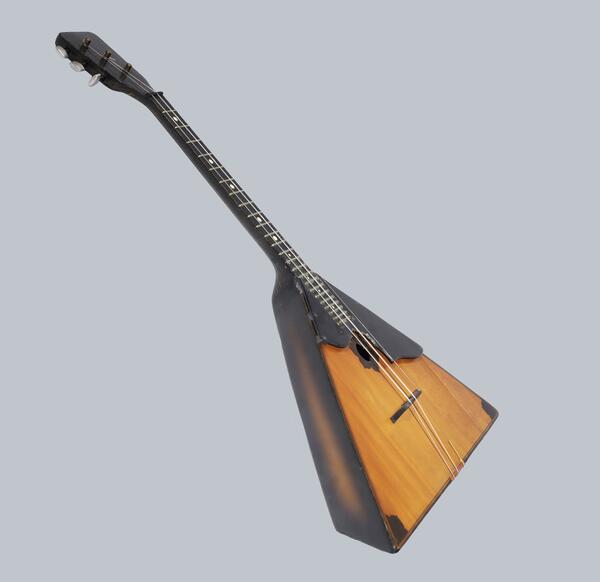
Prima balalaika
#7

According to the virtuoso balalaika player Vladimir Bakitko, a successful performance depends on three main factors: the choice of repertoire, the skills of the musician, and the quality of the instrument. He once described his balalaika which he had played for over three decades,“This one is already an antique. It has a very nice, very soft sound…”Nowadays, this time-honored instrument is displayed at the museum.

There are several etymological theories as to where the word “balalaika” came from. According to one of them, the instrument got its name from the words “balakat” (to blab) and “balagurit” (to joke). The balalaika itself was not taken seriously for a long time.

Before the balalaika appeared, street performers played the domra which accompanied their satirical and sometimes rather impudent verses. Tsar Alexis of Russia banned the use of domra, gusli, and other “demonic instruments” which made them disappear almost completely. Instead of them, the common people started playing a new instrument with two strings and a long fretboard. The body was made of gourds, hollowed-out scoops, or other improvised materials. Even in the 18thcentury, there were instruments with both triangular and rounded bodies.

In the sophisticated 19thcentury, interest in the balalaika almost died out. The instrument was saved from oblivion by the enlightener Vasily Andreyev. He found craftsmen who restored and improved the three-stringed instrument. They included Franz Paserbsky and Semyon Nalimov. Andreyev approved the triangular shape of the body and the size of the deck. Taking into account the quality of the wood, he decided to make the soundboard of spruce and the back of beech. Franz Paserbsky developed a series of balalaikas, which formed the basic Russian folk orchestra: prima, piccolo, tenor, alto, bass, and contrabass.

In 1888, with the support of Emperor Alexander III, Andreyev presented his balalaika band in St. Petersburg.

While it was earlier used only by the common people, with Andreyev’s help the balalaika became a respected concert instrument with a wide range of possibilities. Vladimir Bakitko said in an interview,

#8

I… treat the audience with understanding. In choosing the repertoire I tend to be… very cautious. I stick to the traditional repertoire. I prefer simpler songs… so that the Russian people do not forget the balalaika.

#9

Despite his diverse repertoire and virtuosic skills, Bakitko does not claim to be a performer for sophisticated listeners and believes that his mission is “to help the audience have some fun.”

#6
Name: Prima balalaika
Date of creation: 1957
Place of creation: Leningrad, the USSR
Technique: wood, metal, polymer composition; factory production
Dimensions: 66×42×11 cm
№: 38793888
#3
read morehide

Four-stringed prima domra, Prima balalaika

Exhibition
0
Point your smartphone camera to open in the app
Share
VkontakteOdnoklassnikiTelegram
Share on my website
Copy linkCopied
Copy
Open in app
To see AR mode in action:
  1. Install ARTEFACT app for 
  2. iOS or Android;
  3. Find and download the «Paintings in Details» exhibition
  4. Push the «Augmented reality» button and point your phone's camera at the painting;
  5. Watch what happens on your phone screen whilst you flip through the pictures.
 
We use Cookies
Cookies on the Artefact Website. We use cookies to ensure that we give you the best experience on our website. If you continue without changing your settings, we'll assume that you are happy to receive all cookies on the Artefact website. However, if you would like to, you can change your cookie settings at any time.
Learn more about useHide
Content is available only in Russian

X

Нашли опечатку?...

%title%%type%