#6
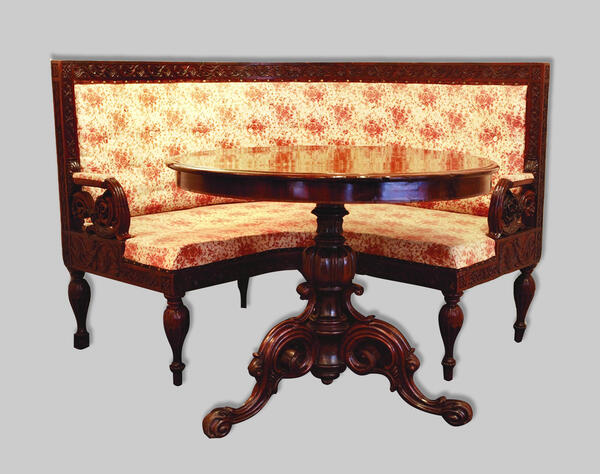
A sofa and a table, a table
#13
#7
#8
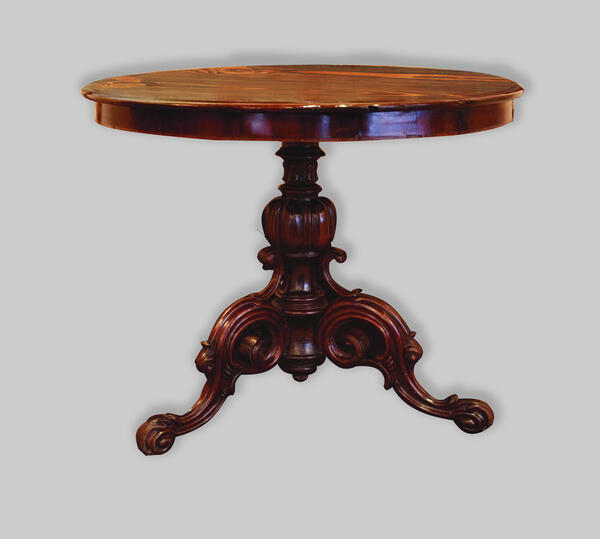
An antique polished table with a round top and curly legs was donated to the Omsk State Museum of History and Local Lore by MargarIta DolInino-Ivnskaya, granddaughter of Andrei Stackenschneider in 1961. Later, the piece became a part of the collection of the Omsk State Dostoevsky Literature Museum.
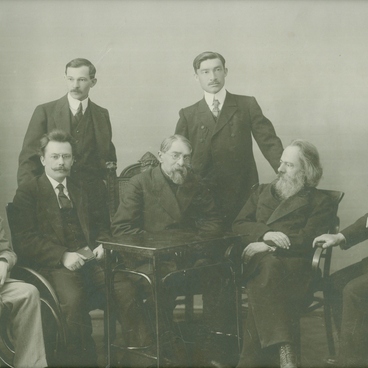
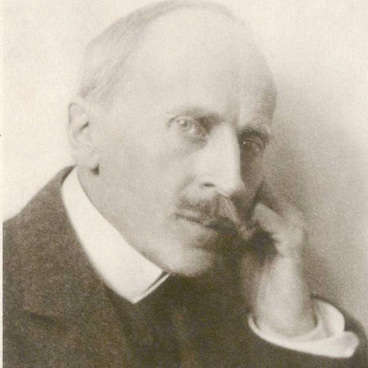
Andrei Stackenschneider was a famous Saint Petersburg architect. His house was one of the most famous literary and artistic salons in the city. The so-called ‘Saturdays’ hosted by StAckenschneider were attended by Fyodor Dostoevsky, Ivan Goncharov, Ivan Turgenev, and many other creatives. Young artists, architects, and actors would often show up. The dining room was used for giving amateur performances.
Dostoevsky made acquaintance with Andrei Stackenschneider in 1860 and quite often visited his literary salon ever since. The salon’s host was Stackenschneider’s elder daughter Elena. DostoEvsky’s friendship with her was one of the brightest spots in his life. Leo Panteleev, a publisher and social activist who would also often visit the salon in the early 1860s, shared his memory of her: “Back in my days, the life and soul of the “Saturdays” was elder daughter Elena. She was an extremely nice person very good at literature, and she had a sharp feeling for art.’ ‘Every Tuesday, she received many outstanding literary figures who recited their works. …Fyodor Mikhailovich loved and respected Elena Andreyevna a lot for her eternal kindness and modesty, ’ claimed Anna Dostoevskaya, the writer’s second wife.
This is what writer Lidia Veselitskaya (who wrote under the pen-name V. Mikulich) noted about Elena Stackenschneider: “Clever, kind, and welcoming… nice, gentle but not unctuous, kind but not expansive, clever but not arrogant.”
The StAckenschneiders and the Dostoevskys bonded a lot and carried on a correspondence. It is known that Elena’s brother Adrian, a trained lawyer, gave Dostoevsky advice when the latter was working on the episodes of the trial of DmItry Karamazov. In addition to that, Dostoevsky was a godfather of Boris, Stackenschneider’s grandson.
Dostoevsky frequented the Stackenschneider salon until 1862 when the Stackenschneider family moved to Gatchina suburbs. Their meetings almost stopped but the thread was picked up in the early 1870s through the mediation of Dostoevsky’s good friend, writer Mikhail Pokrovsky.
On January 27, 1881, Elena Stackenschneider and Dostoevsky met one last time when she came to see the writer on his deathbed.
Andrei Stackenschneider was a famous Saint Petersburg architect. His house was one of the most famous literary and artistic salons in the city. The so-called ‘Saturdays’ hosted by StAckenschneider were attended by Fyodor Dostoevsky, Ivan Goncharov, Ivan Turgenev, and many other creatives. Young artists, architects, and actors would often show up. The dining room was used for giving amateur performances.
Dostoevsky made acquaintance with Andrei Stackenschneider in 1860 and quite often visited his literary salon ever since. The salon’s host was Stackenschneider’s elder daughter Elena. DostoEvsky’s friendship with her was one of the brightest spots in his life. Leo Panteleev, a publisher and social activist who would also often visit the salon in the early 1860s, shared his memory of her: “Back in my days, the life and soul of the “Saturdays” was elder daughter Elena. She was an extremely nice person very good at literature, and she had a sharp feeling for art.’ ‘Every Tuesday, she received many outstanding literary figures who recited their works. …Fyodor Mikhailovich loved and respected Elena Andreyevna a lot for her eternal kindness and modesty, ’ claimed Anna Dostoevskaya, the writer’s second wife.
This is what writer Lidia Veselitskaya (who wrote under the pen-name V. Mikulich) noted about Elena Stackenschneider: “Clever, kind, and welcoming… nice, gentle but not unctuous, kind but not expansive, clever but not arrogant.”
The StAckenschneiders and the Dostoevskys bonded a lot and carried on a correspondence. It is known that Elena’s brother Adrian, a trained lawyer, gave Dostoevsky advice when the latter was working on the episodes of the trial of DmItry Karamazov. In addition to that, Dostoevsky was a godfather of Boris, Stackenschneider’s grandson.
Dostoevsky frequented the Stackenschneider salon until 1862 when the Stackenschneider family moved to Gatchina suburbs. Their meetings almost stopped but the thread was picked up in the early 1870s through the mediation of Dostoevsky’s good friend, writer Mikhail Pokrovsky.
On January 27, 1881, Elena Stackenschneider and Dostoevsky met one last time when she came to see the writer on his deathbed.
#9
Full name: A sofa and a table from the Stackenschneider A.I. salon
Author: unknown
Date: 19-th century
Technique: wood, lacquer, material, carving
Dimensions: 107×162×220 cm
Collection: Municipal budgetary institution of culture ‘Dostoevsky Museum’
Copyright: Municipal budgetary institution of culture ‘Dostoevsky Museum’
Author: unknown
Date: 19-th century
Technique: wood, lacquer, material, carving
Dimensions: 107×162×220 cm
Collection: Municipal budgetary institution of culture ‘Dostoevsky Museum’
Copyright: Municipal budgetary institution of culture ‘Dostoevsky Museum’
#14
Round Table from the Stackenschneider A.I. salon
#10
#11
Andrei Stackenschneider was a well-known Saint Petersburg architect. His house was one of the most famous literary and artistic public salons in the city. The so-called ‘Saturdays’ hosted by Stackenschneider were attended by many famous writers including FyOdor DostoEvsky.
Dostoevsky made acquaintance with Andrei Stackenschneider in 1860 and quite often visited his literary salon ever since. He was in close relations with the architect’s children Elena and Adrian. Adrian was a lawyer. Dostoevsky made acquaintance with him in Saint Petersburg in 1873. July 21, 1874, he wrote to his wife from Bad Ems, “I recently met Stackenschneider, the one who works as a prosecutor in the Kharkiv district court. He has just married in Khariv in May and went abroad with his wife <…> He was a very simple-hearted and frank young man and very clever. He came to see me and told me that they had been in Paris, spent money there, and now were on a tight budget in order to get back home. But 5 days ago, in Zurich, a medical celebrity whom he asked to examine his slightly ailing breast accepted the request and was frightened and ordered urgently, while they were there abroad, not to waste time and take a Kränchen treatment for at least two weeks…”
July 14, 1874, Dostoevsky wrote: “Stackenschneider is sick, it seems, even more than I am. He came here for 3 weeks only since he literally cannot afford to stay here longer <…> Stackenschneider finds that my complexion got incomparably better than he remembers me in Petersburg <…> Now, he is the only person I meet, and only at the spring. We drink and walk together. In my opinion he is a lovely and heartful person <…> They invited me. And I visited them once…”
Adrian gave Dostoevsky a lawyer advice, in particular, when the latter was working on The Brothers Karamazov. The writer’s wife, Anna Dostoevskaya, wrote: ‘In the Stackenschneider family, Elena Andreevna’s brother Adrian Andreevich, a man of great intelligence and a sincere admirer of Fyodor Mikhailovich’s talent, was the most beloved one. Adrian Andreyevich, as a talented lawyer, would often give advice to Fyodor Mikhailovich when it came to the law. And Fyodor Mikhailovich owes him that in The Brothers Karamazov every detail of MItya Karamazov’s trial was so accurate that even the most malicious critic (of which there were many) would fail to find an omission or roughness’.
Working on his last novel, Dostoevsky wrote in a letter that he consulted “one prosecutor (a great practitioner).” And in a letter to Elena Stackenschneider dated July 17, 1880, Dostoevsky asked her to inform her brother, his “dear employee, ” of the publication of A Writer”s Diary.
Dostoevsky made acquaintance with Andrei Stackenschneider in 1860 and quite often visited his literary salon ever since. He was in close relations with the architect’s children Elena and Adrian. Adrian was a lawyer. Dostoevsky made acquaintance with him in Saint Petersburg in 1873. July 21, 1874, he wrote to his wife from Bad Ems, “I recently met Stackenschneider, the one who works as a prosecutor in the Kharkiv district court. He has just married in Khariv in May and went abroad with his wife <…> He was a very simple-hearted and frank young man and very clever. He came to see me and told me that they had been in Paris, spent money there, and now were on a tight budget in order to get back home. But 5 days ago, in Zurich, a medical celebrity whom he asked to examine his slightly ailing breast accepted the request and was frightened and ordered urgently, while they were there abroad, not to waste time and take a Kränchen treatment for at least two weeks…”
July 14, 1874, Dostoevsky wrote: “Stackenschneider is sick, it seems, even more than I am. He came here for 3 weeks only since he literally cannot afford to stay here longer <…> Stackenschneider finds that my complexion got incomparably better than he remembers me in Petersburg <…> Now, he is the only person I meet, and only at the spring. We drink and walk together. In my opinion he is a lovely and heartful person <…> They invited me. And I visited them once…”
Adrian gave Dostoevsky a lawyer advice, in particular, when the latter was working on The Brothers Karamazov. The writer’s wife, Anna Dostoevskaya, wrote: ‘In the Stackenschneider family, Elena Andreevna’s brother Adrian Andreevich, a man of great intelligence and a sincere admirer of Fyodor Mikhailovich’s talent, was the most beloved one. Adrian Andreyevich, as a talented lawyer, would often give advice to Fyodor Mikhailovich when it came to the law. And Fyodor Mikhailovich owes him that in The Brothers Karamazov every detail of MItya Karamazov’s trial was so accurate that even the most malicious critic (of which there were many) would fail to find an omission or roughness’.
Working on his last novel, Dostoevsky wrote in a letter that he consulted “one prosecutor (a great practitioner).” And in a letter to Elena Stackenschneider dated July 17, 1880, Dostoevsky asked her to inform her brother, his “dear employee, ” of the publication of A Writer”s Diary.
#12
Full name: Round Table from the Stackenschneider A.I. salon
Author: unknown
Date: 19-th century
Technique: wood, lacquer, carving
Dimensions: 78×98 cm
Collection: Dostoyevsky Museum
Copyright: Dostoyevsky Museum
Restorers: Dostoyevsky Museum
Goskatalog Number: 15869416
Author: unknown
Date: 19-th century
Technique: wood, lacquer, carving
Dimensions: 78×98 cm
Collection: Dostoyevsky Museum
Copyright: Dostoyevsky Museum
Restorers: Dostoyevsky Museum
Goskatalog Number: 15869416
#15
Municipal budgetary institution of culture «Dostoevsky Museum»
read morehide
A sofa and a table, a table
Dimensions
107x162x220 cm
Collection
Exhibition
0
 Point your smartphone camera to open in the app
Open in app
Share