Font
Color
Graphics
Изображение точки

To see AR mode in action:

1. Install ARTEFACT app for iOS or Android;

2. Find the exhibition «Apartment-Museum of the Ulyanov Family»

3. Push the «Augmented reality» button and point your phone's camera at the exhibit;

Скрыть точки интересаПоказать точки интереса
Показать в высоком качестве

Salt cellar of A.I. Ulyanova

Creation period
the beginning of the 20th century
Place of сreation
Saratov province, the Russian Empire
Dimensions
16x11x13 cm
Technique
wood, carpentry
Collection
0
Open in app
#2

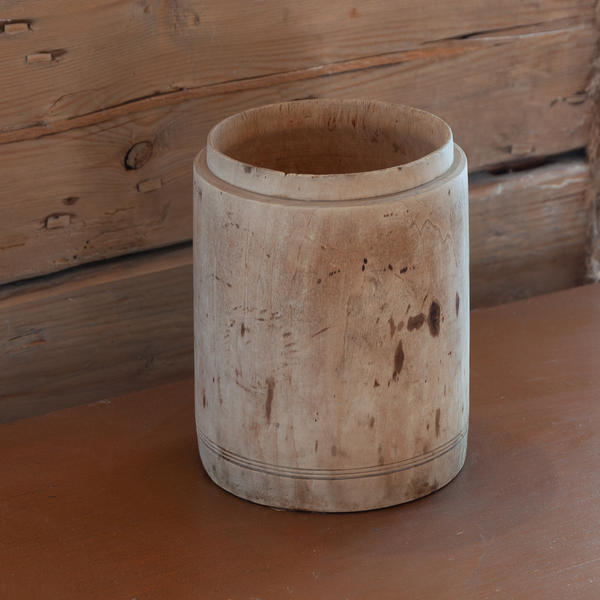
A salt cellar is a container for salt. The exhibit which is presented in the collection is round in shape, with an extension at the bottom, is made of wood and misses a lid. This item belonged to Anna Ilyinichna Ulyanova, married name Elizarova, the elder sister of Vladimir Ilyich Lenin.

In the late 1960s and early 1970s, in connection with the creation of the Apartment-Museum of the Ulyanov Family, Claudia Pavlovna Anokhina provided great help in replenishing the collection with original family heirlooms. She was an old acquaintance of Anna Ilyinichna and the wife of one of her pupils, Dmitry Egorovich Baramzin.

Claudia Pavlovna lived in Anna Ilyinichna’s Moscow apartment at 9 Manezhnaya Street, apartment 11. Augustina Dmitrievna Dernova, a researcher at the museum, who at the time was working on creating the museum’s collection, visited Claudia Pavlovna in the summer of 1968. Claudia Anokhina managed to preserve the apartment’s furnishings, personal belongings, books, photographs and letters. When she found out about the creation of the exhibition, she donated to the future museum a number of things that belonged to Ulyanova-Elizarova and the Ulyanov family, including a wooden salt cellar. On October 26, 1969, with reference to the Soviet news agency TASS, a news item was published on the front page of the newspaper Pravda mentioning this event.

Wooden salt cellars were considered a common household item, were made in various shapes and decorated depending on local tradition: they were cut with a knife and hollowed out with an ax. The material was birch, spruce, and pine wood. They were also woven from roots and birch bark. In central Russia and the Volga region, “chair”-salt cellars were created in the form of a cuboid box with a hinged lid and a high back wall. The surface of such salt cellars was decorated with a finely carved pattern, the back wall was adorned with patterns depicting birds, roots, and church domes. Most of the salt cellars had a lid.

The attitude to this kitchen accessory in Russia has always been special. Tatyana Evgenyevna Lonchinskaya, an employee of the Higher School of Folk Arts, notes,

#4

In everyday life, bread and salt were always revered by our ancestors, they were placed in a special place of honor during festive celebrations. Therefore, since ancient times, the salt cellar was decorated with carvings or paintings that contained deep meaning. Proverbs have preserved a respectful attitude to the object — ‘One eye looks at the politsa (bread), while the other looks at the salt cellar’, ‘Do not dip bread in the salt cellar (crumbs remain)’, ‘Without salt the table is crooked’, ‘Without bread it is insatiable, without salt it is not sweet’.

#3
read morehide
00:00
00:00
1x

Salt cellar of A.I. Ulyanova

Creation period
the beginning of the 20th century
Place of сreation
Saratov province, the Russian Empire
Dimensions
16x11x13 cm
Technique
wood, carpentry
Collection
0
Point your smartphone camera to open in the app
Share
VkontakteOdnoklassnikiTelegram
Share on my website
Copy linkCopied
Copy
Open in app
To see AR mode in action:
  1. Install ARTEFACT app for 
  2. iOS or Android;
  3. Find and download the «Paintings in Details» exhibition
  4. Push the «Augmented reality» button and point your phone's camera at the painting;
  5. Watch what happens on your phone screen whilst you flip through the pictures.
 
We use Cookies
Cookies on the Artefact Website. We use cookies to ensure that we give you the best experience on our website. If you continue without changing your settings, we'll assume that you are happy to receive all cookies on the Artefact website. However, if you would like to, you can change your cookie settings at any time.
Learn more about useHide
Content is available only in Russian

X

Нашли опечатку?...

%title%%type%