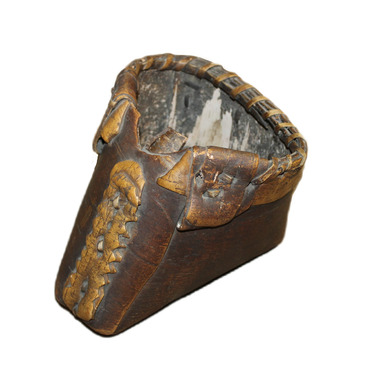
Metal cast iron, cookware for cooking on the stove or in a Russian oven. The body is rounded, strongly narrowed downwards. The bottom is flat, round. The upper part is expanded, the corolla is bent inward. The volume is 2.5 liters.
The cast iron had the shape of a traditional clay stove pot — narrowed to the bottom, expanding to the top and narrowing again to the throat. This form made it possible to put and take it out of the oven with the help of a special tool — a grab, which is an open metal ring on a long wooden handle.
Cast irons became widespread only at the very end of the XIX — early XX centuries. In the first third of the XX century, these vessels began to be made with enamel coating. They, as a rule, had the stamp of the manufacturer indicating the volume in liters.Metal cast iron, cookware for cooking on the stove or in a Russian oven. The body is rounded, strongly narrowed downwards. The bottom is flat, round. The upper part is expanded, the corolla is bent inward. The volume is 2.5 liters.
The cast iron had the shape of a traditional clay stove pot — narrowed to the bottom, expanding to the top and narrowing again to the throat. This form made it possible to put and take it out of the oven with the help of a special tool — a grab, which is an open metal ring on a long wooden handle.
Cast irons became widespread only at the very end of the XIX — early XX centuries. In the first third of the XX century, these vessels began to be made with enamel coating. They, as a rule, had the stamp of the manufacturer indicating the volume in liters.