#1
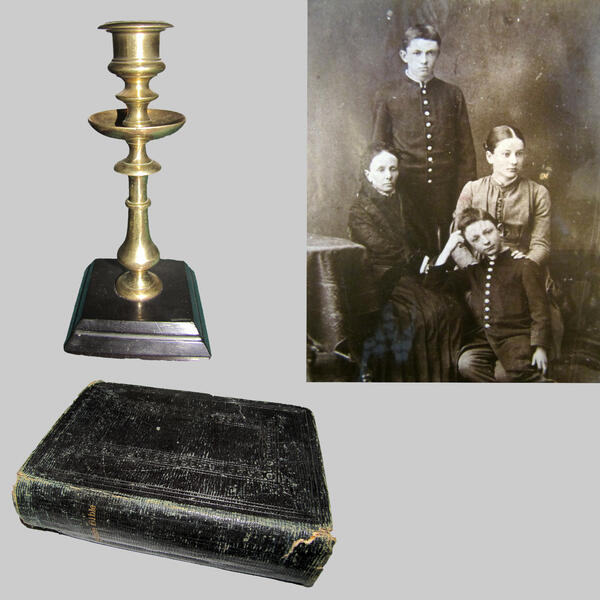
Bible, Candlestick, Zhorzhina Yegorovna Chicherina with children
#2
#3
#5
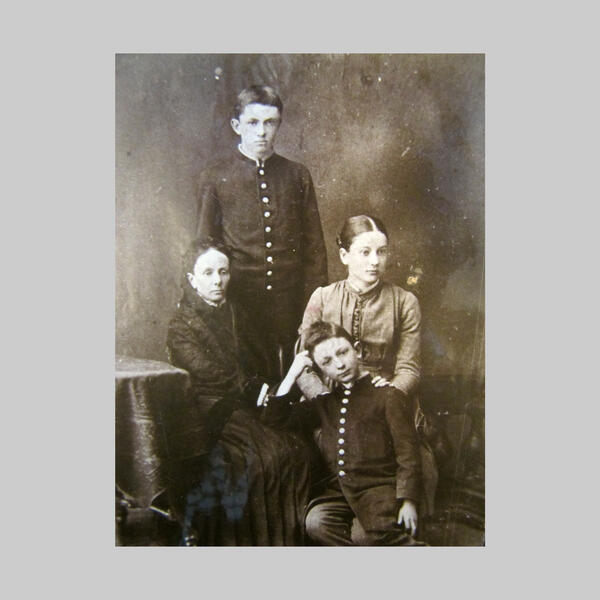
Sofia Chicherina was born in 1867 in Paris. According to the noble tradition, at first the girl studied at home. The only daughter of Zhorzhina and Vasily Chicherin showed special talents in playing the zither and the piano, writing scripts for family theater performances and learning foreign languages. The child excellently spoke French, Italian, German and English.
According to the recollections of relatives, even in her youth, Sofia Chicherina was calm and tactful. Usually it was the sister who resolved conflicts and judged disputes between brothers. In addition, at the age of 13, she discovered a passion for pedagogy and began teaching peasant children in a school that her parents had built and maintained.
On the photo presented as part of the exhibition about the fate of Georgy Chicherin, you can see him with his brother and sister, as well as their mother. Presumably, the photograph was taken at the end of the 19th century in a photo studio in the city of Tambov. This version is supported by the woman’s mourning clothes. The husband and father of the family died in 1882.
It is worth saying that the relationship between relatives remained warm and trusting throughout their lives. In the 1906 correspondence between Sofia and Georgy Chicherin, when the latter lived in exile, one could find respect for revolutionary activity, and an understanding of popular discontent, and bold statements about the cruelty of repression in Russia.
In 1904, Sofia Chicherina visited about 30 settlements in the Vyatka, Kazan, Siberian and Ufa provinces to help create schools for the peoples of the Volga region. In her work, she was guided by the system of Nikolai Ilminsky, an orientalist and missionary. The main idea of his method was that students first had to master their native languages, and only then Russian - as an introduction to world culture.
Enthusiasm for educational activities did not go unnoticed among her contemporaries. Already in 1906, Sofia Chicherina was elected a member of the Russian Geographical Society.
In addition to the practical implementation of her ideas, from 1905 to 1910, the woman managed to publish several scientific articles and books on the state of education and the preservation of dialects among the eastern residents of Russia. For example, the volume “At the Volga Foreigners. Travel Notes.”
According to the recollections of relatives, even in her youth, Sofia Chicherina was calm and tactful. Usually it was the sister who resolved conflicts and judged disputes between brothers. In addition, at the age of 13, she discovered a passion for pedagogy and began teaching peasant children in a school that her parents had built and maintained.
On the photo presented as part of the exhibition about the fate of Georgy Chicherin, you can see him with his brother and sister, as well as their mother. Presumably, the photograph was taken at the end of the 19th century in a photo studio in the city of Tambov. This version is supported by the woman’s mourning clothes. The husband and father of the family died in 1882.
It is worth saying that the relationship between relatives remained warm and trusting throughout their lives. In the 1906 correspondence between Sofia and Georgy Chicherin, when the latter lived in exile, one could find respect for revolutionary activity, and an understanding of popular discontent, and bold statements about the cruelty of repression in Russia.
In 1904, Sofia Chicherina visited about 30 settlements in the Vyatka, Kazan, Siberian and Ufa provinces to help create schools for the peoples of the Volga region. In her work, she was guided by the system of Nikolai Ilminsky, an orientalist and missionary. The main idea of his method was that students first had to master their native languages, and only then Russian - as an introduction to world culture.
Enthusiasm for educational activities did not go unnoticed among her contemporaries. Already in 1906, Sofia Chicherina was elected a member of the Russian Geographical Society.
In addition to the practical implementation of her ideas, from 1905 to 1910, the woman managed to publish several scientific articles and books on the state of education and the preservation of dialects among the eastern residents of Russia. For example, the volume “At the Volga Foreigners. Travel Notes.”
#4
Author: Nikolaev V. P.
Date: the late 19th century
Technique: photopaper
Place: Tambov
Dimensions: 22×13,5 cm
Collection: Tambov Regional Museum of Local Lore
Copyright: Tambov Regional Museum of Local Lore
Date: the late 19th century
Technique: photopaper
Place: Tambov
Dimensions: 22×13,5 cm
Collection: Tambov Regional Museum of Local Lore
Copyright: Tambov Regional Museum of Local Lore
#6
Candlestick
#7

#8
At present, the exhibit is located on the table next to the match stand in the former bedroom of Nikolay Vasilievich, the brother of Georgy Vasilievich Chicherin. Craftsmen of the mid-19th century made the candlestick from metal and stone, equipping the product with a small tray in the form of a saucer, into which the wax dripped. Models with that improvement were popular because they allowed to keep the rooms clean.
For several centuries, the issue of cleanliness in homes was significant not only because of candle drops, but also because of soot. The thing is that artisans and manufactories made artificial lighting sources from animal fat or beeswax, which, when burned, ‘blackened’ things and the interior around.
It wasn’t until 1820 that stearin candles were released, which became brighter and less smoky. In the 1850s, paraffin candles appeared on the market. They often contained palm and coconut oils. It is worth mentioning that their inventors greatly simplified housekeeping and extended the life of many artifacts in modern museums, from carpets to paintings.
As a rule, in the 16-7th centuries, craftsmen created candlesticks from tin, bronze or silver, in the 18th century - from iron, in the 19th century - from cast iron. Stands were made of wood or stone.
It is noteworthy that in those years, the design of candles and related products strove for simplicity. Most of them were the same shape and size. For both the poor and the rich, these household items were not associated with territory decoration or status symbols.
An antique candlestick that belonged to the family of Georgy Chicherin was light and compact enough to quickly carry an accessory from room to room, if necessary.
Nevertheless, there were other options for candlesticks on sale: wall and floor. Their main tasks, in addition to improving visibility, were to create a romantic or festive atmosphere and visually expand the boundaries of space. For example, by placement on a piano, in the corners of dance halls, or on the sides of mirrors.
For several centuries, the issue of cleanliness in homes was significant not only because of candle drops, but also because of soot. The thing is that artisans and manufactories made artificial lighting sources from animal fat or beeswax, which, when burned, ‘blackened’ things and the interior around.
It wasn’t until 1820 that stearin candles were released, which became brighter and less smoky. In the 1850s, paraffin candles appeared on the market. They often contained palm and coconut oils. It is worth mentioning that their inventors greatly simplified housekeeping and extended the life of many artifacts in modern museums, from carpets to paintings.
As a rule, in the 16-7th centuries, craftsmen created candlesticks from tin, bronze or silver, in the 18th century - from iron, in the 19th century - from cast iron. Stands were made of wood or stone.
It is noteworthy that in those years, the design of candles and related products strove for simplicity. Most of them were the same shape and size. For both the poor and the rich, these household items were not associated with territory decoration or status symbols.
An antique candlestick that belonged to the family of Georgy Chicherin was light and compact enough to quickly carry an accessory from room to room, if necessary.
Nevertheless, there were other options for candlesticks on sale: wall and floor. Their main tasks, in addition to improving visibility, were to create a romantic or festive atmosphere and visually expand the boundaries of space. For example, by placement on a piano, in the corners of dance halls, or on the sides of mirrors.
#9
Date: the mid-19th century
Technique: stone, metal
Dimensions: 18,5×8,8×8,8 cm
Collection: House-Museum of G.V. Chicherin
Copyright: House-Museum of G.V. Chicherin
Goskatalog Number: 16935399
Technique: stone, metal
Dimensions: 18,5×8,8×8,8 cm
Collection: House-Museum of G.V. Chicherin
Copyright: House-Museum of G.V. Chicherin
Goskatalog Number: 16935399
#10
Bible
#11
#13
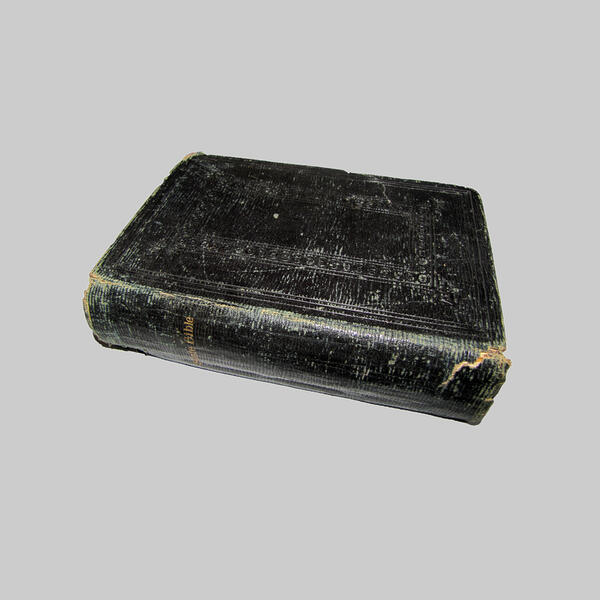
The Bible printed in French was donated to the museum by Georgy Chicherin’s grand-niece Natalia Chicherina. It was passed to her from her grandmother, Natalia Chicherina (born Govorova), who, after her wedding with Nikolay Chicherin, received a Bible as a gift from her mother-in-law, Zhorzhina Chicherina.
Zhorzhina Chicherina was a member of the Society for the Encouragement of Spiritual and Moral Reading. That society was founded by a Russian religious figure, a retired colonel of the guards, Vasily Pashkov. He was one of the richest people in Russia and led a life full of entertainment as a Petersburg aristocrat. However, after his religious conversion, Pashkov devoted himself to Christian service that was active, multifaceted and aimed at various social strata, including the very bottom of society.
Initially, the Pashkovites’ organization emerged in an aristocratic environment. Englishman Lord Grenville Redstock was its spiritual leader. In 1874, he first came to St. Petersburg to preach the evangelical movement.
The most active follower of his doctrine was Vasily Pashkov, from whose name the association got its name.
The ‘Pashkovites’ disseminated their teachings primarily through literary means. Since 1876, the Society for the Encouragement of Spiritual and Moral Reading began to publish a lot of brochures and issue a magazine on the same topic under the name Russian Worker.
In 1884, the Supreme Command followed: ‘To close the society for the encouragement of spiritual and moral reading and take measures to stop the spread of Pashkov’s teachings throughout the Empire.’ In 1886, the Holy Synod again prohibited the distribution of brochures of the above-named society among the people.
Pashkov himself was evicted abroad in 1884 and settled in Paris. But from there, until his death, he continued to support his like-minded people with letters and money.
The teachings of the “Pashkovites” consisted in the denial of the church as a divine institution, sacraments, liturgical rituals, church prayer, hierarchy, holy icons and in highlighting the value of good deeds for human salvation, which is accomplished by faith in Christ alone. They considered the Bible to be the only source of the religious doctrine.
Zhorzhina Chicherina was a member of the Society for the Encouragement of Spiritual and Moral Reading. That society was founded by a Russian religious figure, a retired colonel of the guards, Vasily Pashkov. He was one of the richest people in Russia and led a life full of entertainment as a Petersburg aristocrat. However, after his religious conversion, Pashkov devoted himself to Christian service that was active, multifaceted and aimed at various social strata, including the very bottom of society.
Initially, the Pashkovites’ organization emerged in an aristocratic environment. Englishman Lord Grenville Redstock was its spiritual leader. In 1874, he first came to St. Petersburg to preach the evangelical movement.
The most active follower of his doctrine was Vasily Pashkov, from whose name the association got its name.
The ‘Pashkovites’ disseminated their teachings primarily through literary means. Since 1876, the Society for the Encouragement of Spiritual and Moral Reading began to publish a lot of brochures and issue a magazine on the same topic under the name Russian Worker.
In 1884, the Supreme Command followed: ‘To close the society for the encouragement of spiritual and moral reading and take measures to stop the spread of Pashkov’s teachings throughout the Empire.’ In 1886, the Holy Synod again prohibited the distribution of brochures of the above-named society among the people.
Pashkov himself was evicted abroad in 1884 and settled in Paris. But from there, until his death, he continued to support his like-minded people with letters and money.
The teachings of the “Pashkovites” consisted in the denial of the church as a divine institution, sacraments, liturgical rituals, church prayer, hierarchy, holy icons and in highlighting the value of good deeds for human salvation, which is accomplished by faith in Christ alone. They considered the Bible to be the only source of the religious doctrine.
#12
Date: 1878
Technique: typographic printing, paper, leather
Dimensions: 18×11,5×11,5 cm
Copyright: House-Museum of G.V. Chicherin
Collection: House-Museum of G.V. Chicherin
Goskatalog Number: 18377923
Technique: typographic printing, paper, leather
Dimensions: 18×11,5×11,5 cm
Copyright: House-Museum of G.V. Chicherin
Collection: House-Museum of G.V. Chicherin
Goskatalog Number: 18377923
read morehide
00:00
00:00
1x
Bible,Candlestick,Chicherina with children
Collection
1
 Point your smartphone camera to open in the app
Open in app
Share