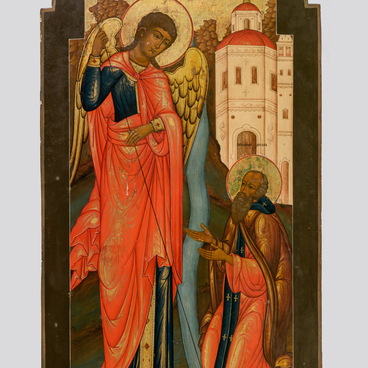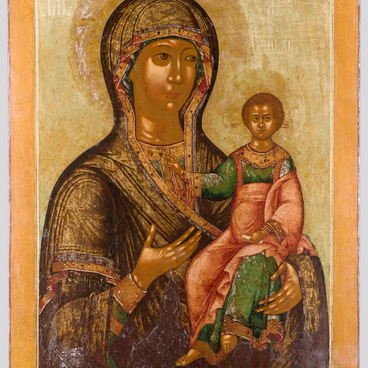


Several iconographic types are dedicated to the image of John the Baptist. Each of them reflects a certain stage of the saint’s life: his conception, nativity, stay in the desert (“Angel of the Desert”), the Baptism of the Lord, the beheading and finding of the head of John the Baptist, and the descent of the prophet into hell.
The episode of the execution of John the Baptist is described by the evangelists Mark and Matthew. For his diatribes, the prophet was imprisoned by King Herod. Soon after, the daughter of Queen Herodias, Salome, taught by her mother, pleased the king with a dance and demanded the head of John as a reward.
In the Christian tradition, the memory of this day marks the beginning of a new church year as a transition to the era of the New Testament: John the Baptist was the last one who prophesied the coming of Christ. A strict fast is observed on this day. During the reign of Ivan the Terrible, icons depicting his heavenly patron John the Baptist were especially often painted. As a rule, they belonged to the iconographic types “The Angel of the Desert” and “The Head of John the Baptist”.
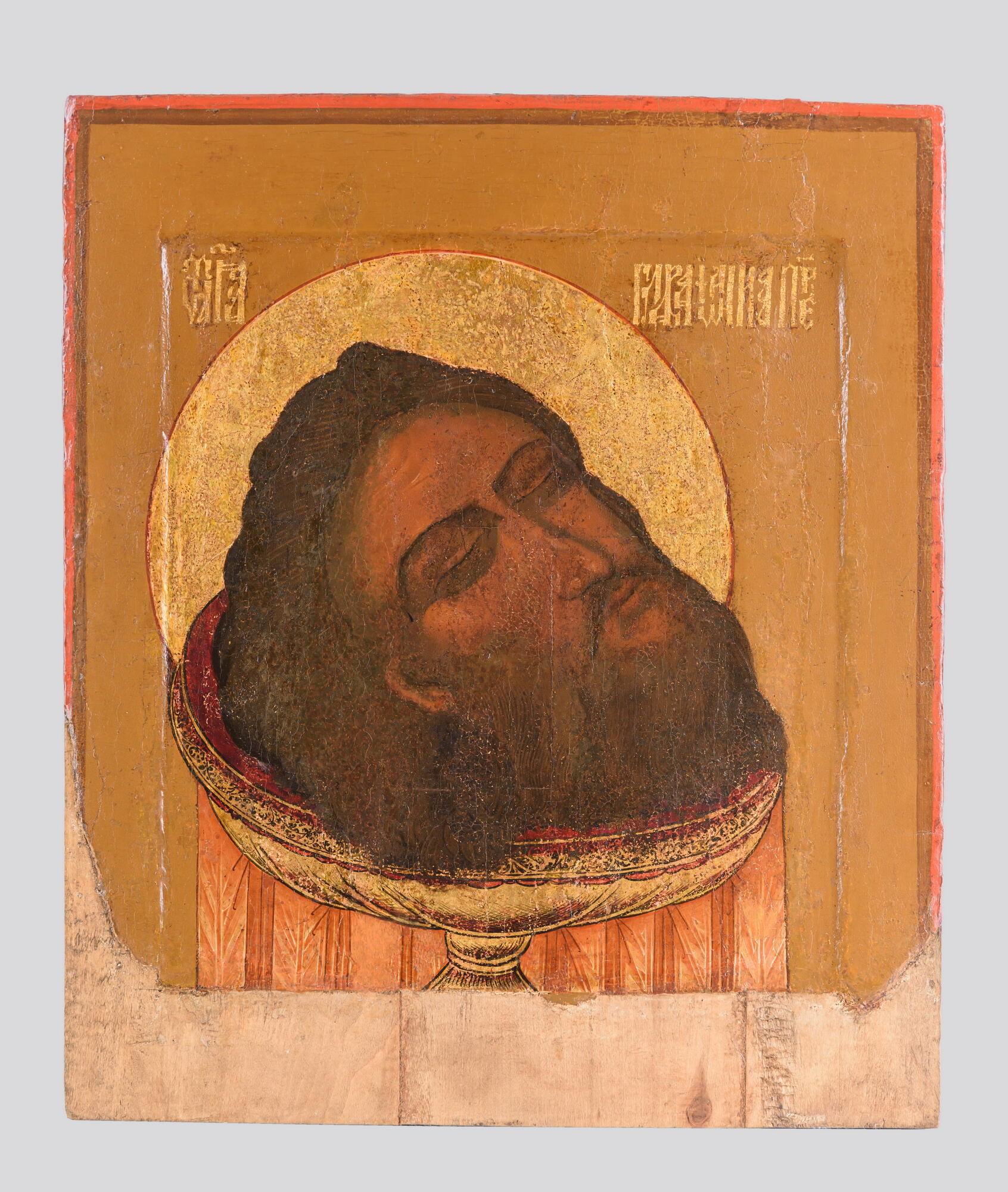
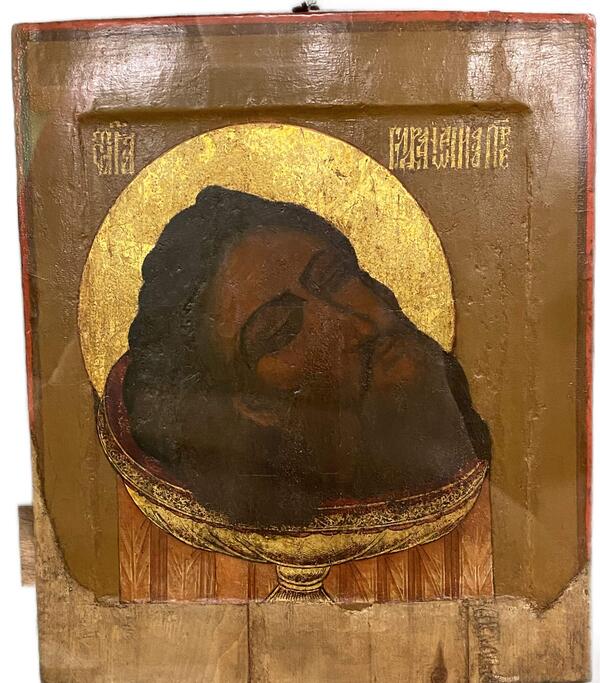
On this icon, as the canon prescribes it, the severed head is large; it lays on a golden platter covered with a crimson cloth. The face of the saint is painted in accordance with the iconographic original. The head is surrounded by a halo — a sign of the prophet’s acquisition of the Kingdom of God and grace. The “lifelike” manner of painting, characteristic of the early 18th century, suggests that the icon was created by an Old Believer painter.
In the late 17th — 18th centuries, the so-called third Stroganov, or baron, images became widespread. Experts note a transition in their style to the “fryazhskaya icon-painting” (a type of painting inspired by Western European) and, in part, secular painting traditions; light colors and golden highlights on clothes are used.
The icon comes from the Nativity Church in Balakhna. It was received by the Local History Museum on January 1, 1948. From 1992 to 2016, it was kept in the Moscow Interregional Scientific and Restoration Art Department, then it was restored there.
Specialists removed the old facings, as well as parts of paint layer and darkened drying oil. They strengthened the paint layer and the gesso, and tinted the icon without restoring the drawing. They only emphasized the character of the old painting.
The episode of the execution of John the Baptist is described by the evangelists Mark and Matthew. For his diatribes, the prophet was imprisoned by King Herod. Soon after, the daughter of Queen Herodias, Salome, taught by her mother, pleased the king with a dance and demanded the head of John as a reward.
In the Christian tradition, the memory of this day marks the beginning of a new church year as a transition to the era of the New Testament: John the Baptist was the last one who prophesied the coming of Christ. A strict fast is observed on this day. During the reign of Ivan the Terrible, icons depicting his heavenly patron John the Baptist were especially often painted. As a rule, they belonged to the iconographic types “The Angel of the Desert” and “The Head of John the Baptist”.
On this icon, as the canon prescribes it, the severed head is large; it lays on a golden platter covered with a crimson cloth. The face of the saint is painted in accordance with the iconographic original. The head is surrounded by a halo — a sign of the prophet’s acquisition of the Kingdom of God and grace. The “lifelike” manner of painting, characteristic of the early 18th century, suggests that the icon was created by an Old Believer painter.
In the late 17th — 18th centuries, the so-called third Stroganov, or baron, images became widespread. Experts note a transition in their style to the “fryazhskaya icon-painting” (a type of painting inspired by Western European) and, in part, secular painting traditions; light colors and golden highlights on clothes are used.
The icon comes from the Nativity Church in Balakhna. It was received by the Local History Museum on January 1, 1948. From 1992 to 2016, it was kept in the Moscow Interregional Scientific and Restoration Art Department, then it was restored there.
Specialists removed the old facings, as well as parts of paint layer and darkened drying oil. They strengthened the paint layer and the gesso, and tinted the icon without restoring the drawing. They only emphasized the character of the old painting.