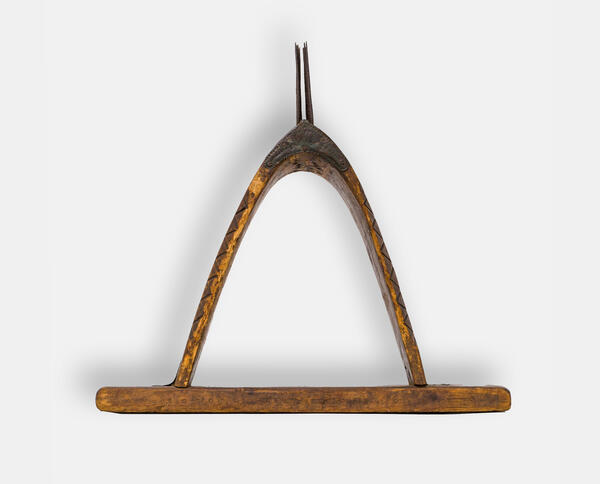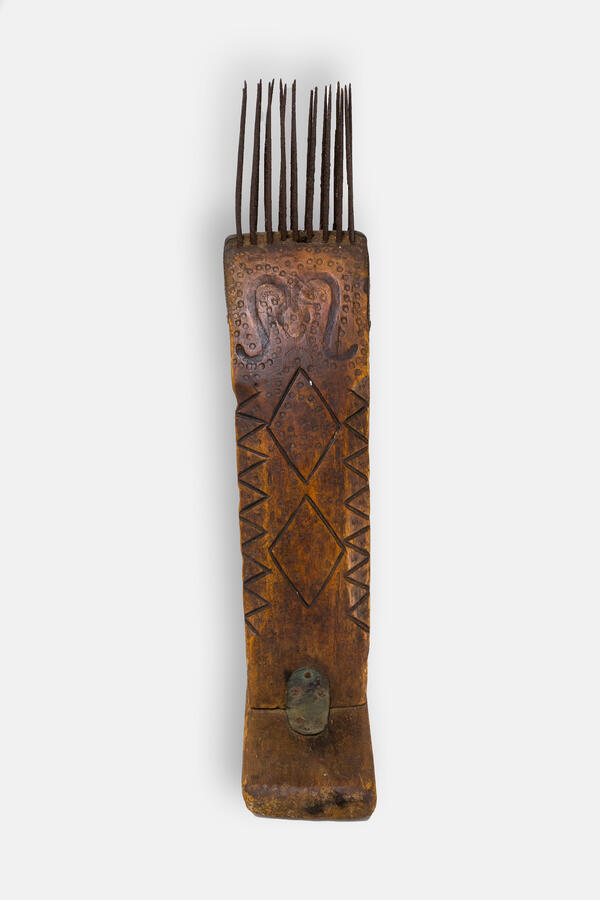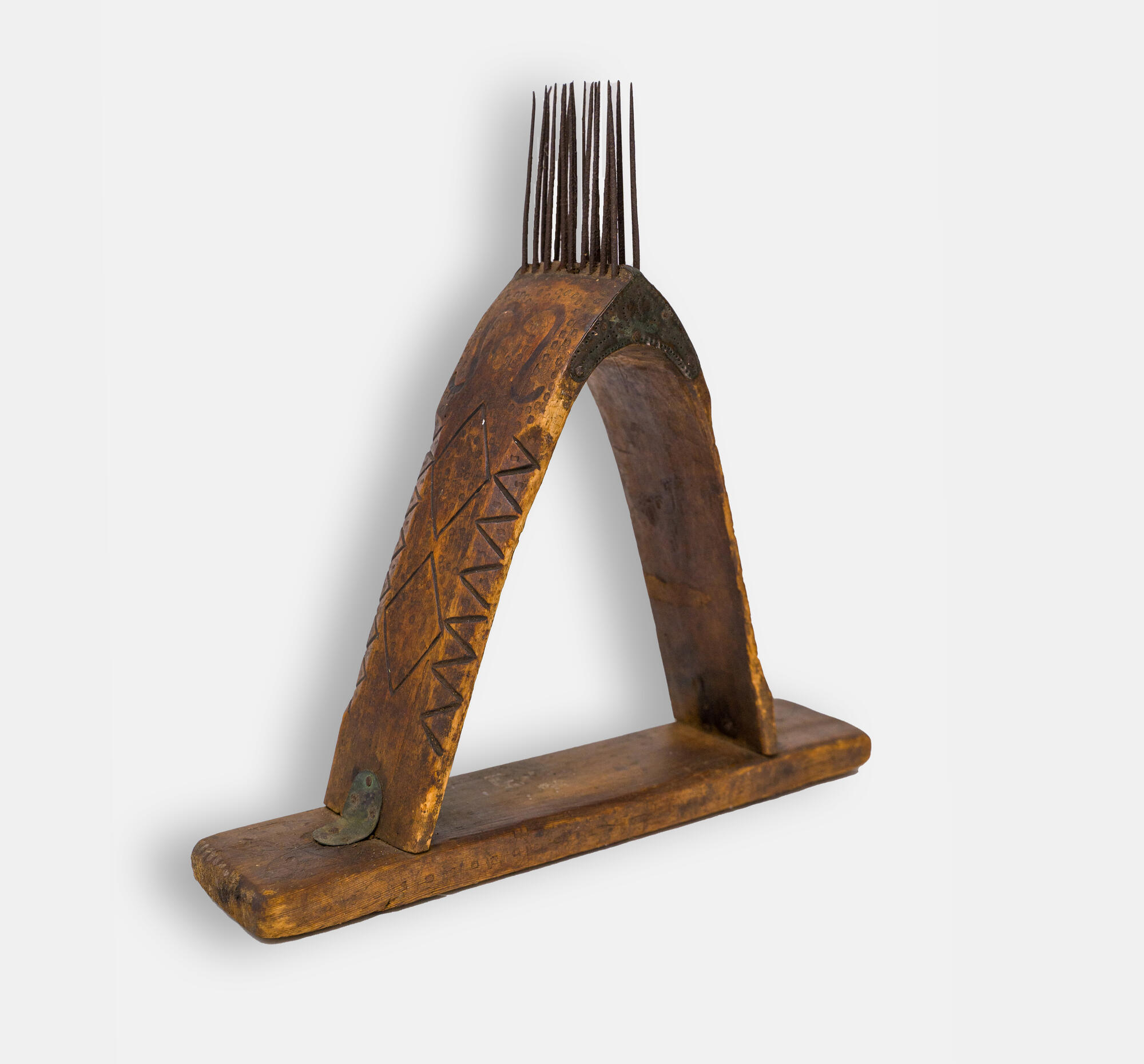


The wool hackle presented in the Adygeysk Museum of Local Lore was donated to the museum in 1995 by Suliyet Khamidovna Achmiz from the town of Tliustenhabl.
The production of homespun cloth consisted of a variety of labor-intensive processes. Traditionally, this difficult work was performed by women, and the preparation of the material could take up to 12 days.
Wool intended for cloth was carefully processed. It was washed, dried in the sun or near the hearth, and then pulled apart by hand. After that, it was combed with a hackle (tsyph) — a triangular board with metal teeth. By doing so, the wool was ruffled and the litter, dust and a significant part of long wool fibers were separated from it. During combing, the wool was sorted into long and short fibers. Short fibers were used to make the warp — a longitudinal thread, and the long ones — to make the weft. The combed wool was beaten with a bow (bzeut). The bow is an arc-shaped stick, the ends of which are connected by a thin rope. When the wool was ruffled by the thread of the bow, long and heavy fibers flew to the side.
The processed wool was spun on a hand spindle (pkhetsyku) — a rather simple device. The wool for the warp and the weft was spun separately. The yarn intended for warp was wound in parallel rows on three pegs sticking from the ground. Then it was removed and tied in loops for easy storage.
The craftswomen hung the woven cloth on a fence and began felting, while occasionally pouring hot water on it. Felting is a physically demanding activity that took about 8–10 hours. While doing that, it was customary to sing a rhythmic work song — “tsypkhe ored”. One woman set the song, and others sang along with her.
The finished cloth was dyed in natural colors: black, brown, gray, yellowish-brown, yellowish-green. The dyes were made of natural materials: oak bark, alder and mineral dyes.
When possible, good cloth was rolled in sulfuric-alkaline mineral water which significantly improved the quality of the material. After felting, the cloth shrunk by 30–40%. Then it was dried in the sun.