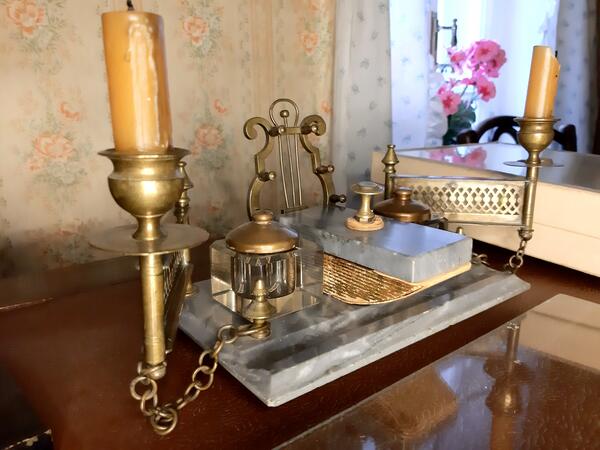
When he was a student, Ivan Petrovich Pavlov spent his summer holidays at home. He often wrote letters from Ryazan to his friends who remained in Saint Petersburg. His inkstand included inkwells, paperweights, a fountain pen holder, and candlesticks. The traditional heavy marble base of the set is flanked by decorative elements in the form of candlesticks. They are movable, so that is possible to adjust the lighting of the table. Chains were fixed to the edges of the candlesticks.
The marble base of the inkstand features a brass holder resembling a lyre. It could hold up to three pencils or quills. The square inkwells are made of thick glass and are closed with flat brass caps. The inkwells were not deep so the frugal use of ink allowed the owner to save money.
Between the inkwells is a paperweight — an arched marble bar with a round handle. The bottom of the paperweight features a wooden part with paper stretched over it to blot the written text. The blotting paper had a special structure and absorbed the ink very quickly so that the written texts dried faster and did not smear. Each inkstand was made to order, so it is almost impossible to find two inkstands that are exactly the same. This device, however, lacks the master’s signature.
In his parents’ house, Ivan Pavlov read a lot of works written by his favorite authors — Ivan Krylov, Mikhail Lermontov, Alexander Pushkin, and William Shakespeare. He also tried his hand at writing something himself. Ivan Pavlov had a notebook, dedicated to his poetry and signed with the pseudonym Volvap — the backward spelling of “Pavlov”. The academician was fluent in German and translated Heinrich Heine’s poem “The Pine and the Palm”, which was also attempted by Mikhail Lermontov, Fyodor Tyutchev, and Afanasy Fet. Ivan Petrovich Pavlov’s variant goes as follows:
The marble base of the inkstand features a brass holder resembling a lyre. It could hold up to three pencils or quills. The square inkwells are made of thick glass and are closed with flat brass caps. The inkwells were not deep so the frugal use of ink allowed the owner to save money.
Between the inkwells is a paperweight — an arched marble bar with a round handle. The bottom of the paperweight features a wooden part with paper stretched over it to blot the written text. The blotting paper had a special structure and absorbed the ink very quickly so that the written texts dried faster and did not smear. Each inkstand was made to order, so it is almost impossible to find two inkstands that are exactly the same. This device, however, lacks the master’s signature.
In his parents’ house, Ivan Pavlov read a lot of works written by his favorite authors — Ivan Krylov, Mikhail Lermontov, Alexander Pushkin, and William Shakespeare. He also tried his hand at writing something himself. Ivan Pavlov had a notebook, dedicated to his poetry and signed with the pseudonym Volvap — the backward spelling of “Pavlov”. The academician was fluent in German and translated Heinrich Heine’s poem “The Pine and the Palm”, which was also attempted by Mikhail Lermontov, Fyodor Tyutchev, and Afanasy Fet. Ivan Petrovich Pavlov’s variant goes as follows: