Font
Color
Graphics
Изображение точки

To see AR mode in action:

1. Install ARTEFACT app for iOS or Android;

2. Find the exhibition «The Ethnography of the Adyghe People»

3. Push the «Augmented reality» button and point your phone's camera at the exhibit;

Скрыть точки интересаПоказать точки интереса
Показать в высоком качестве

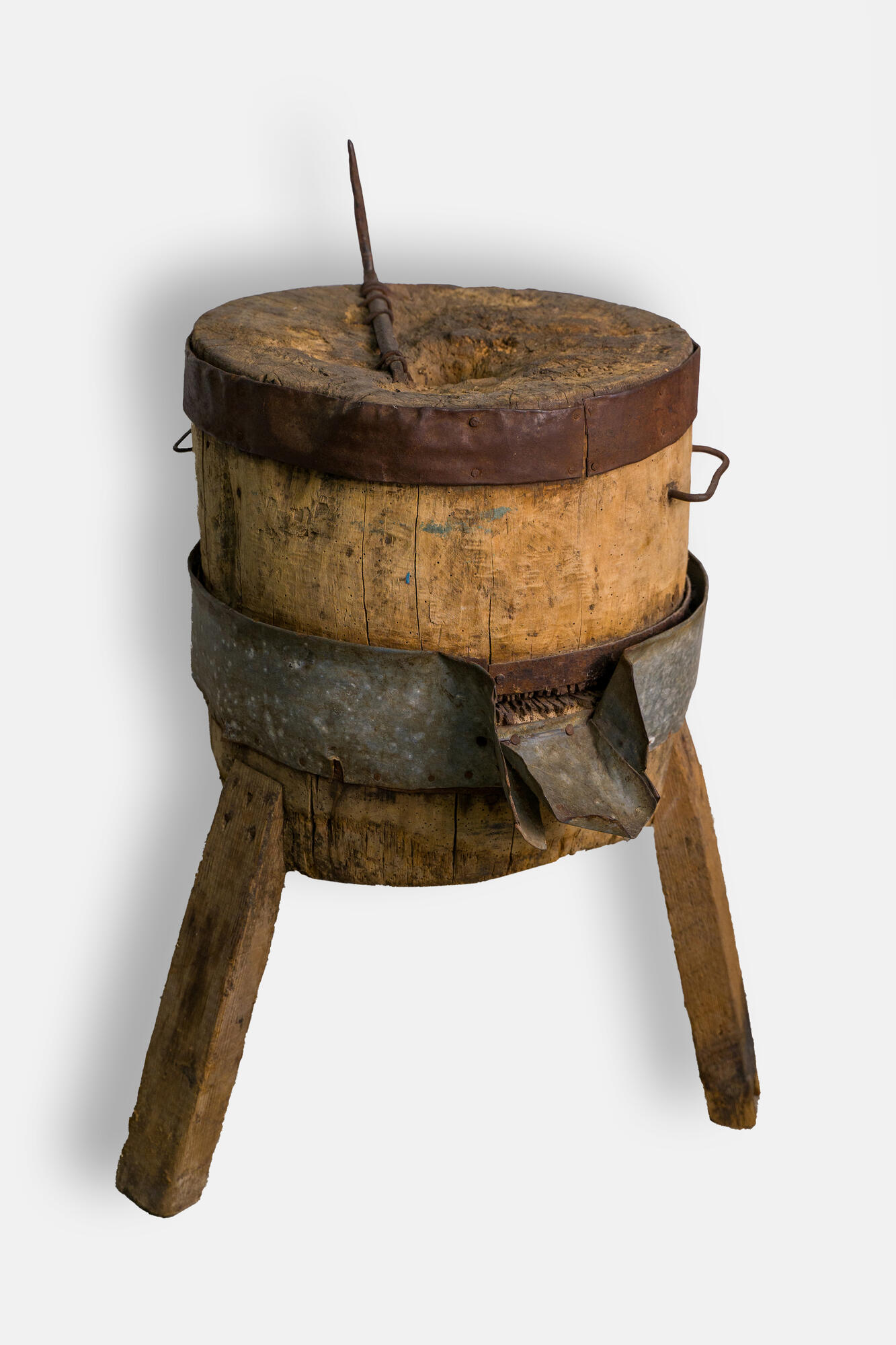
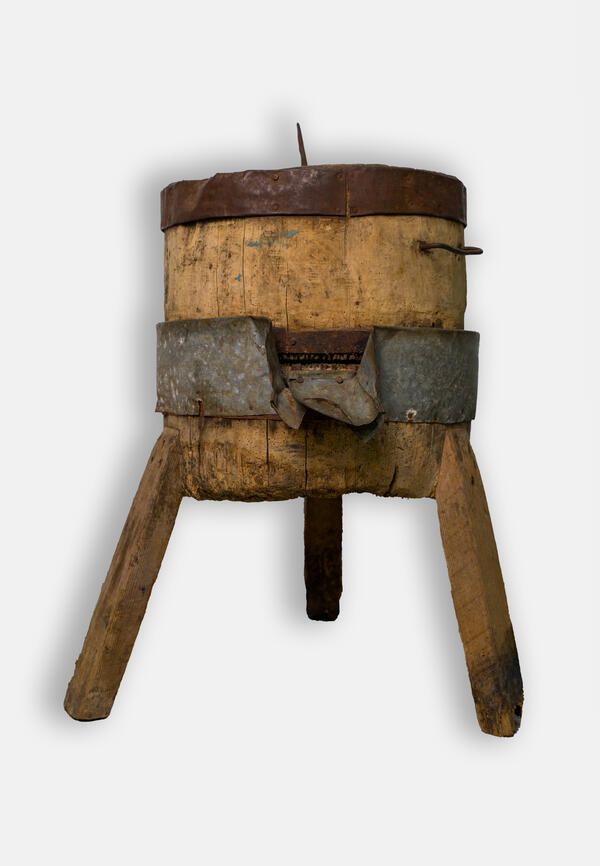
Hand mill

Creation period
circa 1990
Place of сreation
Adygeysk, the USSR
Dimensions
65x89 cm
Technique
metal, wood
0
Open in app
#4

The hand mill is one of humankind’s oldest inventions. Its origins date back to the Neolithic period. Throughout many millennia, the design of the hand mill remained virtually the same. Its key elements are two flat round millstones, the working surfaces of which are fitted to face each other.

For processing grain, the Adyghe used several devices. To peel the husk off the grain, it was loaded into wooden mortars, then it was sent to a large mill or ground manually.

The bodies of these hand mills were made of wood, and there were two types of millstones: wooden (for coarse flour) and stone (for finer flour). Traditionally, the diameter of a millstone was about 70 centimeters. The mills were small and convenient enough to be used at home, while at the same time, their design made it possible to grind any kind of cereals and grains without much effort.

The basis of the Adyghe economy was agriculture. The Adyghe cultivated wheat, barley and millet — the latter was prioritized. The cultivation of millet by the Adyghe was described by Giorgio Interiano, a Genovese historian, ethnographer and traveler, and Dorteli d’Ascoli, a monk of the Dominican Order, who was the head of the Order’s mission in Kaffa and Tataria (current-day Crimea) in 1624–1634 and visited Circassia more than once. In his book “Description of the Black Sea and Tatars”, Interiano wrote that Circassians cooked millet in cauldrons and ate it instead of bread.

Millet is mentioned in Adyghe proverbs and superstitions:

#5

Who does not know how to cultivate the land, sows millet on pebbles. Don’t step on the millet or you’ll lose money. One deeply plowing the land, has millet boiling. If you cook paste, level it nicely so your son gets a pretty bride.

#6

In the Ubin settlements, hand-made round millstones (40 and 50 centimeters in diameter) were found. Their working surfaces were covered with small notches or radial grooves.

The hand mill from the museum’s collection belonged to Garifat Amirzanovna Gadagatel, a native of Edepsukai-1 village, who lived in Adygeysk. The mill was made by her nephew Ramazan Chitav, around the beginning of the 1980s. The mill was donated to the Adygeysk Museum of Local Lore by Rakhmet Sikhatokhovna Tuguz — Garifat Gadagatel’s daughter-in-law.
#8
Hand mill
#7
View in the State Catalogue
read morehide
00:00
00:00
1x

Hand mill

Creation period
circa 1990
Place of сreation
Adygeysk, the USSR
Dimensions
65x89 cm
Technique
metal, wood
0
Point your smartphone camera to open in the app
Share
VkontakteOdnoklassnikiTelegram
Share on my website
Copy linkCopied
Copy
Open in app
To see AR mode in action:
  1. Install ARTEFACT app for 
  2. iOS or Android;
  3. Find and download the «Paintings in Details» exhibition
  4. Push the «Augmented reality» button and point your phone's camera at the painting;
  5. Watch what happens on your phone screen whilst you flip through the pictures.
 
We use Cookies
Cookies on the Artefact Website. We use cookies to ensure that we give you the best experience on our website. If you continue without changing your settings, we'll assume that you are happy to receive all cookies on the Artefact website. However, if you would like to, you can change your cookie settings at any time.
Learn more about useHide
Content is available only in Russian

X

Нашли опечатку?...

%title%%type%