

#13
Writers-contemporaries of Bunin I.A.
#22
#3
#4
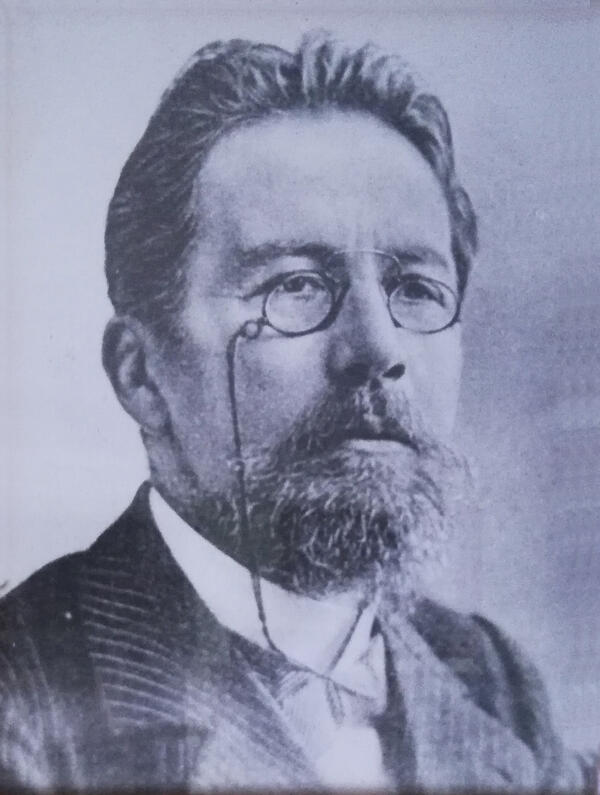
Anton Chekhov is a Russian writer, honorary academician of the St. Petersburg Academy of Sciences. He was born in a large family of a merchant in the third Guild, the owner of a grocery store; he studied at a classical gymnasium. Chekhov’s first literary experiments belong to the period when he was studying at the gymnasium. He started as an author of newspaper satire and short humorous stories (his pen-name was Antosha ChekhontE). He graduated from the medical faculty of the Moscow University (1884). He worked as a district doctor. The stories he wrote in that period were included in the collections “Colorful stories” (1886) and “Innocent speeches” (1887). He wrote for Alexey Suvorin’s newspaper the ‘New Time’ (from 1886), where Chekhov’s stories first appeared under his real name. In the first half of the 1890s, Chekhov became one of the most widely read writers in Russia.
In autumn 1887, during one of his trips to Yelets, Bunin bought the book “Colorful stories” by Antosha Chekhonte at the railway terminal in the city and read it on the train in the same breath. He was delighted with those stories. This was how Chekhov entered his life, they became friends and their friendship was only broken by the death of Anton PAvlovich in 1904. Bunin died in 1953 and his work on the book about Chekhov stopped. In early January 1891, in Yelets, Bunin wrote his first letter to Chekhov: “I kindly ask you and would appreciate so much, that if I sent you two or three of my (printed) stories, you could take time to ever read them when you have nothing else to do, and to give me some comments on them”.
On December 12, 1895, they met personally in Moscow, and two days later Bunin presented Anton Pavlovich an autographed print of his story “On the farm” with a signature: “To Anton Chekhov as a sign of deep respect and sincere cordial disposition.” Bunin often visited Chekhov in Moscow, visited his country house in Yalta. They became good friends as they shared the same views on literature, they had the same judgements about literature, shared their assessments and preferences, which coincided in many ways — up to their mutual admiration for Tolstoy and dislike for Dostoevsky. Their mutual attraction also stemmed from the bright literary talent of each writer, a literary taste, their love of observation and fiction. Usually very reserved, Bunin completely changed when he was with Chekhov: he became the life and soul of the party, showed a wealth of wit, was naturally spontaneous and relaxed. Obviously, Chekhov’s personality was filled with features that Bunin liked, which made him love Chekhov not only as a writer, but also as a person. Chekhov died on July 2, 1904 in Germany, in the resort town of Badenweiler. He was buried in Moscow on Novodevichy cemetery. Until the last hours of his life, Bunin worked on the book ‘About Chekhov’.
In autumn 1887, during one of his trips to Yelets, Bunin bought the book “Colorful stories” by Antosha Chekhonte at the railway terminal in the city and read it on the train in the same breath. He was delighted with those stories. This was how Chekhov entered his life, they became friends and their friendship was only broken by the death of Anton PAvlovich in 1904. Bunin died in 1953 and his work on the book about Chekhov stopped. In early January 1891, in Yelets, Bunin wrote his first letter to Chekhov: “I kindly ask you and would appreciate so much, that if I sent you two or three of my (printed) stories, you could take time to ever read them when you have nothing else to do, and to give me some comments on them”.
On December 12, 1895, they met personally in Moscow, and two days later Bunin presented Anton Pavlovich an autographed print of his story “On the farm” with a signature: “To Anton Chekhov as a sign of deep respect and sincere cordial disposition.” Bunin often visited Chekhov in Moscow, visited his country house in Yalta. They became good friends as they shared the same views on literature, they had the same judgements about literature, shared their assessments and preferences, which coincided in many ways — up to their mutual admiration for Tolstoy and dislike for Dostoevsky. Their mutual attraction also stemmed from the bright literary talent of each writer, a literary taste, their love of observation and fiction. Usually very reserved, Bunin completely changed when he was with Chekhov: he became the life and soul of the party, showed a wealth of wit, was naturally spontaneous and relaxed. Obviously, Chekhov’s personality was filled with features that Bunin liked, which made him love Chekhov not only as a writer, but also as a person. Chekhov died on July 2, 1904 in Germany, in the resort town of Badenweiler. He was buried in Moscow on Novodevichy cemetery. Until the last hours of his life, Bunin worked on the book ‘About Chekhov’.
#20
Full name: Chekhov Anton Pavlovich. A photocopy
Author: Goloschapov Boris Vladimirovich
Date: 1989 year
Technique: photography
Dimensions: 25×21 cm
Collection: Yelets Local History Museum
Copyright: Yelets Local History Museum
Author: Goloschapov Boris Vladimirovich
Date: 1989 year
Technique: photography
Dimensions: 25×21 cm
Collection: Yelets Local History Museum
Copyright: Yelets Local History Museum
#24
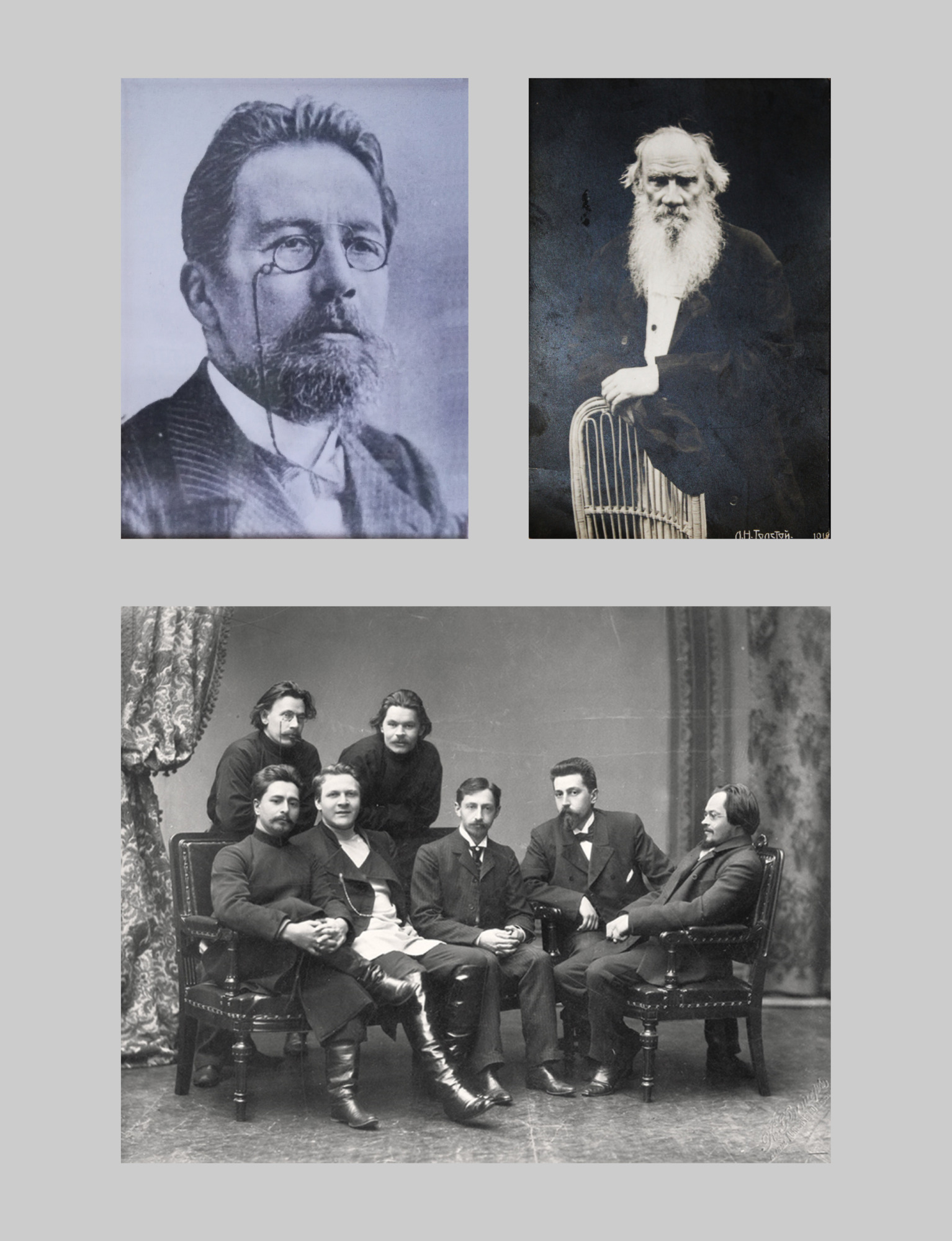
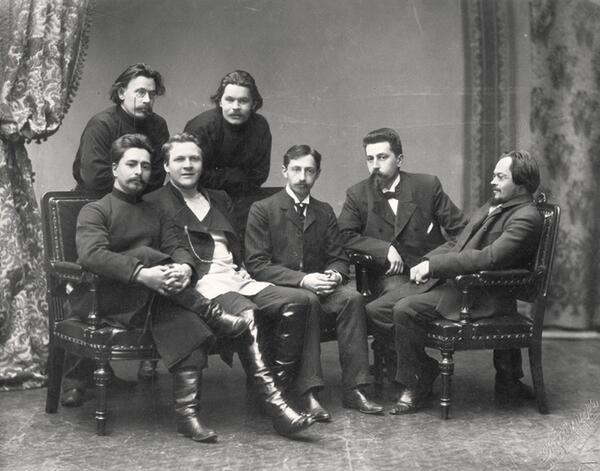
Members of ‘Wednesday’ Moscow literary society. A photocopy
#15
#16
The photo shows the members of the Moscow literary society ‘Wednesday’, organized by the writer Nikolay Teleshov. The meetings of this society usually took place in a 2-floor mansion on the Pokrovsky boulevard. Over the years, the meetings of this society were visited by Chekhov, Gorky, KuprIn, Mamin-Sibiryak, Veresayev, Garin-Mikhailovsky, Yuly and Ivan Bunin. Singers Chaliapin and Sobinov, as well as RachmAninov and NemirOvich-DAnchenko liked to come there… Over a cup of tea, or sometimes a glass of light wine, they were discussing the new literary works. The atmosphere was friendly and relaxed. Jokes and laughing were a usual thing at these meetings. Chaliapin’s performances added special atmosphere to the meetings, he used to say about them: “It”s not like the BolshOy”s performances. BolshOy is not the place to listen to me singing, it is the meetings like this…”
“We met once for breakfast at the Moscow restaurant with German cuisine “Alpine rose”, we were having fun and spending great time, when we suddenly decided to go to a photo studio to be taken a picture. Then we had a kind of quarrel with the Wanderer. I said - Let’s go for a photo! All together! The Wanderer felt offended… Everything could end up in a quarrel, but then everybody started laughing. Chaliapin shouted - Bravo! Of course, we have our photos taken quite often, but at least we’ll leave something for our children to remember us. It happens so that today you’re safe and sound, singing, tomorrow you’re gone’.
Bunin I.A. ‘Chaliapin’
The regular members of this society were given nicknames originating from the names of Moscow streets, squares and avenues. They called it - ‘to give addresses’ This was always done openly, without any offences.
‘For example, Evgeny Goslavsky, as he usually kept silent during any disputes, was called “Bolshaya Molchanovka”, and another fellow, Lev Khitrovo, on the contrary, for his passion to making speeches was called “Samoteka”; Gorky… received the address of the famous Moscow square “Khitrovka”, this place had a bad fame as it had plenty of doss houses and dens; Chaliapin was given the name “Razgulyay”. The younger Bunin, partly for his leanness, partly for his wit, which made others have a tough row to hoe, was called “ZhivodYorka”, and mild BeloUsov — “PrechIstenka”; Alexander Serafimovich received the address “Kudrino” for his bald head; Vikenty Veresayev was called “Stone Bridge” for inviolability of his opinions; ChIrikov was called “Lobnoye Mesto” for his high forehead; KuprIn was called “Konnaya Ploschad” for his passion for horses and the circus.’
Teleshov N.D. ‘Writer’s notes’
“We met once for breakfast at the Moscow restaurant with German cuisine “Alpine rose”, we were having fun and spending great time, when we suddenly decided to go to a photo studio to be taken a picture. Then we had a kind of quarrel with the Wanderer. I said - Let’s go for a photo! All together! The Wanderer felt offended… Everything could end up in a quarrel, but then everybody started laughing. Chaliapin shouted - Bravo! Of course, we have our photos taken quite often, but at least we’ll leave something for our children to remember us. It happens so that today you’re safe and sound, singing, tomorrow you’re gone’.
Bunin I.A. ‘Chaliapin’
The regular members of this society were given nicknames originating from the names of Moscow streets, squares and avenues. They called it - ‘to give addresses’ This was always done openly, without any offences.
‘For example, Evgeny Goslavsky, as he usually kept silent during any disputes, was called “Bolshaya Molchanovka”, and another fellow, Lev Khitrovo, on the contrary, for his passion to making speeches was called “Samoteka”; Gorky… received the address of the famous Moscow square “Khitrovka”, this place had a bad fame as it had plenty of doss houses and dens; Chaliapin was given the name “Razgulyay”. The younger Bunin, partly for his leanness, partly for his wit, which made others have a tough row to hoe, was called “ZhivodYorka”, and mild BeloUsov — “PrechIstenka”; Alexander Serafimovich received the address “Kudrino” for his bald head; Vikenty Veresayev was called “Stone Bridge” for inviolability of his opinions; ChIrikov was called “Lobnoye Mesto” for his high forehead; KuprIn was called “Konnaya Ploschad” for his passion for horses and the circus.’
Teleshov N.D. ‘Writer’s notes’
#21
Full name: Members of “Wednesday” Moscow literary society. A photocopy
Author: Durnev Vladimir Gerasimovich
Date: 2000 year
Technique: photography
Collection: Yelets Local History Museum
Copyright: Yelets Local History Museum
Author: Durnev Vladimir Gerasimovich
Date: 2000 year
Technique: photography
Collection: Yelets Local History Museum
Copyright: Yelets Local History Museum
#25
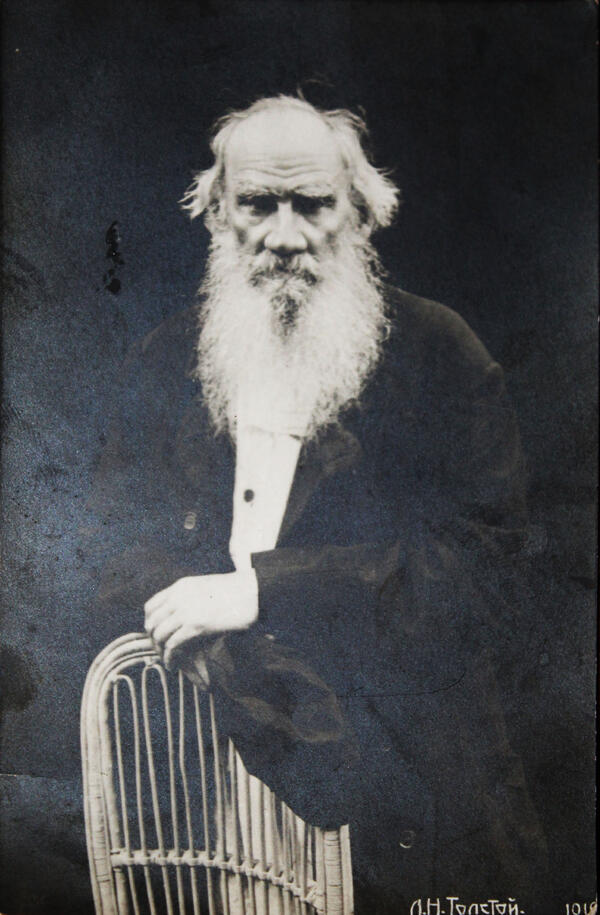
Tolstoy Lev Nikolaevich. A photocopy
#17
#18
As a child, BUnin had heard from his father about TolstOy, whom he his father met in Sevastopol during the Russian-Turkish war. Once in the autumn, Ivan had an irresistible desire to see the writer he adored, whose estate in YAsnaya PolyAna was only a hundred versts from OzYOrki. He saddled a horse and went towards the estate of the great writer. After reaching EfrEmov, BUnin got tired and spent the night on a bench in the city garden. In the morning, shivering with cold and ashamed of his desire, he turned back.
On July 15, 1893, the beginner poet sent his first book of poems and a letter from PoltAva to the famous writer: ‘Dear Lev NikolAevich! Do not be surprised that you will receive a kind of leaflet with this letter, which may be completely unnecessary and uninteresting to you. I am sending that you as to the person whose every word is dear to me, whose works revealed a passion for writing with me (if I dare to use this word when referring to myself).’ In a winter evening between January 4 and 8, 1894, BUnin visited Lev TolstOy in Moscow, he had long dreamt of this meeting. In the story ‘At the dacha’ written in 1895, BUnin reflected his attitude to the Tolstoy proponents, with whom he had already become well acquainted in PoltAva. In 1908, BUnin was a member of the Committee to celebrate the 80th anniversary of TolstOy’s birth. The last time he met TolstOy was at the beginning of winter in 1901, on a frosty evening in Moscow.
He later told Chukovsky about this meeting. When Tolstoy asked if he was working on anything, Bunin replied: “No, Lev Nikolaevich, nothing to write about. And everything that I wrote before, now seems so miserable that I prefer not to remember it. He perked up: “Oh, yes, yes, I know that very well!” - “And there”s nothing to write about, ” I added. He looked at me hesitantly, then it seemed that he had remembered something. “How can it be - nothing?”, he asked. — “If there is nothing to write about, then write that you have nothing to write about, and write and why there is nothing.” Think about why, and write. Yes, yes, try this, - he said firmly.’
Baboreko A., Bunin I.A. ‘Materials for the biography’
‘Bunin’s book is an attempt to look at Tolstoy once again, to experience what he had written. From this point of view, the author succeeded in that very much. From the vast amount of literature about Tolstoy, Bunin extracted and extremely convincingly compared the most sharp and expressive features. He made excellent narration on the basis of the most interesting stories about Tolstoy — according to deceased Ekaterina Lopatina. But what seems to be the best of all, are, of course, the Bunin’s own recollections of his few and brief meetings with Tolstoy, which still were very remarkable. The powerful simplicity of the language, the extraordinary vigilance, and finally - the inner warm strictness make these pages, frankly speaking, deserving the signature of Tolstoy himself. In all the memoir literature about Tolstoy, of course, they have nothing to be compared with.’ ‘The liberation of Tolstoy’ is a book about the living Tolstoy and a book full of a living sense of Tolstoy. It was written in order to communicate this feeling.’
Khodasevich V.M. Paris, Revival newspaper, October 1, 1937
On July 15, 1893, the beginner poet sent his first book of poems and a letter from PoltAva to the famous writer: ‘Dear Lev NikolAevich! Do not be surprised that you will receive a kind of leaflet with this letter, which may be completely unnecessary and uninteresting to you. I am sending that you as to the person whose every word is dear to me, whose works revealed a passion for writing with me (if I dare to use this word when referring to myself).’ In a winter evening between January 4 and 8, 1894, BUnin visited Lev TolstOy in Moscow, he had long dreamt of this meeting. In the story ‘At the dacha’ written in 1895, BUnin reflected his attitude to the Tolstoy proponents, with whom he had already become well acquainted in PoltAva. In 1908, BUnin was a member of the Committee to celebrate the 80th anniversary of TolstOy’s birth. The last time he met TolstOy was at the beginning of winter in 1901, on a frosty evening in Moscow.
He later told Chukovsky about this meeting. When Tolstoy asked if he was working on anything, Bunin replied: “No, Lev Nikolaevich, nothing to write about. And everything that I wrote before, now seems so miserable that I prefer not to remember it. He perked up: “Oh, yes, yes, I know that very well!” - “And there”s nothing to write about, ” I added. He looked at me hesitantly, then it seemed that he had remembered something. “How can it be - nothing?”, he asked. — “If there is nothing to write about, then write that you have nothing to write about, and write and why there is nothing.” Think about why, and write. Yes, yes, try this, - he said firmly.’
Baboreko A., Bunin I.A. ‘Materials for the biography’
‘Bunin’s book is an attempt to look at Tolstoy once again, to experience what he had written. From this point of view, the author succeeded in that very much. From the vast amount of literature about Tolstoy, Bunin extracted and extremely convincingly compared the most sharp and expressive features. He made excellent narration on the basis of the most interesting stories about Tolstoy — according to deceased Ekaterina Lopatina. But what seems to be the best of all, are, of course, the Bunin’s own recollections of his few and brief meetings with Tolstoy, which still were very remarkable. The powerful simplicity of the language, the extraordinary vigilance, and finally - the inner warm strictness make these pages, frankly speaking, deserving the signature of Tolstoy himself. In all the memoir literature about Tolstoy, of course, they have nothing to be compared with.’ ‘The liberation of Tolstoy’ is a book about the living Tolstoy and a book full of a living sense of Tolstoy. It was written in order to communicate this feeling.’
Khodasevich V.M. Paris, Revival newspaper, October 1, 1937
#19
Full name: Tolstoy Lev Nikolaevich. A photocopy
Author: Goloschapov Boris Vladimirovich
Date: 1991 year
Technique: photography
Dimensions: 29×21 cm
Collection: Yelets Local History Museum
Copyright: Yelets Local History Museum
Author: Goloschapov Boris Vladimirovich
Date: 1991 year
Technique: photography
Dimensions: 29×21 cm
Collection: Yelets Local History Museum
Copyright: Yelets Local History Museum
read morehide
00:00
00:00
1x
Writers-contemporaries of Bunin I.A.
Collection
Exhibition
0
 Point your smartphone camera to open in the app
Open in app
Share