

#12
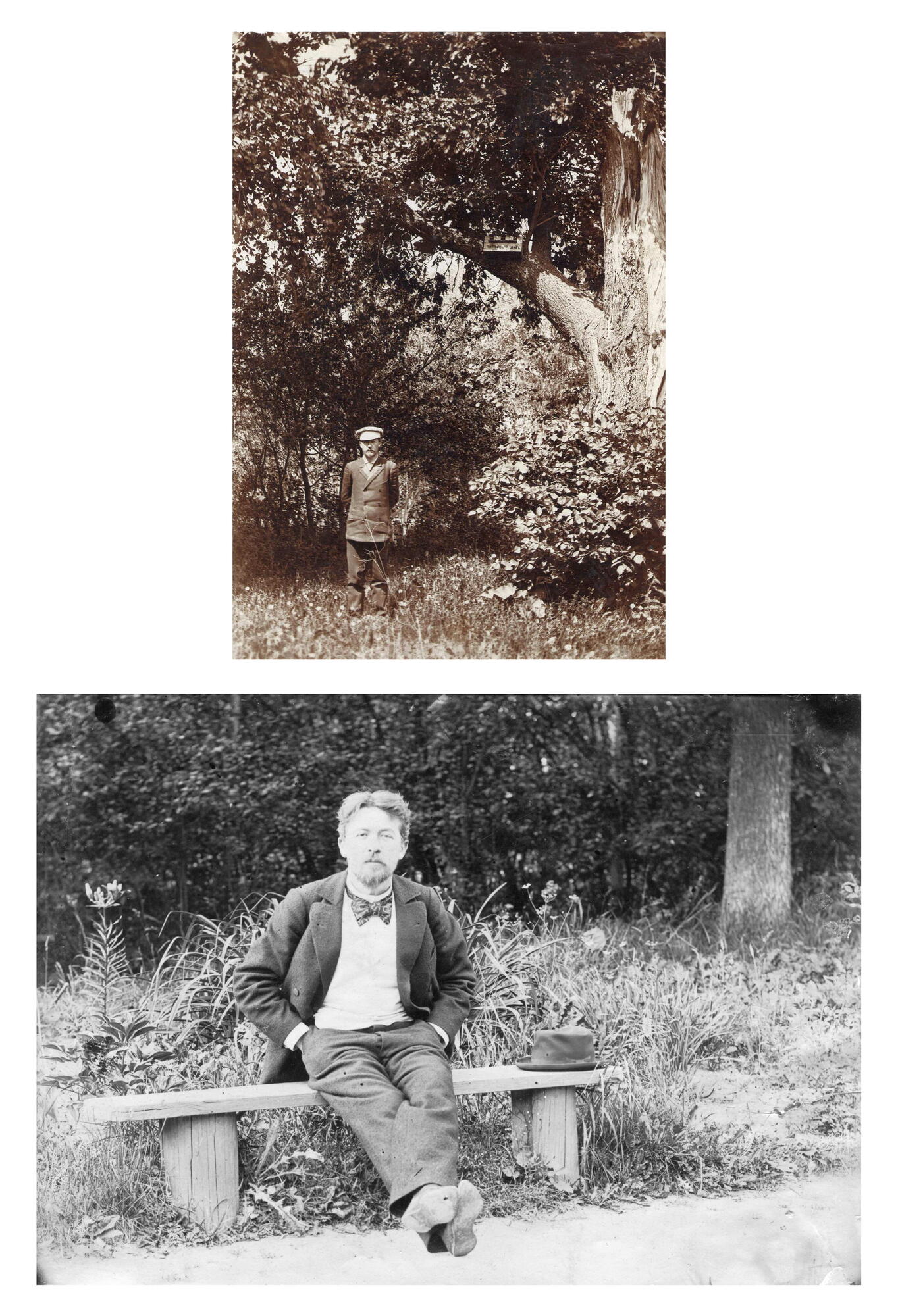
Anton Chekhov at “The Oak of Mamre”
#20
The picture shows Anton Pavlovich Chekhov at his estate in Melikhovo. To his right is an old elm tree, which the Chekhovs called “The Oak of Mamre”. This is the first summer of the Chekhovs at the estate, so the garden is not yet quite tidy. The writer’s elder brother Alexander Chekhov reminisced, “The garden had been neglected, and this added a special charm to it. It was all overgrown with tall, dense grass, and there was an old branchy tree with a hollow trunk almost two girths thick, which was called ‘The Oak of Mamre’ from the Bible; it was especially beautiful and even majestic in its kind, compared to the young stock.”
The Melikhovo elm was indeed similar to the images and descriptions of the tree in the valley of Mamre — sprawling, powerful, with a bifurcated trunk. According to the tradition, Abraham met God and three angels under the Oak of Mamre. This story is widely depicted in the icons “The Old Testament Trinity” and “The Hospitality of Abraham”.
At the end of the 19th century, the legend of the Oak of Mamre gained particular popularity because a tree was found in Palestine that was recognized as a genuine biblical relic. The land around it was bought by the Orthodox Archimandrite Antoninus, and the Holy Trinity Monastery was founded nearby. The tree attracted pilgrims from all over the world, and the image of the Oak of Mamre began to feature in photographs, drawings, and postcards. Anton Pavlovich could have seen some of them and, in his inherent sense of wit and respect, chose this name for his own tree.
Alexander Chekhov recalled that his brother Mikhail had attached a birdhouse with three compartments on one of the thick side branches of “The Oak of Mamre”. The inscription on the birdhouse read “Drinking House”. There were many birdhouses scattered around the garden. Anton Pavlovich was very keen to see the spring come, he was excited about the melting of the snow, the swelling of the buds and the arrival of the birds. He was especially fond of starlings and in his letters to Alexander wrote, “Starlings have already arrived here, they have begun to build their nests and sing. And what about you in the north? Have they not come there yet?”
The Melikhovo elm was indeed similar to the images and descriptions of the tree in the valley of Mamre — sprawling, powerful, with a bifurcated trunk. According to the tradition, Abraham met God and three angels under the Oak of Mamre. This story is widely depicted in the icons “The Old Testament Trinity” and “The Hospitality of Abraham”.
At the end of the 19th century, the legend of the Oak of Mamre gained particular popularity because a tree was found in Palestine that was recognized as a genuine biblical relic. The land around it was bought by the Orthodox Archimandrite Antoninus, and the Holy Trinity Monastery was founded nearby. The tree attracted pilgrims from all over the world, and the image of the Oak of Mamre began to feature in photographs, drawings, and postcards. Anton Pavlovich could have seen some of them and, in his inherent sense of wit and respect, chose this name for his own tree.
Alexander Chekhov recalled that his brother Mikhail had attached a birdhouse with three compartments on one of the thick side branches of “The Oak of Mamre”. The inscription on the birdhouse read “Drinking House”. There were many birdhouses scattered around the garden. Anton Pavlovich was very keen to see the spring come, he was excited about the melting of the snow, the swelling of the buds and the arrival of the birds. He was especially fond of starlings and in his letters to Alexander wrote, “Starlings have already arrived here, they have begun to build their nests and sing. And what about you in the north? Have they not come there yet?”
#21
Наименование: Anton Chekhov at “The Oak of Mamre”
Размеры: 14,2×9,1 см
Коллекция: The Manor House of Anton Chekhov in Melikhovo
Правообладатель изображений: The Manor House of Anton Chekhov in Melikhovo
Размеры: 14,2×9,1 см
Коллекция: The Manor House of Anton Chekhov in Melikhovo
Правообладатель изображений: The Manor House of Anton Chekhov in Melikhovo
#23
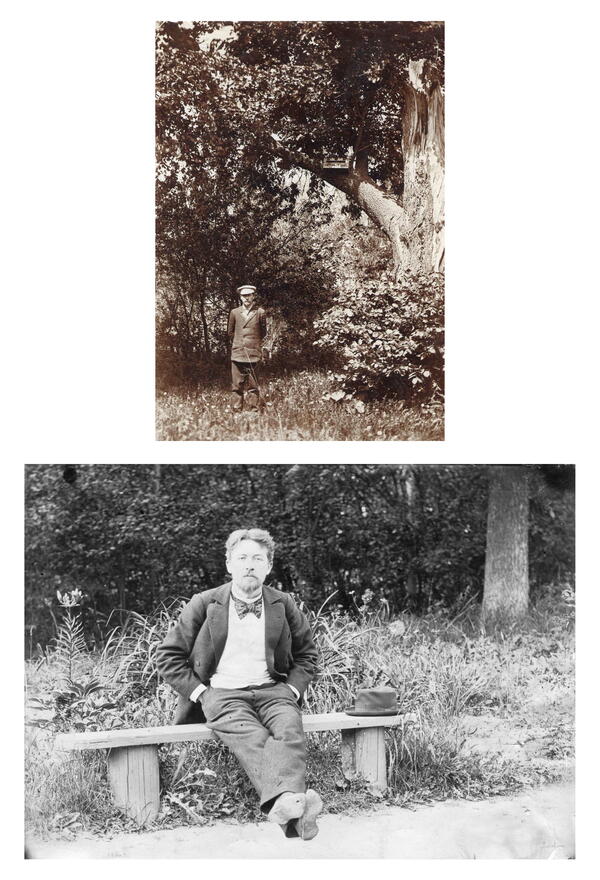
Anton Chekhov on the Bench
#24
When Anton Chekhov bought the estate in Melikhovo, there was a heavily overgrown, irregular plot of land around the house. It took the Chekhovs several years to plant an orchard and a vegetable garden. Anton Chekhov wrote to his publisher Alexei Suvorin, “How many trees I have planted! Thanks to our cultivation, Melikhovo is now beyond recognition and looks incredibly cozy and beautiful.”
The writer Tatiana L. Shchepkina-Kupernik reminisced, “Anton Pavlovich spent all his time free from work and studies in the garden. He would plant, sow, coat apple trees with something white, prune roses and was proud of his garden.”
Anton Pavlovich was particularly passionate about planting flowers and trees. In his garden he was able to arrange a continuous succession of blooming. As soon as the snow melted, blue crocuses came up, followed by red tulips and bluebells. In the garden there were asters, dahlias, lilies, delphiniums, zinnias, gladioluses, mallows, but most importantly — roses. Anton Pavlovich loved roses most of all, took great care of them himself, and when he was away, he would ask about the roses in letters and provide his instructions.
Anton Chekhov wrote, “We have not had any rain, everything is drying up, but the garden is good, my roses are blooming wonderfully.” Besides flowers, the writer took care of a small pond in front of the house, where in the first winter he dumped snow for more water, and later put some fish there. Rarely did any of Chekhov’s friends dare to bathe in the small, weedy pond, but there were those brave enough to do it.
Shchepkina-Kupernik wrote in her memoirs, “He showed each alley, each tree in a special light: ‘These pines look particularly good at sunset, when the trunks are quite red. The Oak of Mamre — that was what he called the old and branchy oak tree, a remnant of the old garden — you have to look at it at twilight, it’s so mysterious at that time…’.”
When fruit was ripe in the garden, the Chekhovs would gather all the village children and treat them to apples, cherries, and gooseberries. Anton Chekhov wrote, “We have so many cherries that we don’t know what to do with them. There is no one to pick gooseberries. I have never been so rich. I stand under a tree eating cherries, and it feels strange that no one is chasing me. I used to get my ears pulled for berries every day when I was a kid.”
The writer Tatiana L. Shchepkina-Kupernik reminisced, “Anton Pavlovich spent all his time free from work and studies in the garden. He would plant, sow, coat apple trees with something white, prune roses and was proud of his garden.”
Anton Pavlovich was particularly passionate about planting flowers and trees. In his garden he was able to arrange a continuous succession of blooming. As soon as the snow melted, blue crocuses came up, followed by red tulips and bluebells. In the garden there were asters, dahlias, lilies, delphiniums, zinnias, gladioluses, mallows, but most importantly — roses. Anton Pavlovich loved roses most of all, took great care of them himself, and when he was away, he would ask about the roses in letters and provide his instructions.
Anton Chekhov wrote, “We have not had any rain, everything is drying up, but the garden is good, my roses are blooming wonderfully.” Besides flowers, the writer took care of a small pond in front of the house, where in the first winter he dumped snow for more water, and later put some fish there. Rarely did any of Chekhov’s friends dare to bathe in the small, weedy pond, but there were those brave enough to do it.
Shchepkina-Kupernik wrote in her memoirs, “He showed each alley, each tree in a special light: ‘These pines look particularly good at sunset, when the trunks are quite red. The Oak of Mamre — that was what he called the old and branchy oak tree, a remnant of the old garden — you have to look at it at twilight, it’s so mysterious at that time…’.”
When fruit was ripe in the garden, the Chekhovs would gather all the village children and treat them to apples, cherries, and gooseberries. Anton Chekhov wrote, “We have so many cherries that we don’t know what to do with them. There is no one to pick gooseberries. I have never been so rich. I stand under a tree eating cherries, and it feels strange that no one is chasing me. I used to get my ears pulled for berries every day when I was a kid.”
#25
Наименование: Anton Chekhov on the Bench
Размеры: 10,5×15 см
Коллекция: The Manor House of Anton Chekhov in Melikhovo
Правообладатель изображений: The Manor House of Anton Chekhov in Melikhovo
Размеры: 10,5×15 см
Коллекция: The Manor House of Anton Chekhov in Melikhovo
Правообладатель изображений: The Manor House of Anton Chekhov in Melikhovo
#26
Ministry of Culture of the Russian Federation
read morehide
Chekhov at the Mamvri oak, Chekhov on the bench
Collection
0
 Point your smartphone camera to open in the app
Open in app
Share