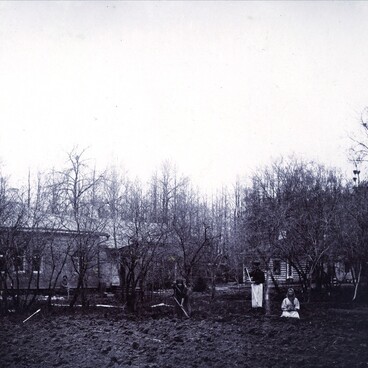
Chekhov et al., Temptation of Anthony, Works
Creation period
Place of сreation
Technique
Collection
0
Open in app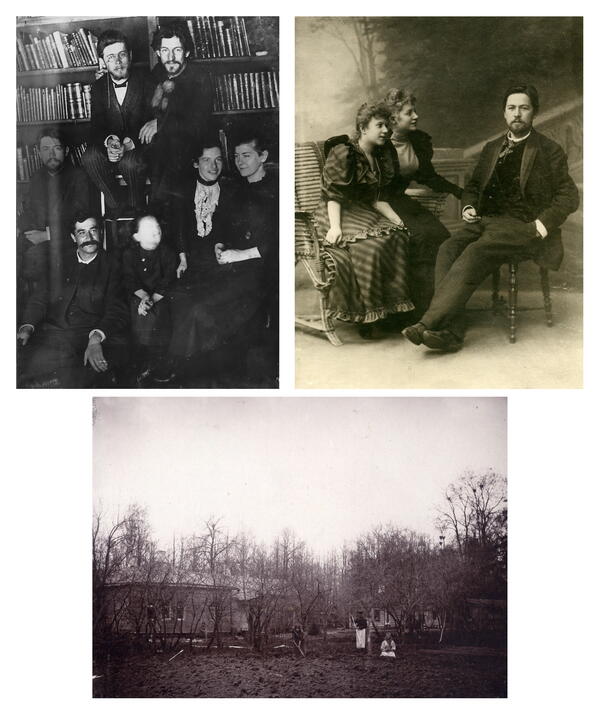
#3
Anton Chekhov with his guests
#20
The first thing Chekhov did after moving to his new estate in Melikhovo was to order shelves for books. Anton Pavlovich wrote in one of his letters, “I’m reading away.” He had a large library, which included books by Russian and foreign classics, a lot of reference literature on medicine, history, economics and gardening. Chekhov also stored some humorous magazines: “Strekoza”, “Oskolki”, and “Alarm Clock”, which published his first stories and drawings made by his brother Nikolay.
In the photo from Chekhov’s study in Melikhovo, the writer himself is on the far left. In the upper row are his brothers, Mikhail and Ivan. On the far right is his beloved sister Masha, and next to her is Aleksandra Lesova, a schoolteacher from the village. The man with the mustache is Alexander Smagin, a landowner from Poltava. Chekhov’s library was much loved by his family and guests, who were borrowing books to read. “I have already read ‘The Gardenins’, but I don’t have the book, and I will be very happy to have it. The public that use my library will also be glad.” Anton Chekhov wrote that to the author of the novel, Alexander Hertel.
Alexander Chekhov recalled, “I went to Melikhovo in winter and found guests too. Everything was the same, but only my brother, as I noticed, began to cough. However, he attributed this cough to bronchitis. Besides, there was a change in his study: the books had disappeared from the shelves. They had been sent to Taganrog, to the city library, which was later named after Chekhov.”
Anton Chekhov supported the Taganrog library for 14 years, by sending books and money. This cooperation began with a request sent through the writer’s uncle, Mitrofan Yegorovich Chekhov. Anton Pavlovich eagerly responded, sent three of his books, as well as Leo Tolstoy’s “The Power of Darkness” signed by the author and commented, “I do request the city library to accept from me all those books with author’s facsimiles, which I now have and which I have been collecting and keeping especially for the library of my hometown.” During the last ten years alone, Anton Pavlovich sent 1,693 books to the Taganrog library. When Chekhov moved to Yalta, he took with him only 160 books, including medical ones. The rest of the writer’s collection was sent to Taganrog. The last parcel with books from Chekhov came a month before his death.
In the photo from Chekhov’s study in Melikhovo, the writer himself is on the far left. In the upper row are his brothers, Mikhail and Ivan. On the far right is his beloved sister Masha, and next to her is Aleksandra Lesova, a schoolteacher from the village. The man with the mustache is Alexander Smagin, a landowner from Poltava. Chekhov’s library was much loved by his family and guests, who were borrowing books to read. “I have already read ‘The Gardenins’, but I don’t have the book, and I will be very happy to have it. The public that use my library will also be glad.” Anton Chekhov wrote that to the author of the novel, Alexander Hertel.
Alexander Chekhov recalled, “I went to Melikhovo in winter and found guests too. Everything was the same, but only my brother, as I noticed, began to cough. However, he attributed this cough to bronchitis. Besides, there was a change in his study: the books had disappeared from the shelves. They had been sent to Taganrog, to the city library, which was later named after Chekhov.”
Anton Chekhov supported the Taganrog library for 14 years, by sending books and money. This cooperation began with a request sent through the writer’s uncle, Mitrofan Yegorovich Chekhov. Anton Pavlovich eagerly responded, sent three of his books, as well as Leo Tolstoy’s “The Power of Darkness” signed by the author and commented, “I do request the city library to accept from me all those books with author’s facsimiles, which I now have and which I have been collecting and keeping especially for the library of my hometown.” During the last ten years alone, Anton Pavlovich sent 1,693 books to the Taganrog library. When Chekhov moved to Yalta, he took with him only 160 books, including medical ones. The rest of the writer’s collection was sent to Taganrog. The last parcel with books from Chekhov came a month before his death.
#21
Наименование: Anton Chekhov with his guests
Размеры: 17,5×11,8 см
Коллекция: The Manor House of Anton Chekhov in Melikhovo
Правообладатель изображений: The Manor House of Anton Chekhov in Melikhovo
Размеры: 17,5×11,8 см
Коллекция: The Manor House of Anton Chekhov in Melikhovo
Правообладатель изображений: The Manor House of Anton Chekhov in Melikhovo
#22
Photograph “The Temptation of Saint Anthony”
#23
This photograph was taken in Moscow, in Trunov’s photo studio, in the fall of 1893. In the picture are Anton Chekhov and two of his friends: the actress Lydia Borisovna Yavorskaya and the writer and translator Tatiana Lvovna Shchepkina-Kupernik. The shot was taken during a photo session for a small book of stories by Chekhov and Shchepkina-Kupernik, which was supplemented with portraits of the authors. The book was published by the editor of “The Artist” magazine Fyodor Kumanin, referred to as Sapyega in Chekhov’s correspondence.
The story of this photograph is told in the memoirs of Tatiana Shchepkina-Kupernik: “We were taken to Trunov by Kumanin, who was shooting us for “The Artist”. We were all photographed together and separately; finally, it was decided to photograph the three of us together to keep the memory. It took a long time for everyone to get seated, we laughed, and when the photographer said “look into the camera”, Anton Pavlovich turned away and made a poker face, but we just could not calm down, while laughing and pestering him with something — so Chekhov dubbed the resulting picture “The Temptation of Saint Anthony”.
The writer chose this title not only because it resembled the story, but also inspired by a two-week stay in Moscow in the fall of 1893. Having arrived from Melikhovo, Chekhov stayed at the Great Moscow Hotel. The news of this spread around Moscow with lightning speed, a large company gathered, and began to honor the guest. That was followed by visits from one editorial office to another, restaurants, dinners, theaters, and literary gatherings.
Chekhov was honored so intensely that someone jokingly compared him to Admiral Avelan. Fyodor Avelan led a Russian squadron sent to France on a friendly visit on the occasion of the conclusion of the Franco-Russian alliance. Owing to the Franco-Russian friendship, Vice-Admiral Avelan was continuously honored both in Russia and in France. Chekhov’s group of friends and acquaintances called themselves the “Avelan squadron” and referred to their activities and journeys as “sailing”. Both of Chekhov’s friends, Tatiana Schepkina-Kupernik and Lydia Yavorskaya, joined this circle with ease enjoying the atmosphere of fun, youth, play, creative improvisation. Tatyana was 19 and Lydia was 22. Like the others, the girls got their friendly nicknames: “Fantasy” and “Poetry”.
The story of this photograph is told in the memoirs of Tatiana Shchepkina-Kupernik: “We were taken to Trunov by Kumanin, who was shooting us for “The Artist”. We were all photographed together and separately; finally, it was decided to photograph the three of us together to keep the memory. It took a long time for everyone to get seated, we laughed, and when the photographer said “look into the camera”, Anton Pavlovich turned away and made a poker face, but we just could not calm down, while laughing and pestering him with something — so Chekhov dubbed the resulting picture “The Temptation of Saint Anthony”.
The writer chose this title not only because it resembled the story, but also inspired by a two-week stay in Moscow in the fall of 1893. Having arrived from Melikhovo, Chekhov stayed at the Great Moscow Hotel. The news of this spread around Moscow with lightning speed, a large company gathered, and began to honor the guest. That was followed by visits from one editorial office to another, restaurants, dinners, theaters, and literary gatherings.
Chekhov was honored so intensely that someone jokingly compared him to Admiral Avelan. Fyodor Avelan led a Russian squadron sent to France on a friendly visit on the occasion of the conclusion of the Franco-Russian alliance. Owing to the Franco-Russian friendship, Vice-Admiral Avelan was continuously honored both in Russia and in France. Chekhov’s group of friends and acquaintances called themselves the “Avelan squadron” and referred to their activities and journeys as “sailing”. Both of Chekhov’s friends, Tatiana Schepkina-Kupernik and Lydia Yavorskaya, joined this circle with ease enjoying the atmosphere of fun, youth, play, creative improvisation. Tatyana was 19 and Lydia was 22. Like the others, the girls got their friendly nicknames: “Fantasy” and “Poetry”.
#24
Наименование: Photograph “The Temptation of Saint Anthony”
Размеры: 12,3×8,5 см
Коллекция: The Manor House of Anton Chekhov in Melikhovo
Правообладатель изображений: The Manor House of Anton Chekhov in Melikhovo
Размеры: 12,3×8,5 см
Коллекция: The Manor House of Anton Chekhov in Melikhovo
Правообладатель изображений: The Manor House of Anton Chekhov in Melikhovo
#25
Spring work in the garden
#26
The writer’s father, Pavel Yegorovich Chekhov, wrote in his diary on April 25, 1897, “We began to make vegetable beds in the garden.” This photograph was taken at the Melikhovo estate in April, after Anton Pavlovich was discharged from the hospital, where he was finally diagnosed with tuberculosis. A month before that he had had a serious attack of the disease: he was bleeding from his throat.
Anton Pavlovich wrote in April 1897, “I am at home now. Before the holiday I was in the Ostroumov clinic for two weeks, coughing up blood; the doctors determined an apical process in the lungs. I feel great, nothing hurts, nothing bothers me inside, but the doctors forbade me from drinking, moving, and talking; they told me to eat a lot, forbade me to work — and I feel a bit bored. I do nothing, feed the sparrows on hemp seeds and prune one rose a day. After my pruning, the roses bloom splendidly. I don’t do household chores.” Anton Pavlovich had the idea of having a bell set up in the front garden. The guests and family were often late for dinner, it was difficult to get together all those who had a rest in the garden, worked on the vegetable patch or went for a swim to the Big Pond. The bell rang daily at noon, it was the signal for dinner for the Chekhov family, guests of the estate and peasants in the village.
The writer’s brother Mikhail Chekhov, recalled, “As we got up early, when the sun rose, we had an early lunch: at twelve o’clock in the afternoon. Anton Pavlovich bought a bell and hung it in the estate on a high pole. Once a day, at exactly twelve o’clock in the afternoon, Frol, or someone else, was to strike twelve times, and the whole neighborhood, within a radius of six or seven versts, upon hearing the bell, would quit their work and sit down to lunch. At eleven o’clock in the morning, after Anton Pavlovich had had enough time to work and write, he would come into the dining-room and take a silent but meaningful look at his watch. His mother would at once jump up from behind the sewing-machine and start fussing: ‘Oh, dear me, Antosha is hungry! ’ The bell to the kitchen, which was in a separate room, started to rattle. Anyuta and Masha came running in, and preparations for lunch began.”
Anton Pavlovich wrote in April 1897, “I am at home now. Before the holiday I was in the Ostroumov clinic for two weeks, coughing up blood; the doctors determined an apical process in the lungs. I feel great, nothing hurts, nothing bothers me inside, but the doctors forbade me from drinking, moving, and talking; they told me to eat a lot, forbade me to work — and I feel a bit bored. I do nothing, feed the sparrows on hemp seeds and prune one rose a day. After my pruning, the roses bloom splendidly. I don’t do household chores.” Anton Pavlovich had the idea of having a bell set up in the front garden. The guests and family were often late for dinner, it was difficult to get together all those who had a rest in the garden, worked on the vegetable patch or went for a swim to the Big Pond. The bell rang daily at noon, it was the signal for dinner for the Chekhov family, guests of the estate and peasants in the village.
The writer’s brother Mikhail Chekhov, recalled, “As we got up early, when the sun rose, we had an early lunch: at twelve o’clock in the afternoon. Anton Pavlovich bought a bell and hung it in the estate on a high pole. Once a day, at exactly twelve o’clock in the afternoon, Frol, or someone else, was to strike twelve times, and the whole neighborhood, within a radius of six or seven versts, upon hearing the bell, would quit their work and sit down to lunch. At eleven o’clock in the morning, after Anton Pavlovich had had enough time to work and write, he would come into the dining-room and take a silent but meaningful look at his watch. His mother would at once jump up from behind the sewing-machine and start fussing: ‘Oh, dear me, Antosha is hungry! ’ The bell to the kitchen, which was in a separate room, started to rattle. Anyuta and Masha came running in, and preparations for lunch began.”
#27
Наименование: Spring work in the garden
Размеры: 17,5×26 см
Коллекция: The Manor House of Anton Chekhov in Melikhovo
Правообладатель изображений: The Manor House of Anton Chekhov in Melikhovo
Размеры: 17,5×26 см
Коллекция: The Manor House of Anton Chekhov in Melikhovo
Правообладатель изображений: The Manor House of Anton Chekhov in Melikhovo
#28
Ministry of Culture of the Russian Federation
read morehide
Chekhov et al., Temptation of Anthony, Works
Creation period
Place of сreation
Technique
Collection
0
 Point your smartphone camera to open in the app
Open in app
Share