Khakass nomadic life was always closely connected with music. The Khakass national culture had many musical instruments: two-stringed and three-stringed plucked khomys, two-stringed bow yykh, wind khobrakh, reed plucked timir khomys, percussion tur and others.
But the main and most widespread national instrument, which has only Khakass roots, is chatkhan. From ancient times, the Khakass people used it for solo performances and accompaniment, less often as an ensemble. Since it was created (according to some chronicles, in the 11th century) up to the present day the chatkhan underwent many changes among different Khakass ethnic groups (Kyzyl, Kachin, Sagay).
Initially, the tool was carved out of a single piece of cedar or pine. Later versions began to be chipped or glued together from separate planks. Early chatkhans had only three or four strings, which were made from animal tendons and guts or horsehair. Over time, their number increased to six or seven, and stronger and more durable strings were made from metals such as copper, brass, and steel. Nowadays chatkhans may have up to 12 strings. Usually, the instrument was tuned by using movable stands made from bone that were under each string.
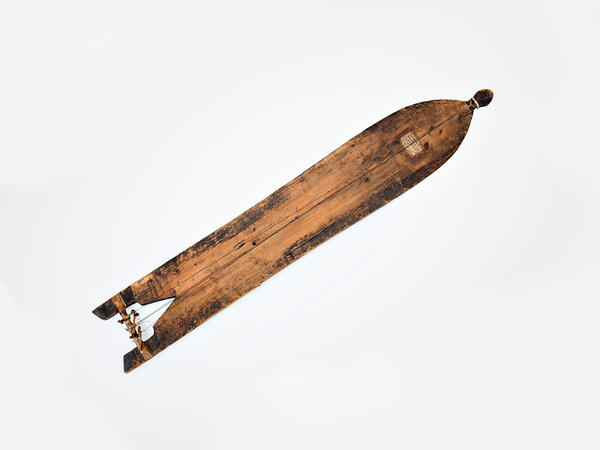
The chatkhan from the museum collection was created in the 19th century. The instruments similar to this one could have from seven to nine strings of wire or sheep’s guts.
The chatkhan was played sitting on a chair. Less often players sat on the floor on a large piece of felt or a leather mat with their feet tucked under them. One edge of the instrument was placed on the knees and the other rested on the floor. The second edge of the modern chatkhans is placed on special supporting legs. The fingers of the right hand would extract sounds from the strings by plucking or tapping, and the left hand would raise or lower the sound or add semitones.
The Khakass chatkhan is accompanied by khai — throat singing. This is a traditional vocal art. One of the most important and major genres of the Khakass folklore is alyptych nymakha, heroic stories, which are accompanied by the instrument when told. The chatkhan was the obligatory instrument of khaiji (storytellers of the Khakass epos) and takhpakhchi (singers).
But the main and most widespread national instrument, which has only Khakass roots, is chatkhan. From ancient times, the Khakass people used it for solo performances and accompaniment, less often as an ensemble. Since it was created (according to some chronicles, in the 11th century) up to the present day the chatkhan underwent many changes among different Khakass ethnic groups (Kyzyl, Kachin, Sagay).
Initially, the tool was carved out of a single piece of cedar or pine. Later versions began to be chipped or glued together from separate planks. Early chatkhans had only three or four strings, which were made from animal tendons and guts or horsehair. Over time, their number increased to six or seven, and stronger and more durable strings were made from metals such as copper, brass, and steel. Nowadays chatkhans may have up to 12 strings. Usually, the instrument was tuned by using movable stands made from bone that were under each string.
The chatkhan from the museum collection was created in the 19th century. The instruments similar to this one could have from seven to nine strings of wire or sheep’s guts.
The chatkhan was played sitting on a chair. Less often players sat on the floor on a large piece of felt or a leather mat with their feet tucked under them. One edge of the instrument was placed on the knees and the other rested on the floor. The second edge of the modern chatkhans is placed on special supporting legs. The fingers of the right hand would extract sounds from the strings by plucking or tapping, and the left hand would raise or lower the sound or add semitones.
The Khakass chatkhan is accompanied by khai — throat singing. This is a traditional vocal art. One of the most important and major genres of the Khakass folklore is alyptych nymakha, heroic stories, which are accompanied by the instrument when told. The chatkhan was the obligatory instrument of khaiji (storytellers of the Khakass epos) and takhpakhchi (singers).