Font
Color
Graphics
Изображение точки

To see AR mode in action:

1. Install ARTEFACT app for iOS or Android;

2. Find the exhibition «Old Novorossiysk»

3. Push the «Augmented reality» button and point your phone's camera at the exhibit;

Скрыть точки интересаПоказать точки интереса
Показать в высоком качестве

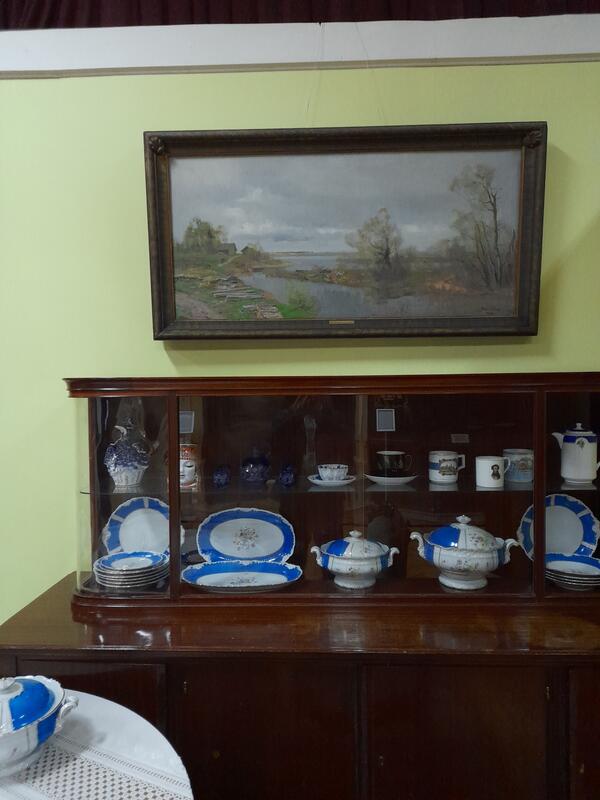
Tea cup, Mug “Milk”, Picture

0
Open in app
#8
Tea cup
#3
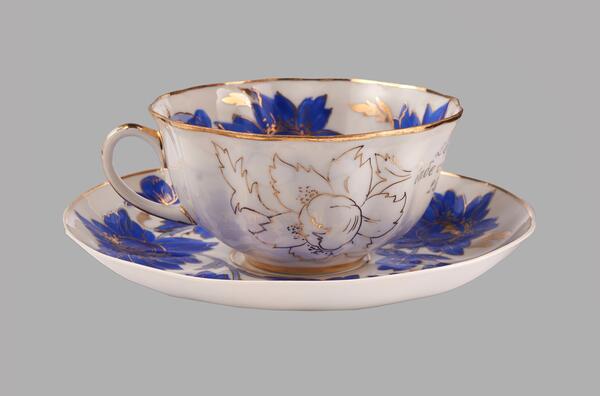
The tea cup, displayed in the museum’s permanent exhibition, belonged to the family of the Soviet writer Fyodor Vasilyevich Gladkov. The cup is presented in the interior of the “Living room of Fyodor Vasilyevich Gladkov”. His name is connected with Novorossiysk. Fyodor Gladkov wrote the novel “Cement”, dedicated to the restoration of the cement industry, which made him famous throughout the country. The novel reflected Gladkov’s impressions of Novorossiysk, where he repeatedly lived.

This is a rounded tea cup on a ring leg, with a vertical convex relief on the body. The rim is wavy, the inside is painted with blue flowers and gold, the contours of flowers are painted with gold on the outside, as well as the handle. The tea cup was made by the porcelain artist Ivan Grigorievich Konkov and produced at the Dulyovo Porcelain Factory.

The Dulyovo Porcelain Factory was founded in 1832, when the merchant Terenty Kuznetsov acquired the land of the Dulyovo wasteland near the village of Likino and built a porcelain factory there. Later, the city of Likino-Dulyovo appeared there. At the end of the 19th century, the factory was a member of the “Partnership for the Production of Porcelain and Faience Products of M.S. Kuznetsov”. Kuznetsov became a faience magnate, a supplier to the imperial court. The Dulyovo factory was one of the most successful enterprises of the partnership. The products of the Dulyovo factory were valued in Russia and around the world.

The secret of the worldwide success lay in the talent of craftsmen and artists, as well as in a special way of processing materials and fuel quality. To make clay especially malleable, it was kept in cellars for a year, which was called “letovanie” (which can be loosely translated as “summering”). Peat was collected only until July 20, since the later one did not dry out by the time of use.

During the Soviet period, the Dulyovo factory was nationalized and remained one of the best enterprises in the industry. Back then many factory artisans received awards at world exhibitions, including the artist Ivan Grigorievich Konkov. After 1991, the Dulyovo factory had financial difficulties, and in 2012, the factory was sold to Russian entrepreneurs. Now it is a completely modernized enterprise.
#9
Наименование: Tea cup
Дата создания: 1956
Техника: factory made, firing, overglaze painting
Размеры: 11,5×10 cm
Правообладатель изображений: Novorossiysk Historical Museum-Reserve
Коллекция: Novorossiysk Historical Museum-Reserve
Место создания: Likino-Dulyovo, the USSR
#10
Mug “Milk”
#5
An interesting product of the Lomonosov Porcelain Factory (LFZ) is presented in the interior of the writer Fyodor Vasilyevich Gladkov. It is a mug (milk jug) with the face of a girl in a national headdress.

The decorative mug LFZ “Milk” was released in memory of the famous sculptor Natalya Yakovlevna Danko. The sculptor designed the model in 1919 and it became her most famous work.

In addition to LFZ, at least five more factories produced milk jugs in the shape of an Asian woman’s head. Those were the Tuymazinsky Porcelain and Tuymazinsky Medical Glass Factory, the Tbilisi Ceramic Plant, the Kislovodsk Porcelain Factory, NPO Elektrokeramika in Leningrad, and the Velikoluksky Electrotechnical Porcelain Factory.

The handle of the mug is massive, the edge is straight, the body is oval-shaped, and the bottom is flat. The mug is painted in a fabulous, almost fantastic manner characteristic of the artist Alexey Viktorovich Vorobyovsky. The painting features elegant thin brushstrokes that remind of the world of Persian miniatures. The mug’s design — a woman’s face — clearly has Asian features: a slit of closed eyes, black thin crescent-shaped eyebrows, a bright headdress, and rich colors.

The mug is known in many pictorial versions, has many repetitions and almost always becomes the first item in the collection of a novice collector of LFZ products.

The world-famous plant was founded in 1744 by the order of Empress Elizaveta Petrovna. It was originally called the Nevsky Porcelain Factory, from 1765 — the Imperial Porcelain Factory, from 1917 — the State Porcelain Factory, in 1925 the factory was named after M.V. Lomonosov to commemorate the 200th anniversary of the Russian Academy of Sciences. In 2005, the factory changed its name to the Imperial Porcelain Factory. For a long time, the factory used a brand in the form of three interlaced letters — LFZ. Since 1991, an inscription has appeared under the abbreviation: Made in Russia. Currently, the plant uses a maker’s mark, which features a blue double-headed eagle.
#11
Наименование: Mug “Milk”
Дата создания: the 1940s
Техника: overglaze polychrome painting, porcelain, firing, gilding
Размеры: 13,5×16×11 cm
Правообладатель изображений: Novorossiysk Historical Museum-Reserve
Коллекция: Novorossiysk Historical Museum-Reserve
Место создания: Leningrad, the USSR
#12
River. Flood
#7
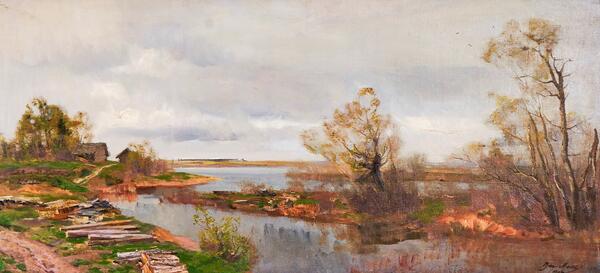
The painting “River. Flood” is presented in the interior “Living room of the writer F.V. Gladkov”.

Vasily Vasilyevich Meshkov mainly painted cityscapes. In 1914, during the First World War, he served as an artist of the Army Headquarters. During that time, he created numerous studies depicting the war. After 1917, he worked as a theater artist. In 1922, the painter joined the Association of Artists of Revolutionary Russia. After his trip to Crimea and the Caucasus from 1924 to 1925, Meshkov returned to landscape painting.

During the Great Patriotic War, Vasily Meshkov visited the front on several occasions. As a result, he created a series of works on a military theme in 1944, including a series of paintings under the general title “On the Roads of Retreat of the Nazis.”

After the war, Meshkov worked fruitfully in his favorite landscape genre. His canvases were distinguished by a special majestic and severe interpretation of Russian nature.

The painting “River. Flood” was created in the artist’s characteristic “silver” manner and echoes such famous paintings of his as “Gray Day”, “Silver Rain”, “Cold”, “After the Rain”, and “Lake”. His landscapes convey the poetic state of nature, consonant with the mood of his soul. The landscapes of Vasily Meshkov are shrouded in a silver haze; they enchant the viewer, evoking the love for the Motherland, for its groves, fields, meadows, and rivers.

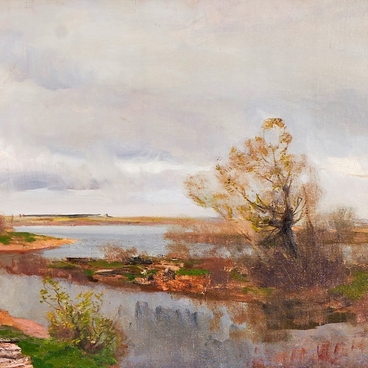
The picture accurately renders the state of nature awakening after a long winter. The low gray clouds are echoes of winter and cold, but there is no ice on the river, the young grass along the banks is emerald-green, and tender young leaves cover the tops of trees. The waters of the river are trying to overflow the banks. At first glance, the landscape looks simple and even mundane — a high bank and the vague outlines of gray houses or sheds on the hill behind the trees. However, after studying this unpretentious picture for a longer time, the viewers achieve the state of quiet joy.

This is such a familiar landscape. Motherland. That Motherland, for which bloody battles were fought somewhere. After all, the picture was painted in 1944. The war was still going on, but the victory was near. Faith in victory was getting stronger, like a river flooding in spring. It is interesting that Meshkov initially called the painting “Spring”.

According to the memoirs of Boris Fyodorovich Gladkov, the writer’s son, the painting was presented to Fyodor Vasilyevich by the artist Vasily Vasilyevich Meshkov, with whom the writer’s family maintained friendly relations.
#13
Наименование: River. Flood
Дата создания: 1944
Техника: painting, canvas, oil
Размеры: 60×120 cm
Правообладатель изображений: Novorossiysk Historical Museum-Reserve
Коллекция: Novorossiysk Historical Museum-Reserve
Место создания: the USSR
#14
read morehide
00:00
00:00
1x

Tea cup, Mug “Milk”, Picture

0
Point your smartphone camera to open in the app
Share
VkontakteOdnoklassnikiTelegram
Share on my website
Copy linkCopied
Copy
Open in app
To see AR mode in action:
  1. Install ARTEFACT app for 
  2. iOS or Android;
  3. Find and download the «Paintings in Details» exhibition
  4. Push the «Augmented reality» button and point your phone's camera at the painting;
  5. Watch what happens on your phone screen whilst you flip through the pictures.
 
We use Cookies
Cookies on the Artefact Website. We use cookies to ensure that we give you the best experience on our website. If you continue without changing your settings, we'll assume that you are happy to receive all cookies on the Artefact website. However, if you would like to, you can change your cookie settings at any time.
Learn more about useHide
Content is available only in Russian

X

Нашли опечатку?...

%title%%type%