The traditional game culture of the indigenous peoples of the North can be considered a unique system of raising children. Through games, they pass on the necessary knowledge and skills to the younger generation, educating future hunters, fishermen, reindeer herders, and homemakers.
In a traditional northern family, toys have always been treated seriously. From an early age, Khanty children are taught to make their own toys — later they help their younger siblings master the same skills. While crafting something by themselves, the child learns the purpose of the item they are making, gets a grasp of the methods required for doing that, learns to respect work and take care of objects.
All Khanty children’s toys were traditionally made of natural materials, such as clay, birch bark, wood, leather, and fur. In the past, children also often played with the bones of fish, birds, and animals, as well as their heads, paws, feathers, skins, tails, ears, and beaks.
More than just a source of entertainment, toys were regarded as a means for children to understand the world around them and their place in that world. For example, from the age of five, a girl learned to sew dolls and make traditional clothing for them — and by the time she got married, she was already able to cut sophisticated fur clothes and footwear for the whole family.
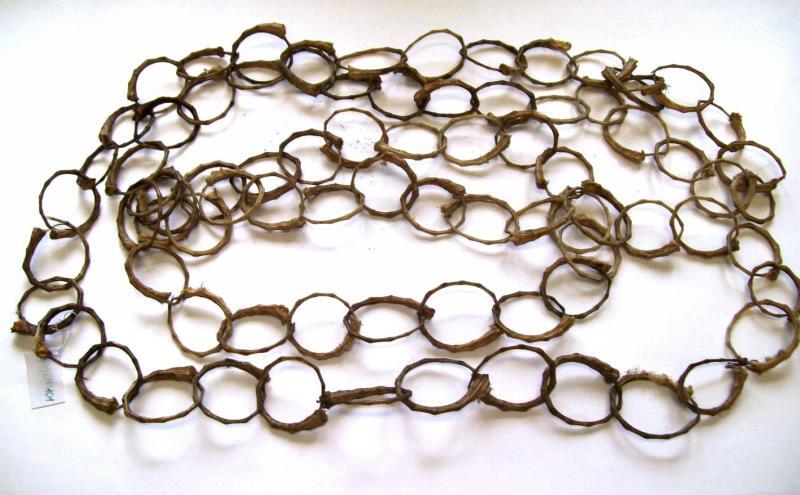
The chain from the collection of the Ethnographic Museum of the Varyogan Village is made of squirrel tails — 82 links in total. With the help of such chains, Khanty children learned to count. The number of links increased with each hunting season — and the child also got used to observing the passage of time.
When the father brought home a squirrel, each part of the carcass had its own use: paws were used as amulets, pelts were used for sewing traditional winter clothes, meat was eaten, and the bone part of the tail was added to the children’s squirrel tail chain.
The chain links were made as follows: the separated part of the squirrel tail vertebrae was cleaned of meat, fat, and other organic matter, fastened by twisting, with the thin tip of the tail inserted in the part where it was cut.
Nowadays, handmade toys are rarely used by the indigenous peoples of the North. They are made only by those families that still lead a traditional lifestyle.