Font
Color
Graphics
Изображение точки

To see AR mode in action:

1. Install ARTEFACT app for iOS or Android;

2. Find the exhibition «The Alexander Palace»

3. Push the «Augmented reality» button and point your phone's camera at the exhibit;

Скрыть точки интересаПоказать точки интереса
Показать в высоком качестве

Bust of Catherine II, Marie Antoinette, Cossacks

0
Open in app
#1
Bust of Empress Catherine II
#2
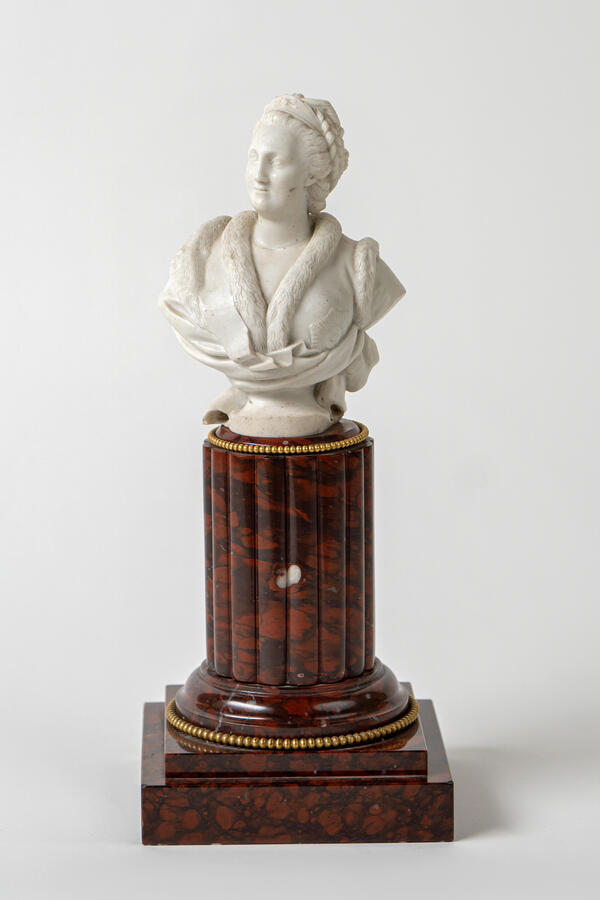
The bust of Catherine II wearing a diadem, a dress trimmed with sable, and a ribbon and star of the Order of St Andrew on her chest was made at a porcelain factory founded by a Russified Englishman called Franz Gardner. The half-length portrait of the empress is mounted on a stone pedestal decorated with bronze belts. The bust on display is a copy of the French original, created in 1779 based on a design by the French sculptor Louis-Simon Boizot, head of the sculpture workshop at the Sevres Porcelain Manufactory.

Boizot’s porcelain portrait was part of a grandiose table ornament for the famous cameo service commissioned by Catherine II from the Sevres Porcelain Manufactory in 1778–79. The table ornament was made of biscuit. The centerpiece featured the composition “Russian Parnassus” with the theme “The sciences and arts anxious to honor the Russian empress, whose victorious armies have restored peace in her country.” The service was intended for Catherine’s favorite, His Serene Highness Prince Grigory Potemkin.

In Russia, the bust, based on Louis-Simon Boizot’s model, was only produced at the Gardner Porcelain Factory in the late 18th — early 19th centuries. It is quite possible that the biscuit portrait was produced at the factory on a government commission. The sculptural portrait of Catherine II is based on an engraving after the original by the Italian artist Pietro Antonio Rotari made in 1762. The portrait was engraved several times both in Russia and in Western Europe. According to the empress herself, the portrait came out “rather well-turned.”

In 1762 Princess Ekaterina Dashkova, the Empress’s favorite and one of the most educated women of her era, composed verses to this portrait: “As Nature strove to bring Thee into the world, // Her gifts for Thee alone She exhausted. // To raise you to the top of your grandeur; // And by rewarding you with everything, She has rewarded us.”

The bust of Catherine II on a pedestal comes from the State Study of Emperor Nicholas II in the Alexander Palace and today it occupies its original place.
#3
Наименование: Bust of Empress Catherine II
Дата создания: 1779 — the early 19th century
Место создания: Gardner Factory, Verbilki village, Moscow Province, Russia
Техника: biscuit, stone, bronze
Размеры: 14×10,5×7,5 cm
#4
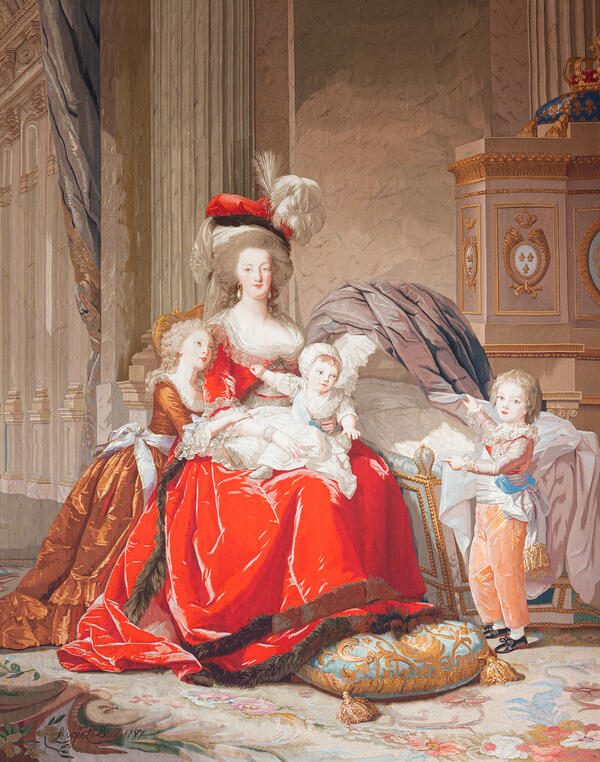
Tapestry “Marie Antoinette and Her Children”
#5
The “Marie Antoinette and Her Children” tapestry is one of the most iconic pieces in the collection of the Alexander Palace. A tapestry is a hand-woven lint-free wall rug. In a narrower sense, it is the product of the still operating manufactory in Paris, established in the suburb of Saint-Marcelle in 1662.

The tapestry placed in the Corner Drawing Room of the Empress Alexandra Feodorovna reproduces the composition of the painting by the famous French artist Elisabeth Vigée-Lebrun, which was created a few years before the Great French Revolution. It depicts Marie Antoinette, Queen of France and Navarre and wife of Louis XVI, with her three children — daughter Marie Thérèse and sons Louis Joseph Xavier Francois and Louis Carles. The fate of the queen was tragic; she was executed by guillotine during the revolution.

In 1902, the president of France, Émile Loubet, paid an official visit to Russia. On May 20 [O.S. 7 May], the French cruiser Montcalm arrived at the Kronstadt roadstead. The president boarded the imperial yacht “Alexandria” and sailed with Nicholas II to Peterhof. Later he visited the French Embassy in St. Petersburg. The next day the French delegation left for Krasnoye Selo, for the big maneuvers of the Russian army. Loubet visited Tsarskoe Selo, where a gala dinner was held at the Great Palace on May 22 [O.S. 9 May]. The president did not come empty-handed — he brought a tapestry as a gift to the empress Alexandra Feodorovna was delighted to receive the present from the head of the French Republic, and the tapestry found its place in the apartments of the crowned family. It was placed in the living room opposite the portrait of the empress.

Interestingly, some contemporaries were wary of the gift. State Secretary Alexander Polovtsov, who visited the Alexander Palace on 18 November 1905, wrote in his diary: “We reach the Corner Drawing Room through the numerous halls. There are pictures hanging on the walls: one, I think, by Neville, depicts a mounted regiment with chorus singers, another — the portrait of the reigning Empress, and a third — the portrait of Marie Antoinette with her children. The association between these two portraits in the days of the present turmoil cannot be regarded as fortunate.”

Having survived all the vicissitudes of the 20th century, the tapestry remains in the museum’s collection. By the time the palace was opened after the restoration, the gift of the French president had taken its original place.
#6
Наименование: Tapestry “Marie Antoinette and Her Children”
Дата создания: 1897–1899
Место создания: National Tapestry Manufactory, France
Техника: silk, wool; weaving
Размеры: 287×226 cm
#7
Cossacks of the Life-Guards Ataman Regiment
#8
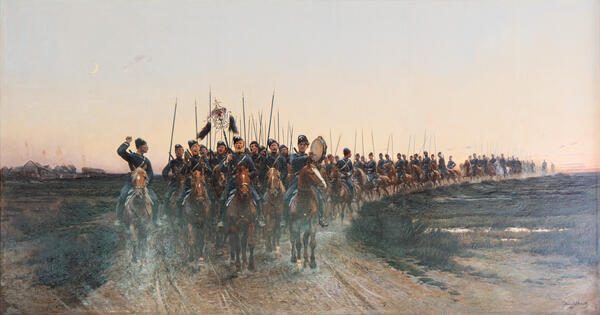
The painting “Cossacks of the Life-Guards Ataman Regiment” was originally kept in the Winter Palace in St. Petersburg. When the imperial couple (Nicholas II and Alexandra Feodorovna) settled at Tsarskoe Selo, this large-scale painting appeared in the empress’ Corner Drawing Room in the Alexander Palace.

The canvas was painted by Jean Baptiste Édouard Detaille, a French academic painter and combat artist, Commander of the Legion of Honor who became known for his incredibly realistic works devoted to military themes. Among his works are portraits of soldiers, depictions of military maneuvers, battles, and everyday scenes of army life. The artist was particularly interested in the era of the Napoleonic Wars.

Paintings by Detaille are distinguished by a great accuracy in depicting details.

Since 1879, the artist, who had already been known far beyond his homeland, worked in various countries, including the Russian Empire. In 1888–1889, Detaille visited St. Petersburg, where he created a number of battle paintings on commission from the Russian Imperial Court. Nicholas II highly appreciated the master’s works: his paintings were used to decorate the Emperor’s Working Study and State Study in the Alexander Palace.

The artist depicts the Cossacks of the Life-Guards Ataman Regiment returning at sunset to the barracks in a village near Krasnoe Selo, where in the summertime military camps were set up and maneuvers of the Guards regiments were held. Tired horses move at a slow pace after the exercises, and the riders sing traditional regimental songs. To achieve convincing accuracy in conveying the characteristic details of the landscape and the peculiarities of lighting, Jean-Baptiste Detaille spent long hours in the plein air. It was the work in natural light that helped create expressive nature sketches, which later served as the basis for a large painting.

In “Cossacks of the Life-Guards Ataman Regiment”, the artist masterfully conveyed the evening scenery during the white nights of St. Petersburg, when the light, breaking through the haze of mist, illuminates the horses and riders.
#9
Наименование: Cossacks of the Life-Guards Ataman Regiment
Дата создания: 1889
Место создания: Russia
Техника: oil, canvas
Размеры: 244×450 cm
#10
read morehide
00:00
00:00
1x

Bust of Catherine II, Marie Antoinette, Cossacks

0
Point your smartphone camera to open in the app
Share
VkontakteOdnoklassnikiTelegram
Share on my website
Copy linkCopied
Copy
Open in app
To see AR mode in action:
  1. Install ARTEFACT app for 
  2. iOS or Android;
  3. Find and download the «Paintings in Details» exhibition
  4. Push the «Augmented reality» button and point your phone's camera at the painting;
  5. Watch what happens on your phone screen whilst you flip through the pictures.
 
We use Cookies
Cookies on the Artefact Website. We use cookies to ensure that we give you the best experience on our website. If you continue without changing your settings, we'll assume that you are happy to receive all cookies on the Artefact website. However, if you would like to, you can change your cookie settings at any time.
Learn more about useHide
Content is available only in Russian

X

Нашли опечатку?...

%title%%type%