Font
Color
Graphics
Изображение точки

To see AR mode in action:

1. Install ARTEFACT app for iOS or Android;

2. Find the exhibition «The Alexander Palace»

3. Push the «Augmented reality» button and point your phone's camera at the exhibit;

Скрыть точки интересаПоказать точки интереса
Показать в высоком качестве

Bust of Alexander I, Two chairs, Carpet

0
Open in app
#1
Bust of Alexander I
#2
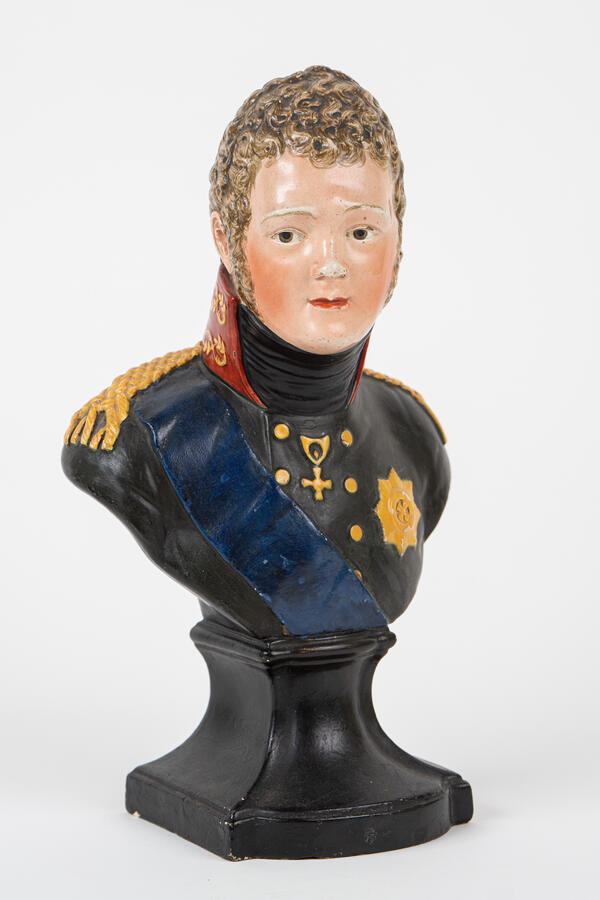
The bust of Emperor Alexander I, made at Enoch Wood’s factory in the early 19th century, is part of the collection of the Tsarskoe Selo State Museum and Heritage Site.

This bust was in the Alexander Palace, where the tables and consoles of the Corner Drawing Room housed commemorative ceramic, marble and bronze pieces made by foreign and Russian manufacturers, including Staffordshire ceramic busts of Alexander I, the first owner of the palace.

The ceramic bust is a polychrome-painted chest-length image of Emperor Alexander I on a sculptural pedestal. The tsar is dressed in the uniform of the Life-Guards Preobrazhensky Regiment, one of the most elite military units of the Russian Empire. On his chest, the emperor has two orders: the Order of St Andrew and the Order of St George fourth class.

The Staffordshire Potteries was an industrial area encompassing six towns in England: Burslem, Fenton, Hanley, Longton, Stoke and Tunstall. North Staffordshire became a center of ceramic production in the early 17th century due to the local sufficient availability of clay and coal. Hundreds of factories produced all kinds of pottery — from tableware and decorative pieces to industrial items. The Staffordshire industry was a major innovator in developing new varieties of pottery and porcelain, such as bone china, as well as transfer printing.

One of the leading pottery makers was Enoch Wood (1759–1840), an English potter who came from an influential family of Staffordshire ceramists. Wood studied drawing in Liverpool, then was apprenticed to a well-known potter in Hanley. He started out as a fashion designer and established a successful factory in Burslem, trading as Wood and Caldwell. In the 18th century, the factory produced a large number of figurines as well as other types of ceramics and earthenware that Wood modeled himself. After 1818, when Enoch Wood’s sons became partners, the company was renamed Enoch Wood & Sons. The firm produced blue and white transfer printed earthenware, most of which was exported to America.
#3
Наименование: Bust of Alexander I
Дата создания: 1812–1818
Место создания: Enoch Wood Factory, Burslem, Staffordshire, Great Britain
Техника: ceramics; polychrome painting
Размеры: 30×17×10,5 cm
#4
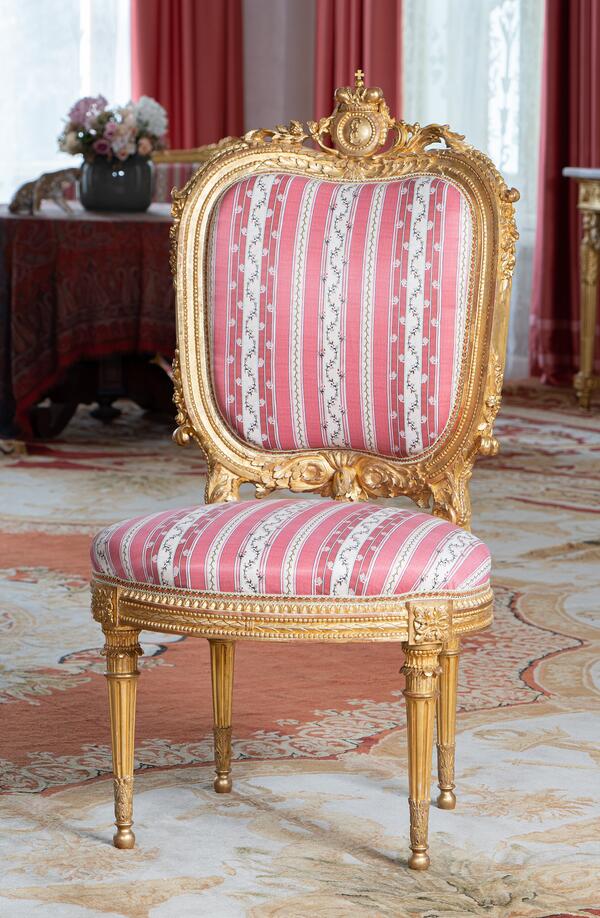
Two chairs from the Corner Drawing Room
#5
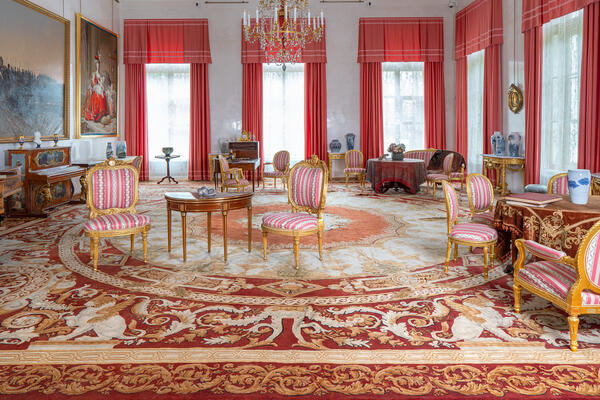
The exhibition of the Alexander Palace shows two gilded carved chairs with a rolled back and seat, on four carved fluted legs, with the cubes decorated with rosettes. The backs of the chairs have a circular medallion beneath a crown, with stylized branches of palm and laurel going sideways.

The chairs come from the Corner Drawing Room of Empress Alexandra Feodorovna in the Alexander Palace. They were evacuated to Novosibirsk in1941, which is why they have been preserved and can be seen in their original place today. In 1902–1903 when the Concert Hall was converted into the Maple Drawing Room and the State Study, the Corner Drawing Room was joined to the corridor and became part of the Emperor’s private apartments, while retaining its ceremonial purpose.

According to archive documents, on June 1 1903, Empress Alexandra Feodorovna ordered: “The furniture in the Corner Drawing Room of the Alexander Palace shall be replaced by that taken last year from the Chinese Theater on Her Majesty’s instruction, and repaired. The upholstering of this furniture and the valances of the windows shall be made upon the samples of fabric by the manufacturer Sapozhnikov, approved by the Empress.”

The1917 inventories of the Alexander Palace include the following description of the furniture in the Corner Drawing Room: “The furniture in the Louis XVI style, made in Russia at the end of the 18th century, re-gilded and upholstered in silk produced at the Sapozhnikov factory in Moscow. In the style of striped fabrics of the Louis XVI’s era.”

According to a pre-war inventory of 1940, the Corner Drawing Room had 3 sofas, 10 armchairs and 10 chairs upholstered in “pink silk faille with white stripes, embroidered with garlands of small flowers.” The backs of the chairs were upholstered in the same material.

The upholstery has been repeatedly renewed throughout the “museum” life of the items. During the restoration of the chairs in 2021, the original upholstery was recreated, based on a preserved fragment of the upholstery manufactured in 1903 for the Corner Drawing Room furniture.
#6
Наименование: Two chairs from the Corner Drawing Room
Дата создания: the late 18th century
Место создания: Russia
Техника: wood, bronze, faille; carving, gilding
Размеры: 124×61×69 cm
#7
Carpet
#8
The Corner Drawing Room, which was one of Empress Alexandra Feodorovna’s apartments, features a magnificent woolen carpet of almost 100m² with a central radial pattern of griffins, dolphins, masks and cartouches. It is in pale, greenish and dark terracotta tones and has a border on the perimeter.

The carpet was made at the Savonnerie factory in France in the early 19th century and was purchased especially for the Billiard Room (later the Corner Drawing Room) in the east wing of the Alexander Palace. At that time the carpet was spread only during Their Majesties’ stay (from spring to autumn). To protect it from spoiling during breakfasts and luncheons, it was covered with water-resistant sailcloth.

The Savonnerie factory was founded in France in the 17th century on the site of a former soap factory and was named accordingly (French “Savonnerie” means soap factory, from savon — soap). It was located on the right bank of the Seine, on the Chaillot Hill (now the Trocadero district). King Henry IV of France played a crucial role in creating the factory. He ordered to open his own carpet weaving factory, as importing carpets from the East was exorbitantly expensive for the French treasury. Savonnerie carpets adorned the Louvre and Versailles, and were also used as diplomatic gifts and expensive high status presents the king gave to his entourage.

The individual style of the factory was formed under the influence of classical oriental patterns and ornaments, followed by elements of European art of different epochs: luxurious baroque, refined rococo and elegant classicism. The designs of the carpets are full of intricate floral ornaments, compositions of vignettes, bouquets and wreaths; they are decorated with the images of heraldic medallions, zoomorphic motifs. Carpets were made mainly from wool with natural silk. The latter brought out the beauty of the intricately detailed pattern. It took several months to create a sketch. The number of colors and tones used in the production ranged from 200 to 400.

By the late 18th century, the Savonnerie factory was producing not only carpets, but also panels for screens and tapestries. The decline of the factory began during the Great French Revolution. In 1825, the company, experiencing financial difficulties, merged with the Gobelins factory (later the Manufactory of National Furniture), losing the independence of its brand. The Savonnerie products preserved in museums and private collections are undoubtedly unique works of applied art.
#9
Наименование: Carpet
Дата создания: the early 19th century
Место создания: Savonnerie factory, France
Техника: wool, canvas; weaving
Размеры: 963×963 cm
#10
read morehide
00:00
00:00
1x

Bust of Alexander I, Two chairs, Carpet

0
Point your smartphone camera to open in the app
Share
VkontakteOdnoklassnikiTelegram
Share on my website
Copy linkCopied
Copy
Open in app
To see AR mode in action:
  1. Install ARTEFACT app for 
  2. iOS or Android;
  3. Find and download the «Paintings in Details» exhibition
  4. Push the «Augmented reality» button and point your phone's camera at the painting;
  5. Watch what happens on your phone screen whilst you flip through the pictures.
 
We use Cookies
Cookies on the Artefact Website. We use cookies to ensure that we give you the best experience on our website. If you continue without changing your settings, we'll assume that you are happy to receive all cookies on the Artefact website. However, if you would like to, you can change your cookie settings at any time.
Learn more about cookie useHide
Content is available only in Russian

X

Нашли опечатку?...

%title%%type%