#21
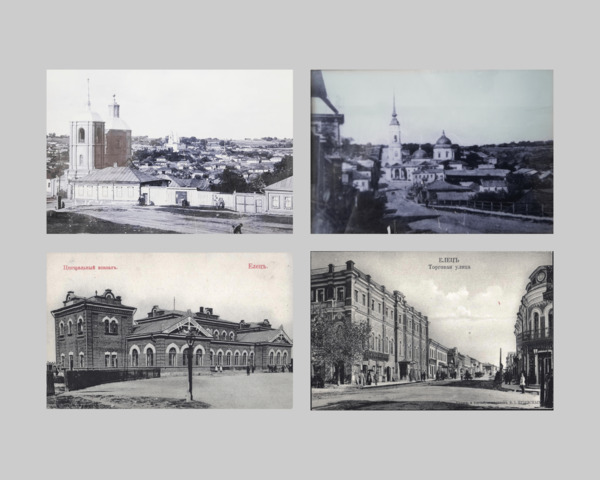
Photos of Yelets in the 19th century
#37
#23

#24
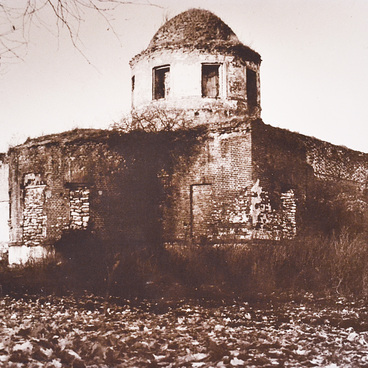
Just below the Ascension Cathedral was the VvedEnskaya Church, the oldest in the city. The construction of a stone building in the ‘baroque’ style, instead of the wooden one that had fallen into disrepair, began in the 18th century. It was consecrated in 1761, and by the middle of the 19th century the church was completed. Evening services in this church forever remained in the memory of the writer.
‘After my father and mother left… on Saturday evening, I had to go to Vespers, to the VvedEnskaya Church, which was located in one of the back alleys near the gymnasium. I remember so much those quiet and sad evenings of late autumn under its gloomy and low arches!…No, it’s not true what I said about Gothic cathedrals, about their organs: I never cried in these cathedrals like I did in that church in those dark and hollow nights, after saying goodbye to my father and mother, when I was entering its low arches like my parent’s home, in silence, feeling that heat and twilight, standing there in my long overcoat and listening to mournful and humble prayers.
Bunin I.A. “Arseniev”s life”
Each of the YelEts churches had a particularly revered shrine. In Vvedenskaya Church, it was the miraculous icon of the mother of God “Recovery of the dead”.
’… the ancient icon, with ever-burning lampions and always some woman with a dark shawl, standing on her knees and praying, with her three finger tips put on her forehead with mournful eyes looking at the brown-gold frame shining in the lampion light, at the small and the same dark medieval face, humbly and mournfully inclined to the left shoulder under the silver crown sparkling with diamonds, pearls and rubies…’
Bunin I.A. “Arseniev”s life”
The houses located nearby were surrounded with large gardens, making the area look very picturesque and unusual.
“Walking along the Sadovaya street, he came to a cliff at the river, with an ancient low church at the end of the road. It was the dead end, around him there were the gardens behind the fences, the wooden houses with three windows on the facade; the golden cross above the dome glimmers softly, melting in the warm air… the church doors were open, and he crossed himself as he entered. Low arches, nobody around, it is cold inside and there is this old, church smell. The bare, low walls are painted blue like sugar paper, the dome is light, the bottom is bluish, gloomy; the altar is gleaming, and the red silk of the veil can be seen through the slots of the Sanctuary Doors… He climbed the steps of the pulpit and went to the miraculous icon near the north door of the altar. It was made of thick dark wood with a velvet cherry lining, and it was all colorful behind the lamp that flickered in front of it: the dark silver of the cover, on the cover there were a lot of fake precious stones, icon pendants and ribbons, tin hearts, hands and feet, healed body parts… “
Bunin I.A. “April”
‘After my father and mother left… on Saturday evening, I had to go to Vespers, to the VvedEnskaya Church, which was located in one of the back alleys near the gymnasium. I remember so much those quiet and sad evenings of late autumn under its gloomy and low arches!…No, it’s not true what I said about Gothic cathedrals, about their organs: I never cried in these cathedrals like I did in that church in those dark and hollow nights, after saying goodbye to my father and mother, when I was entering its low arches like my parent’s home, in silence, feeling that heat and twilight, standing there in my long overcoat and listening to mournful and humble prayers.
Bunin I.A. “Arseniev”s life”
Each of the YelEts churches had a particularly revered shrine. In Vvedenskaya Church, it was the miraculous icon of the mother of God “Recovery of the dead”.
’… the ancient icon, with ever-burning lampions and always some woman with a dark shawl, standing on her knees and praying, with her three finger tips put on her forehead with mournful eyes looking at the brown-gold frame shining in the lampion light, at the small and the same dark medieval face, humbly and mournfully inclined to the left shoulder under the silver crown sparkling with diamonds, pearls and rubies…’
Bunin I.A. “Arseniev”s life”
The houses located nearby were surrounded with large gardens, making the area look very picturesque and unusual.
“Walking along the Sadovaya street, he came to a cliff at the river, with an ancient low church at the end of the road. It was the dead end, around him there were the gardens behind the fences, the wooden houses with three windows on the facade; the golden cross above the dome glimmers softly, melting in the warm air… the church doors were open, and he crossed himself as he entered. Low arches, nobody around, it is cold inside and there is this old, church smell. The bare, low walls are painted blue like sugar paper, the dome is light, the bottom is bluish, gloomy; the altar is gleaming, and the red silk of the veil can be seen through the slots of the Sanctuary Doors… He climbed the steps of the pulpit and went to the miraculous icon near the north door of the altar. It was made of thick dark wood with a velvet cherry lining, and it was all colorful behind the lamp that flickered in front of it: the dark silver of the cover, on the cover there were a lot of fake precious stones, icon pendants and ribbons, tin hearts, hands and feet, healed body parts… “
Bunin I.A. “April”
#25
Full name The Church of the Presentation of the most Holy Virgin into the Temple. Photocopied from a post card
Author Ivanov Sim Egorovich
Date 2010 year
Technique photography
Dimensions 10×15 cm
Collection Yelets Local History Museum
Copyright Yelets Local History Museum
Author Ivanov Sim Egorovich
Date 2010 year
Technique photography
Dimensions 10×15 cm
Collection Yelets Local History Museum
Copyright Yelets Local History Museum
#38
Vladimiro-Sergievskaya Church. Photocopy
#27
#28
The picture taken northwards, from Staromoskovskaya street, from the hill, one can see so-called Black Quarter. This name relates to the status of the land where the craftsmen could live. The ‘black’ lands were tax-liable, in contrast to the ‘white’ lands where the residents didn’t have to pay any charges or taxes. This residential quarter has long accommodated the small-scale handicraft production. Among the residents of this quarter were tanners and saddlers, shoemakers and furriers, carpenters and woodworkers — in other words, those who were in charge of provisioning for the military population of the city, who supplied clothing, shoes, weapons and household items.
There is a legend which is probably supported by a historical fact. Tsar AlexEy Mikhailovich was passing Yelets in a nasty weather. The roads were so dirty and the mud was so thick, that the Tsar’s carriage got hopelessly stuck in the center of the Black Quarter. Then the local residents unharnessed the exhausted horses, and pulled the carriage out of the mud, taking it uphill on their hands and dragging it all the way to the village of Rogatoye. And the Tsar ordered to grant them a plot of land, across which he passed in such an unusual way. The residents had kept the Tsar’s Charter for a long time, but they did not save it during the great fire.
One of the heroes of Bunin’s ‘Village’, TIkhon Krasov, grew up in the Black Quarter: ‘In the Black Quarter he spent his childhood - on this hill, among the low mud huts with rotten and blackened roofs, among the manure cakes which were dried in front of the houses to be used as fuel, among garbage, ashes and rags… Now there was no trace of the hut where Tikhon Ilyich was born and grew up. It was replaced by a new plank-made house with a rusty sign over the entrance: “Spiritual tailor SObolev”. Everything else in that settlement was the same as before: pigs and chickens lying at the doors; long poles at the gates, and on the poles there were the ram horns; big white faces of lace-makers looking from behind the rows of flower pots on tiny windows; barefoot boys with one shoulder strap, running about and flying a kite with a washcloth tail; blond, quiet girls playing their favorite game - the funeral of dolls… On the hill, in the field, … there was a cemetery, there, among the old trees, there was a terrible grave of the rich and miser ZYkov, which dropped through the same moment when it was filled with earth’.
In the center of the photo there is VladImiro-SErgievskaya Church. It was founded to commemorate the miraculous salvation of Russia from the Tamerlane’s invasion. The Church was dedicated to the icon the Virgin of Vladimir. And the second part of its name the Church received from the name of the chapel dedicated to St. Sergius of Radonezh. The wooden Church in the Black Quarter was built in the 17th century. The stone church building was erected in 1779, and the high bell tower was built in 1809. It was one of the most elegant churches in the city.
There is a legend which is probably supported by a historical fact. Tsar AlexEy Mikhailovich was passing Yelets in a nasty weather. The roads were so dirty and the mud was so thick, that the Tsar’s carriage got hopelessly stuck in the center of the Black Quarter. Then the local residents unharnessed the exhausted horses, and pulled the carriage out of the mud, taking it uphill on their hands and dragging it all the way to the village of Rogatoye. And the Tsar ordered to grant them a plot of land, across which he passed in such an unusual way. The residents had kept the Tsar’s Charter for a long time, but they did not save it during the great fire.
One of the heroes of Bunin’s ‘Village’, TIkhon Krasov, grew up in the Black Quarter: ‘In the Black Quarter he spent his childhood - on this hill, among the low mud huts with rotten and blackened roofs, among the manure cakes which were dried in front of the houses to be used as fuel, among garbage, ashes and rags… Now there was no trace of the hut where Tikhon Ilyich was born and grew up. It was replaced by a new plank-made house with a rusty sign over the entrance: “Spiritual tailor SObolev”. Everything else in that settlement was the same as before: pigs and chickens lying at the doors; long poles at the gates, and on the poles there were the ram horns; big white faces of lace-makers looking from behind the rows of flower pots on tiny windows; barefoot boys with one shoulder strap, running about and flying a kite with a washcloth tail; blond, quiet girls playing their favorite game - the funeral of dolls… On the hill, in the field, … there was a cemetery, there, among the old trees, there was a terrible grave of the rich and miser ZYkov, which dropped through the same moment when it was filled with earth’.
In the center of the photo there is VladImiro-SErgievskaya Church. It was founded to commemorate the miraculous salvation of Russia from the Tamerlane’s invasion. The Church was dedicated to the icon the Virgin of Vladimir. And the second part of its name the Church received from the name of the chapel dedicated to St. Sergius of Radonezh. The wooden Church in the Black Quarter was built in the 17th century. The stone church building was erected in 1779, and the high bell tower was built in 1809. It was one of the most elegant churches in the city.
#29
Full name Vladimiro-Sergievskaya Church. Photocopy
Author Ivanov Sim Egorovich
Date 2010
Dimensions 10×15 cm
Collection Yelets Local History Museum
Copyright Yelets Local History Museum
Author Ivanov Sim Egorovich
Date 2010
Dimensions 10×15 cm
Collection Yelets Local History Museum
Copyright Yelets Local History Museum
#39
Central train station. Photocopied from a post card
#30
#31
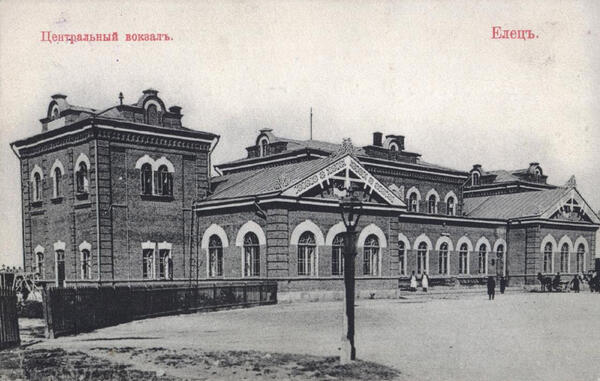
The Central Railway Terminal is situated in the ZasOsnensky district of the city. In 1884, Bunin, a student of YelEts gymnasium, together with his parents saw off his brother YUly here, who was under arrest.
‘We went to the train station to bid farewell to him. I think I was mostly shocked by the fact that when we arrived at the station, we had to go to the third-class waiting room, where my brother, under the supervision of the gendarmes, was waiting for the train to leave, as if he no longer dared to stay with decent, free people, being deprived of the freedom to choose and decide, of the possibility to drink tea or eat pies with them’.
Bunin I.A. ‘Arseniev”s life’
Ivan was coming at the train station in the next few days.
‘I was killing time, wandered around the city, in the suburbs, in ZarEchye I was watching the trains passing the station, in the hustle and bustle of arrivals and departures, I envied those who hurriedly and excitedly were getting on the long-distance trains, I got frozen when a huge doorman wearing a long livery went out into the middle of the waiting room and shouted with his majestic bass, with a threatening, severe sadness, where and what train was going to…’
Bunin I.A. ‘Arseniev”s life’
A very interesting and detailed description of the railway terminal and a restaurant at Yelets station was given in the journal ‘Passenger”s Companion’ dated 1899. In particular: ‘Yelets, 2nd class station. A huge building of the passenger railway terminal was built in 1899, it was intended to serve the two lines of the South-Eastern Railways: OrlOvsko-GrYAzinskaya and YelEts-ValUyskaya… A big, shared use waiting room, about 980 square feet, for 1st and 2nd class passengers, and a buffet-dining room for class 1 and 2 passengers, 2,156 square feet. A large, separated 3rd class waiting room, about 3,185 square feet; men”s and ladies’ restroom, post and telegraph office, buffet with hot and cold dishes, alcoholic beverages, tea and coffee, book and newspaper rack. 18 different passenger trains depart and arrive daily from and to this station.’ Abduil SinYAyev, who was the owner of the station buffet in 1911-1914, was a true go-getter. This can be concluded from the below description of the daily routine in 1916:
“An experienced train driver, especially if he knows well a particular leg of the route, can do many things. The train stop at Yelets station lasts only 10 minutes, which is not enough for the passengers to have dinner. But sometimes the waiter would run to the train and passed a silver tray to the train driver: a glass of vodka and a sandwich with black caviar: Vasily Timofeevich! That”s for you! “From Abdulla Mahmudovich! (all buffet owners were Tatars from Kazan) with a request not to hurry up at this stop, please delay the departure a little bit!” - “Tell Abdulka, ok, I will” Then he said to the assistant: “Come to the station duty officer, tell him we need some more time to lubricate the bearings.” And the train stop lasts for 25 minutes, and 3 individual dinners are served for the train driver and his assistant. The timetable will be complied with, even sooner than the train reaches GryAzi, Vasily Timofeevich knows all slopes, all turns and climbs…’
Solzhenitsyn A.I. ‘The Red wheel’
‘We went to the train station to bid farewell to him. I think I was mostly shocked by the fact that when we arrived at the station, we had to go to the third-class waiting room, where my brother, under the supervision of the gendarmes, was waiting for the train to leave, as if he no longer dared to stay with decent, free people, being deprived of the freedom to choose and decide, of the possibility to drink tea or eat pies with them’.
Bunin I.A. ‘Arseniev”s life’
Ivan was coming at the train station in the next few days.
‘I was killing time, wandered around the city, in the suburbs, in ZarEchye I was watching the trains passing the station, in the hustle and bustle of arrivals and departures, I envied those who hurriedly and excitedly were getting on the long-distance trains, I got frozen when a huge doorman wearing a long livery went out into the middle of the waiting room and shouted with his majestic bass, with a threatening, severe sadness, where and what train was going to…’
Bunin I.A. ‘Arseniev”s life’
A very interesting and detailed description of the railway terminal and a restaurant at Yelets station was given in the journal ‘Passenger”s Companion’ dated 1899. In particular: ‘Yelets, 2nd class station. A huge building of the passenger railway terminal was built in 1899, it was intended to serve the two lines of the South-Eastern Railways: OrlOvsko-GrYAzinskaya and YelEts-ValUyskaya… A big, shared use waiting room, about 980 square feet, for 1st and 2nd class passengers, and a buffet-dining room for class 1 and 2 passengers, 2,156 square feet. A large, separated 3rd class waiting room, about 3,185 square feet; men”s and ladies’ restroom, post and telegraph office, buffet with hot and cold dishes, alcoholic beverages, tea and coffee, book and newspaper rack. 18 different passenger trains depart and arrive daily from and to this station.’ Abduil SinYAyev, who was the owner of the station buffet in 1911-1914, was a true go-getter. This can be concluded from the below description of the daily routine in 1916:
“An experienced train driver, especially if he knows well a particular leg of the route, can do many things. The train stop at Yelets station lasts only 10 minutes, which is not enough for the passengers to have dinner. But sometimes the waiter would run to the train and passed a silver tray to the train driver: a glass of vodka and a sandwich with black caviar: Vasily Timofeevich! That”s for you! “From Abdulla Mahmudovich! (all buffet owners were Tatars from Kazan) with a request not to hurry up at this stop, please delay the departure a little bit!” - “Tell Abdulka, ok, I will” Then he said to the assistant: “Come to the station duty officer, tell him we need some more time to lubricate the bearings.” And the train stop lasts for 25 minutes, and 3 individual dinners are served for the train driver and his assistant. The timetable will be complied with, even sooner than the train reaches GryAzi, Vasily Timofeevich knows all slopes, all turns and climbs…’
Solzhenitsyn A.I. ‘The Red wheel’
#32
Full name Central train station. Photocopied from a post card
Author Ivanov Sim Egorovich
Date 2010 year
Technique photography
Dimensions 10×15 cm
Author Ivanov Sim Egorovich
Date 2010 year
Technique photography
Dimensions 10×15 cm
#40
Torgovaya street. Photocopy from a postcard
#34
#35
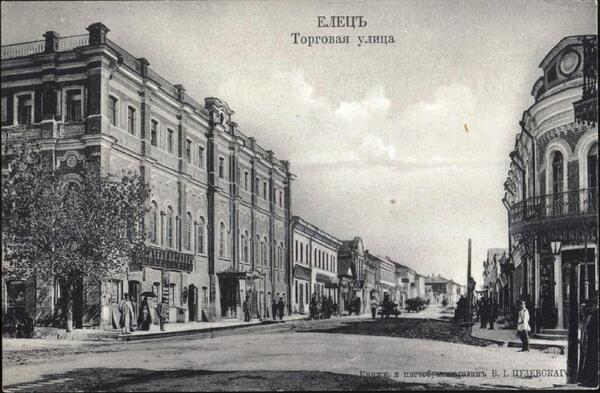
The MIra street is the busiest and most remarkable street in YelEts. It is a complete naturally evolved architectural complex consisting of the houses built mainly in the middle of the 19th century. Here, in the center of the city, the richest residents of the city — merchants had built their mansions. These were solid structures, with meter-thick walls that would last for centuries. The design of their facades is based on classical architectural forms. All the buildings are situated close to each other. The houses are different in details and proportions, they were built at different times, they are, however, well combined with each other, they maintain a single scale, well aligned with the width of the street. But at the same time, this scale is proportional to the human perception, and hence it creates the feeling of intimacy, and at the same time brings the aroma of antiquity, which makes the look of YelEts unique and attractive. The street was a busy shopping street in the city center. This meaning has the old name of the street — Torgovaya or Trade street. Torgovaya street, located in the city center, was a continuous row of the best shops, hotels, and photo studios. Eye-catching signs of large stores inevitable attracted the attention of potential buyers. Merchants who were not so wealthy used simple tin signs with the name of the owner and his type of activity. The memory of Ivan Bunin, the Nobel prize winner, who keenly perceived the world around him, kept the following:
‘The smell of bakeries and iron roofs, the pavement on the TorgOvaya street, tea, buns and the sounds of Persian march in the Kars tavern… the floors in the shops watered from teapots, the smell of fish from the fish shops, dill, RomAnov shag’.
Bunin I.A. ‘Bowl of life’
Young Ivan Bunin made his first purchase for his own money in Puzevsky’s stationery store on Torgovaya street: an album for photographs. Next to it was the Klimenko’s photo studio ‘Aneli’. In Yelets photo studios in different years were taken pictures of many of the Bunins, their relatives and friends. He often went to the Rusinov’s bookstore - to read or borrow some interesting books and magazines. Nearby, at the Zalkind’s bookstore, you could subscribe to the newspaper Orlovsky Vestnik, where Bunin would work for in a few years… For wealthy customers Torgovaya street offered: salon of ladies gifts, Guelet’s “Gramophone records”, Sakharov’s bird store, Dayev’s “golden” store, two great stores with stationery - the Zalkind’s one and Puzevsky’s one. Neronov’s shop was selling sugar, coffee, and various goods from colonial regions delivered from St. Petersburg; and Berger’s pastry shop attracted with the aromas of fresh pastries.
‘The smell of bakeries and iron roofs, the pavement on the TorgOvaya street, tea, buns and the sounds of Persian march in the Kars tavern… the floors in the shops watered from teapots, the smell of fish from the fish shops, dill, RomAnov shag’.
Bunin I.A. ‘Bowl of life’
Young Ivan Bunin made his first purchase for his own money in Puzevsky’s stationery store on Torgovaya street: an album for photographs. Next to it was the Klimenko’s photo studio ‘Aneli’. In Yelets photo studios in different years were taken pictures of many of the Bunins, their relatives and friends. He often went to the Rusinov’s bookstore - to read or borrow some interesting books and magazines. Nearby, at the Zalkind’s bookstore, you could subscribe to the newspaper Orlovsky Vestnik, where Bunin would work for in a few years… For wealthy customers Torgovaya street offered: salon of ladies gifts, Guelet’s “Gramophone records”, Sakharov’s bird store, Dayev’s “golden” store, two great stores with stationery - the Zalkind’s one and Puzevsky’s one. Neronov’s shop was selling sugar, coffee, and various goods from colonial regions delivered from St. Petersburg; and Berger’s pastry shop attracted with the aromas of fresh pastries.
#36
Full name Torgovaya street. Photocopy from a postcard
Author Ivanov Sim Egorovich
Date Torgovaya street. Photocopied from a post card
Technique photography
Dimensions 10×15 cm
Collection Yelets Local History Museum
Copyright Yelets Local History Museum
Author Ivanov Sim Egorovich
Date Torgovaya street. Photocopied from a post card
Technique photography
Dimensions 10×15 cm
Collection Yelets Local History Museum
Copyright Yelets Local History Museum
read morehide
00:00
00:00
1x
Photos of Yelets in the 19th century
Collection
Exhibition
0
 Point your smartphone camera to open in the app
Open in app
Share