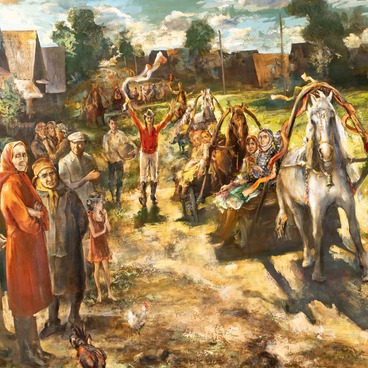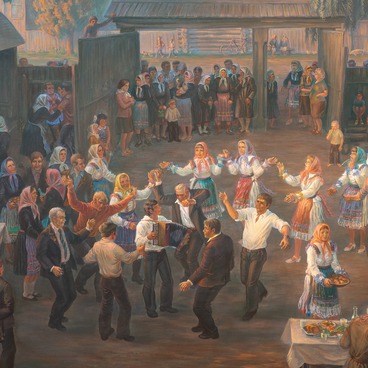
The plot of the canvas “Agavayrem” displayed in the museum’s exhibition represents an ancient agricultural holiday dedicated to the deities of fertility, earth and forces of nature. It completes the spring cycle of the festive rites of the Mari people.
The city of Yoshkar-Ola, the capital of the Mari El Republic, has often invited artists to the All-Russian Plein Air. In 2016, a plein air session was held based on the theme “Mari El — the land of ancestors: traditions and modernity”. Artists from all over Russia got acquainted with the peculiarities of the Mari culture and the traditional Mari religion, took part in the Agavayrem festival in the village of Nemda-Obalysh. After that, they stayed in the Novotoryalsky district and created works inspired by ethnic materials.
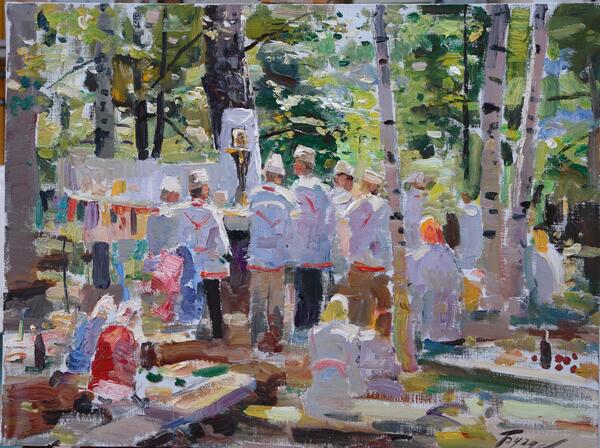
The Moscow artist Alexander Bugaev works in the landscape and still life genres, continuing in his work the traditions of the Russian national realistic landscape painting. The artist depicted the rite in a sacred grove. Alexander Bugaev has a peculiar artistic manner: the artist’s paintings are bright, cheerful and at the same time lyrical.
The Mari people took great care when preparing for Agavayrem: they cleaned their houses, yards, streets, and stocked up on food in advance to make ritual meals. They celebrated Agavayrem for two or three days. Early in the morning of the first day, a bathhouse was heated. After washing up and putting on clean festive clothes, the women baked pancakes, vatrushkas (pastries with quark), cottage cheese pies, and painted eggs. All the treats and candles were carried in a basket to the sacred grove (oto). The Mari people consider the sacred grove a sanctified territory within which human contact with God is possible. Everything that was cooked had to be delivered intact: if bread or a candle broke on the way, it was considered unsuitable for the ritual. On the first day of the holiday, the Mari people came to the sacred grove with the entire family to pray. Prayer in the sacred grove is a joyous event, a feast for the soul. Women wear national Mari clothes: dresses, caftans, and aprons, and cover their heads with a scarf. Men belt their white caftans with red girdles.
On the second day, they observed the custom of tashlam: they went from house to house with a kart (a priest) that read prayers. The third day was all about entertainment: everyone had fun, played on a swing set, sang, danced, and played traditional games.
The city of Yoshkar-Ola, the capital of the Mari El Republic, has often invited artists to the All-Russian Plein Air. In 2016, a plein air session was held based on the theme “Mari El — the land of ancestors: traditions and modernity”. Artists from all over Russia got acquainted with the peculiarities of the Mari culture and the traditional Mari religion, took part in the Agavayrem festival in the village of Nemda-Obalysh. After that, they stayed in the Novotoryalsky district and created works inspired by ethnic materials.
The Moscow artist Alexander Bugaev works in the landscape and still life genres, continuing in his work the traditions of the Russian national realistic landscape painting. The artist depicted the rite in a sacred grove. Alexander Bugaev has a peculiar artistic manner: the artist’s paintings are bright, cheerful and at the same time lyrical.
The Mari people took great care when preparing for Agavayrem: they cleaned their houses, yards, streets, and stocked up on food in advance to make ritual meals. They celebrated Agavayrem for two or three days. Early in the morning of the first day, a bathhouse was heated. After washing up and putting on clean festive clothes, the women baked pancakes, vatrushkas (pastries with quark), cottage cheese pies, and painted eggs. All the treats and candles were carried in a basket to the sacred grove (oto). The Mari people consider the sacred grove a sanctified territory within which human contact with God is possible. Everything that was cooked had to be delivered intact: if bread or a candle broke on the way, it was considered unsuitable for the ritual. On the first day of the holiday, the Mari people came to the sacred grove with the entire family to pray. Prayer in the sacred grove is a joyous event, a feast for the soul. Women wear national Mari clothes: dresses, caftans, and aprons, and cover their heads with a scarf. Men belt their white caftans with red girdles.
On the second day, they observed the custom of tashlam: they went from house to house with a kart (a priest) that read prayers. The third day was all about entertainment: everyone had fun, played on a swing set, sang, danced, and played traditional games.