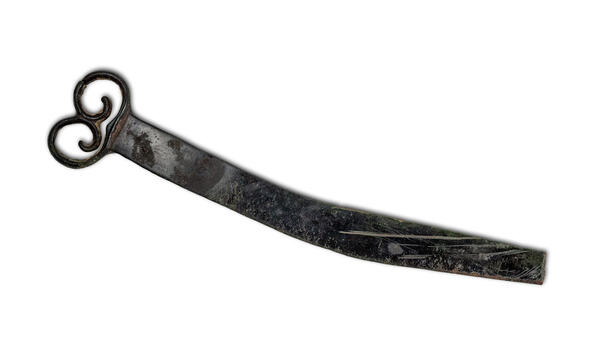
The collection of the Kursk Museum of Archaeology features several bronze and iron knives dating back to the 8th–3rd centuries BCE. They were brought to the Kursk province in 1907 by amateur archaeologist Konstantin Sosnovsky. His work in various parts of Russia was connected with private trips across the territory under his jurisdiction, which could easily be combined with field archaeology activities.
The collection of bronze knives was gathered by Konstantin Petrovich on the territory of the Minusinsk Basin during his service with the excise department in the Yenisei province. In terms of shape, the knives can either have a distinct handle or lack one. Knives of the first type have a ledge between the blade and the handle, often adorned with the head of a predatory bird or a hoof-like mark. Scholars date them to the 7th–4th centuries BCE.
Knives of the second type — without a distinct handle and featuring one or more round or teardrop-shaped holes — first appeared in the 7th century BCE, and by the 5th century BCE, new classes of this type of knife emerged, decorated with wide loop-like holes at the top of the handle, large rings, or oval or round shapes. From the turn of the 5th–4th centuries BCE and up to the end of the Tagar archaeological culture, knives with a buckle-shaped end on the handle were used.
All the knives presented were used as tools for
processing wood and bone, and for cutting shoes and clothing in the absence of
scissors. They could also be used for digging up various edible roots, cutting
food, and butchering animals. Additionally, they might have been used as
weapons. The described artifact was made by the bearers of the Tagar
archaeological culture, which flourished between the 8th and 1st centuries BCE
in Southern Siberia, within the modern Republic of Khakassia, the southern part
of the Krasnoyarsk Territory, and the eastern part of the Kemerovo Region. The
culture was named after an island on the Yenisei River opposite Minusinsk. The
lands of this people housed some of the largest bronze smelting centers in
ancient Eurasia. In literature, the representatives of the Tagar culture are
often associated with the Dingling — a historically documented Europoid
population of Central Asia.